
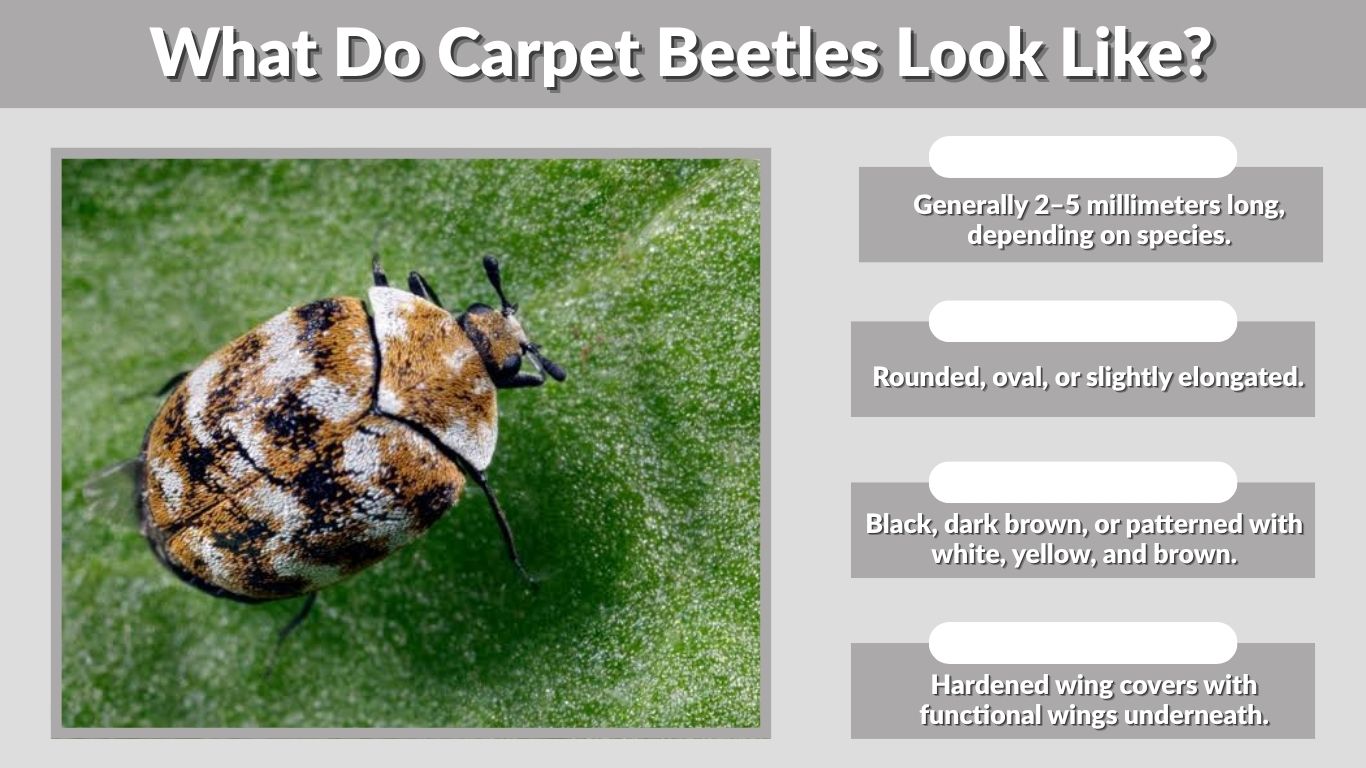
What do carpet beetles look like, and how can you identify them inside your home? Carpet beetles are tiny, oval-shaped insects that range from solid black to mottled patterns of brown, white, and yellow. Adult beetles usually measure around 2–5 millimeters, while their larvae have elongated, hairy bodies resembling miniature caterpillars. These insects are commonly found near windows, carpets, closets, and upholstered furniture. Understanding their appearance at different life stages can help distinguish carpet beetles from bed bugs and other household pests. This guide explains their physical characteristics, eggs, larvae, and common infestation signs.
What Do Carpet Beetles Look Like?
Adult carpet beetles are small insects with rounded or oval bodies, short antennae, and six legs. Their appearance varies among species, but most have hard wing covers and can fly.
Carpet beetles belong to the family Dermestidae. Although adults are frequently noticed near windows, larvae usually remain hidden in dark areas.
Common Physical Characteristics
You can identify adult carpet beetles by examining these features:
- Size: Generally 2–5 millimeters long, depending on species.
- Body shape: Rounded, oval, or slightly elongated.
- Color: Black, dark brown, or patterned with white, yellow, and brown.
- Wings: Hardened wing covers with functional wings underneath.
- Antennae: Short and often slightly club-shaped.
- Legs: Six small legs attached beneath the body.
Their small size makes them easy to overlook, especially on dark carpets or furniture.
What Do Different Types of Carpet Beetles Look Like?
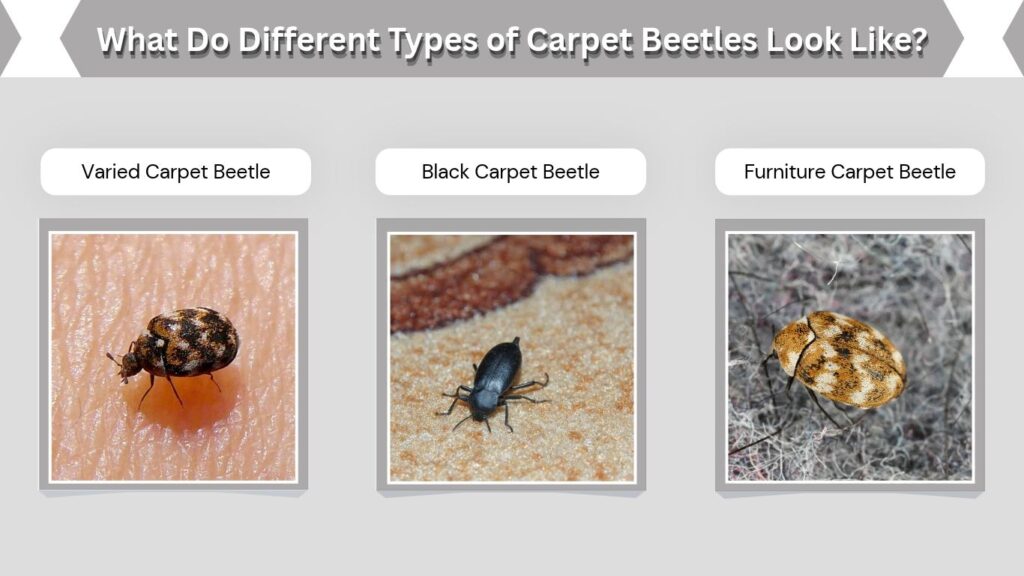
Several carpet beetle species occur in homes, and each has distinct colors and body patterns. Knowing the differences can help identify which species may be responsible for an infestation.
1. Varied Carpet Beetle
The varied carpet beetle (Anthrenus verbasci) is one of the most recognizable species. Adults measure approximately 2–3 millimeters and have rounded bodies covered with mottled white, brown, black, and yellowish scales.
Their appearance resembles a tiny speckled ladybug. Older adults may lose their colored scales and appear mostly dark brown or black.
2. Black Carpet Beetle
Black carpet beetles (Attagenus unicolor) have elongated oval bodies that are typically shiny black or dark brown. Adults usually measure approximately 3–5 millimeters.
Unlike varied carpet beetles, their bodies generally lack noticeable multicolored patterns.
Their larvae are brown, elongated, and tapered toward the rear, with a distinctive tuft of long hairs at the end.
3. Furniture Carpet Beetle
Furniture carpet beetles (Anthrenus flavipes) have rounded bodies measuring roughly 2–3.5 millimeters.
Adults display mottled patterns of black, white, and yellowish-orange scales.
Their larvae are hairy and broader near the front, gradually narrowing toward the rear. These insects commonly develop in animal-based upholstery materials and stored fabrics.
What Do Carpet Beetle Eggs Look Like?
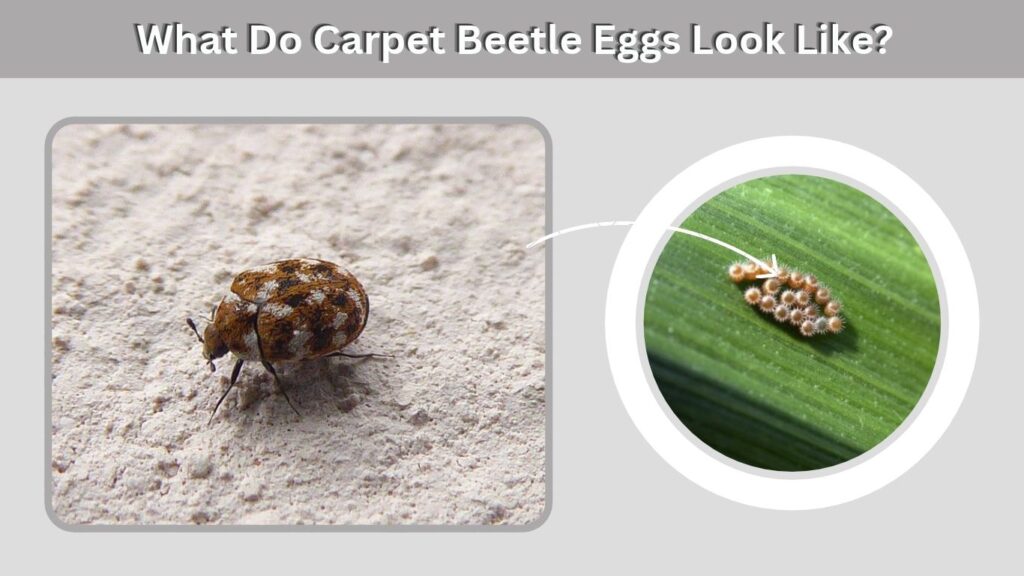
Carpet beetle eggs are extremely small, making them difficult to detect without close inspection. They are usually white or cream-colored, oval, and deposited in protected locations near suitable larval food sources.
Depending on the species, eggs may measure around 0.5–0.8 millimeters in length.
Where Can You Find Carpet Beetle Eggs?
Female carpet beetles commonly lay eggs in hidden household locations.
Potential egg-laying sites include:
- Wool carpets and rugs
- Upholstered furniture
- Closets containing natural-fiber clothing
- Cracks and crevices near baseboards
- Areas containing pet hair or accumulated lint
- Feather-filled furnishings and stored animal materials
Carpet beetle eggs do not typically form large, easily visible egg sacs. Because of their small size, they are often overlooked until larvae emerge.
What Do Carpet Beetle Larvae Look Like?
Carpet beetle larvae look very different from adults. They generally have elongated, segmented bodies covered with dense hairs or bristles.
Depending on the species, mature larvae may measure approximately 3–8 millimeters long. Their colors range from light brown to dark brown or nearly black.
Identifying Carpet Beetle Larvae
Common characteristics include:
- Hairy body: Dense bristles cover much of the body.
- Segmented appearance: Alternating bands or visible body divisions.
- Brown coloring: Shades vary by species and developmental stage.
- Slow movement: Larvae crawl rather than fly or jump.
- Hair tufts: Some species have noticeable tufts at the rear.
Larvae are responsible for most carpet beetle damage because they feed on wool, fur, feathers, and other suitable organic materials.
Carpet Beetles vs. Bed Bugs: How to Tell the Difference
Carpet beetles are sometimes mistaken for bed bugs because both are small household insects. However, their appearance and feeding behavior differ significantly.
| Feature | Carpet Beetles | Bed Bugs |
| Body shape | Rounded or oval, often domed | Broad, oval, and flattened |
| Adult color | Black or multicolored | Reddish-brown |
| Wings | Adults can fly | Cannot fly |
| Food | Adults mainly consume pollen | Feed on blood |
| Immature stage | Hairy, wormlike larvae | Flattened, six-legged nymphs |
| Common signs | Shed larval skins, fabric damage | Dark fecal spots, shed skins |
Bed bugs have flattened bodies adapted for hiding in narrow spaces. Carpet beetles generally have harder, more rounded bodies.
Unlike bed bugs, carpet beetles do not bite humans, although larval hairs can cause skin irritation in sensitive individuals.
What Bugs Look Like Carpet Beetles?
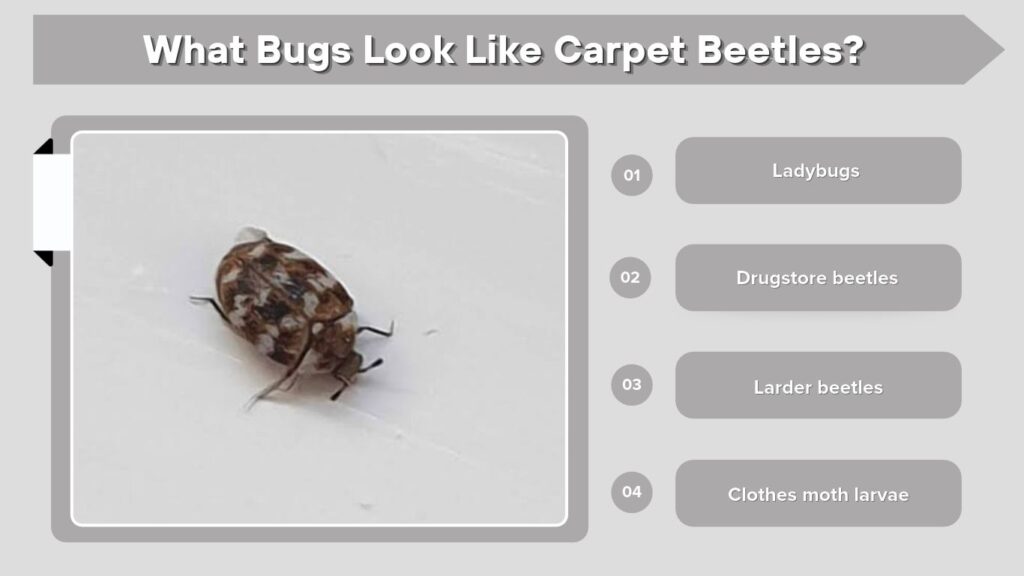
Several household insects resemble adult carpet beetles or their larvae. Correct identification helps prevent unnecessary pest treatments.
Common Carpet Beetle Lookalikes
- Ladybugs: Have rounded bodies but are generally larger and often more brightly colored.
- Drugstore beetles: Small, uniformly brown beetles with oval or cylindrical bodies.
- Larder beetles: Larger dermestid beetles with a distinctive pale band across their dark wing covers.
- Clothes moth larvae: Soft-bodied caterpillars that may occur in damaged fabrics but lack the dense bristles typical of carpet beetle larvae.
A magnifying glass or clear close-up photograph can help distinguish these insects.
What Does a Carpet Beetle Infestation Look Like?
Carpet beetle infestations are often identified through damaged fabrics, discarded larval skins, and repeated insect sightings.
Adults may appear around windows, while larvae hide beneath furniture or inside stored belongings.
What Does Carpet Beetle Damage Look Like?
Carpet beetle larvae can create irregular holes and worn patches in natural-fiber materials.
Affected wool carpets may develop thin or damaged sections, particularly around edges or beneath furniture.
Clothing may show scattered holes or weakened areas. However, fabric damage alone cannot confirm carpet beetles because other pests can cause similar problems.
What Do Carpet Beetle Droppings Look Like?
Carpet beetle larval droppings, also called frass, may appear as tiny granular pellets or dust-like debris near feeding locations.
Some pellets are approximately the size of grains of salt.
Their appearance varies, and frass can resemble ordinary household dirt. Finding it alongside larvae, shed skins, or fabric damage provides stronger evidence of an infestation.
What Does a Carpet Beetle Nest Look Like?
Carpet beetles do not build organized nests like ants or wasps.
Instead, females deposit eggs near materials that larvae can eat. Infested areas may contain larvae, shed skins, droppings, and damaged natural fibers.
These accumulations are sometimes described as carpet beetle nests, although they are actually feeding and breeding locations.
How to Identify Carpet Beetles in Your Home
When checking for carpet beetles, inspect both visible adults and concealed larval habitats.
Look around sunny windows for adult beetles. Then examine wool rugs, furniture seams, storage boxes, closets, and baseboards for larvae.
Use a flashlight to inspect dark corners and a magnifying glass to examine small specimens.
If larvae or shed skins are present, vacuum the affected areas and inspect nearby fabrics for damage.
Finding a single adult does not necessarily mean you have an infestation, but repeated sightings or active larvae deserve further investigation.
FAQs
1. What Do Carpet Beetles Look Like to the Human Eye?
Carpet beetles look like tiny oval or rounded bugs, often black, brown, or speckled with lighter colors. Most adults are approximately 2–5 millimeters long, making them visible without magnification, although their detailed markings can be difficult to see.
2. What Do Baby Carpet Beetles Look Like?
Baby carpet beetles are newly hatched larvae rather than miniature adult beetles. They have tiny elongated bodies that become increasingly hairy as they develop. Their appearance differs significantly from adult carpet beetles, which have hardened wing covers.
3. What Do Carpet Beetle Shells Look Like?
Carpet beetle shells are usually the discarded skins of developing larvae. They appear brownish, hollow, segmented, and covered with small hairs. Finding these skins near carpets, furniture, or stored clothing may indicate current or previous larval activity.
4. Do Carpet Beetles Look Like Ladybugs?
Some carpet beetles resemble miniature ladybugs because they have rounded bodies and patterned wing covers. However, carpet beetles are generally much smaller and may display mottled brown, white, and yellow scales rather than the bold coloring typical of many ladybugs.
5. What Do Carpet Beetle Bites Look Like?
Carpet beetles do not bite humans. However, contact with their larval hairs can produce itchy bumps, redness, or rashes in sensitive individuals. These reactions may resemble insect bites, but skin symptoms alone cannot confirm exposure to carpet beetles.
