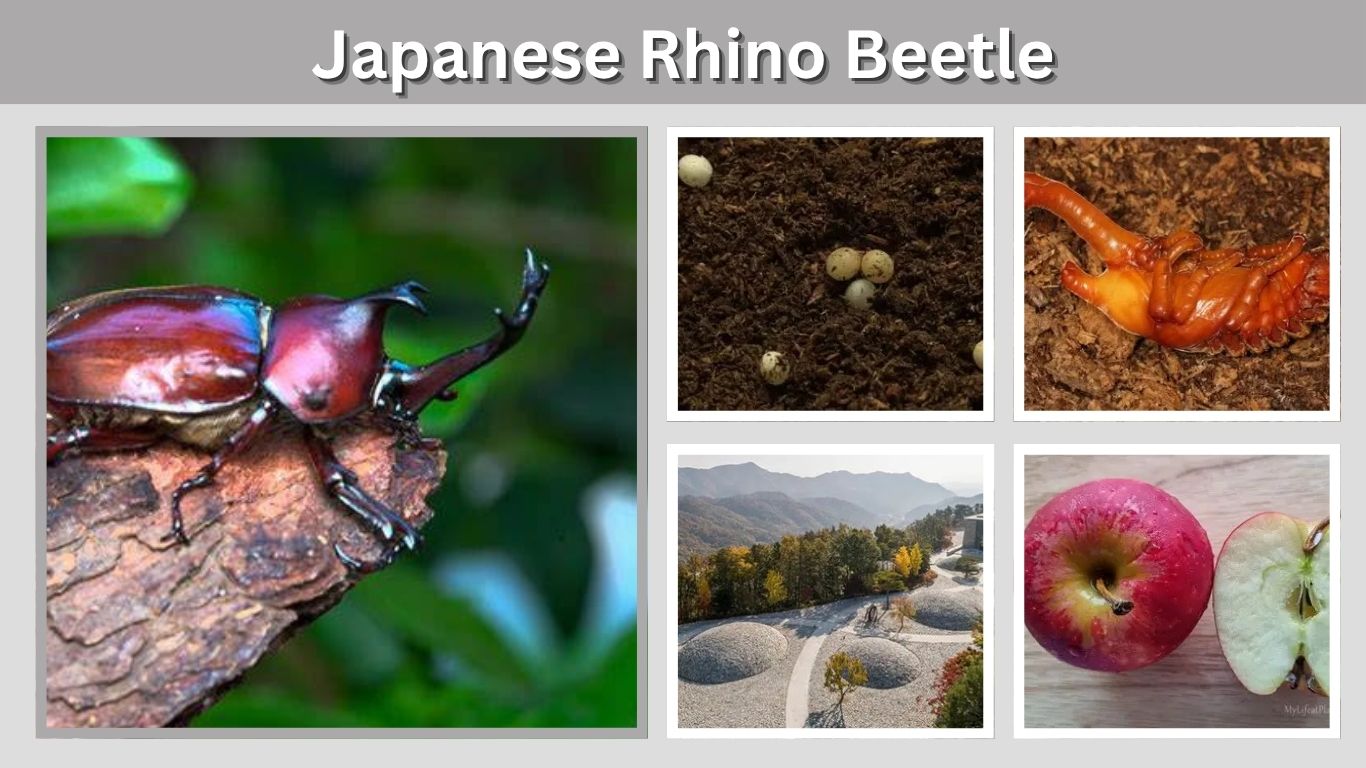
The Japanese rhino beetle is a famous horned beetle known for its strong body, forked male horn, and summer activity in Japan. Also called the Japanese rhinoceros beetle or kabutomushi, it is popular in nature study, pet insect keeping, games, and culture. This guide explains its body parts, habitat, diet, life cycle, lifespan, care, and safety in simple detail.
What Is a Japanese Rhino Beetle?
The Japanese rhino beetle is a large scarab beetle with a hard, shiny body and powerful legs. Males are especially easy to recognize because they have a long horn on the head and a smaller horn on the thorax. Females do not have the large horn, so they look rounder and less dramatic.
This beetle is often called kabutomushi in Japan. The name connects with kabuto, a traditional samurai helmet, because the male’s horned head looks helmet-like. It is one of the most familiar summer insects in Japan and is often kept by children and insect hobbyists.
The scientific name is commonly written as Allomyrina dichotoma. Some sources also use Trypoxylus dichotomus. Because of this, both names may appear in care sheets, science articles, and beetle hobby discussions.
Japanese Rhino Beetle Diagram and Body Parts
A diagram of a Japanese rhino beetle usually labels the horn, head, thorax, abdomen, legs, antennae, elytra, wings, and claws. Understanding these parts makes identification easier, especially when comparing males, females, larvae, and similar beetles.
Main Body Parts
- Head: The front section with eyes, mouthparts, antennae, and the male’s main horn.
- Horn: Large forked structure on males, used for pushing and lifting rivals.
- Thorax: Middle body section where the legs and wings attach.
- Thoracic horn: Smaller horn-like projection on the male’s upper body.
- Elytra: Hard wing covers that protect the soft flight wings.
- Wings: Folded under the elytra and used for flying.
- Abdomen: Rear body section that contains many internal organs.
- Legs: Six strong legs with spines for gripping bark and soil.
- Claws: Hooked tips on the feet that help the beetle climb.
The male horn is the most important feature in a diagram. It is not a stinger, and it is not used to bite people. It works like a lifting tool during beetle fights. The female has no large horn, so her diagram looks simpler and more rounded.
Quick Facts About the Japanese Rhino Beetle
The Japanese rhino beetle is admired because it is strong, easy to recognize, and active during warm months. It has a short adult life but spends a long time developing as a larva underground or inside decaying material.
| Feature | Details |
| Common names | Japanese rhino beetle, Japanese rhinoceros beetle, kabutomushi |
| Scientific name | Allomyrina dichotoma / Trypoxylus dichotomus |
| Family | Scarabaeidae |
| Adult size | Often around 30–80 mm including the horn |
| Adult food | Tree sap, beetle jelly, soft ripe fruit |
| Larval food | Decaying wood, leaf mold, humus-rich substrate |
| Main habitat | Broad-leaved forests and wooded areas |
| Adult lifespan | Usually a few months |
| Full life cycle | Often close to one year |
| Human danger | Not venomous and does not sting |
Japanese Rhino Beetle Habitat and Natural Range
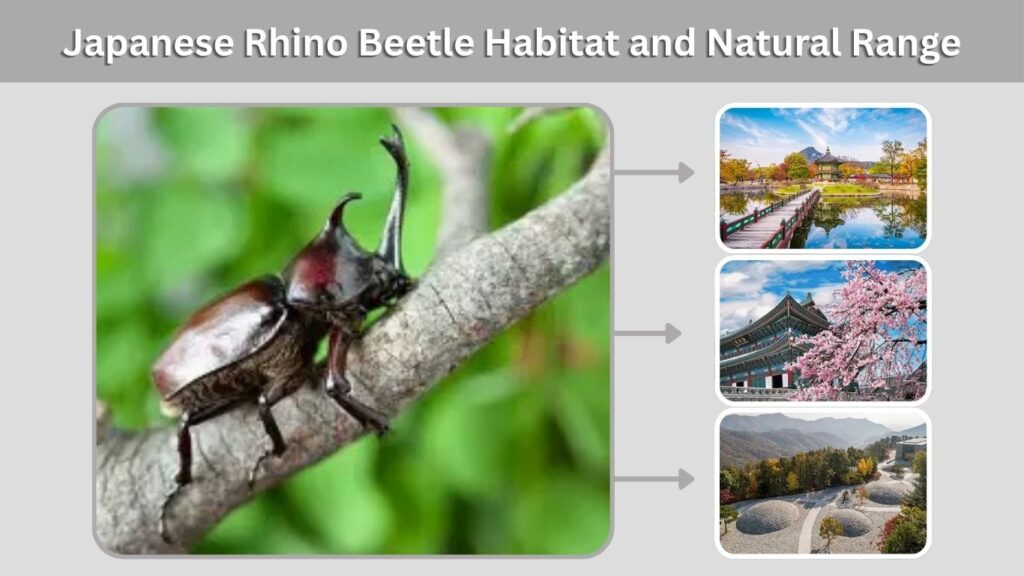
The Japanese rhino beetle lives in parts of East and Southeast Asia. It is strongly associated with Japan, but it is also found in areas such as Korea, China, Taiwan, and nearby regions. It prefers warm forests and wooded places where tree sap and decaying organic material are available.
Adults are often linked with broad-leaved trees. They feed from sap flows on wounded tree trunks, especially during warm summer nights. These sap-feeding areas can attract several beetles at once, including males looking for mates or fighting opportunities.
The larvae live in a very different place. They stay hidden in soil, leaf mold, humus, or decaying wood. This soft, decomposed material gives them both food and shelter. Because larvae depend on rotten plant material, they are part of the natural recycling process in forests.
Japanese Rhino Beetle Diet
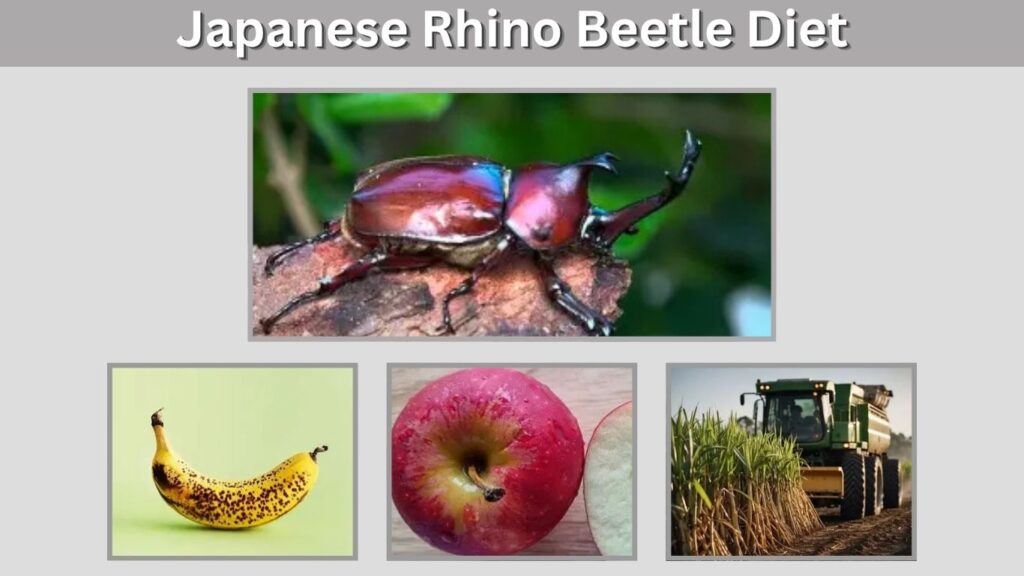
The diet depends on the life stage. Adults need sugary liquid foods, while larvae need decomposed plant material. In captivity, poor food and dirty conditions can quickly reduce health, so feeding should be simple, clean, and consistent.
Adult Food List
- Tree sap from suitable broad-leaved trees
- Commercial beetle jelly
- Ripe banana in small amounts
- Apple or other soft fruit in moderation
- Sugar-rich natural plant fluids
For pet beetles, beetle jelly is often the best food because it is cleaner than fruit and does not spoil as quickly. Fruit can be used, but it should be removed before it becomes moldy. Mold, fruit flies, and mites can create problems in a small enclosure.
Avoid citrus fruit, salty foods, bread, candy, chocolate, processed sweets, and pesticide-treated fruit. Adults do not need a complicated diet, but they do need steady access to safe food during their active period.
Larval Food
Larvae eat decaying wood, leaf mold, and humus-rich material. They should not be fed fresh leaves or fresh wood chips. The substrate must be soft, aged, and suitable for beetle larvae. Many keepers use fermented flake soil or prepared decayed hardwood substrate.
Larvae spend months feeding underground, so their food quality strongly affects adult size. A larva with poor nutrition may become a smaller adult. Males may also develop smaller horns when larval nutrition is weak.
Life Cycle of the Japanese Rhino Beetle
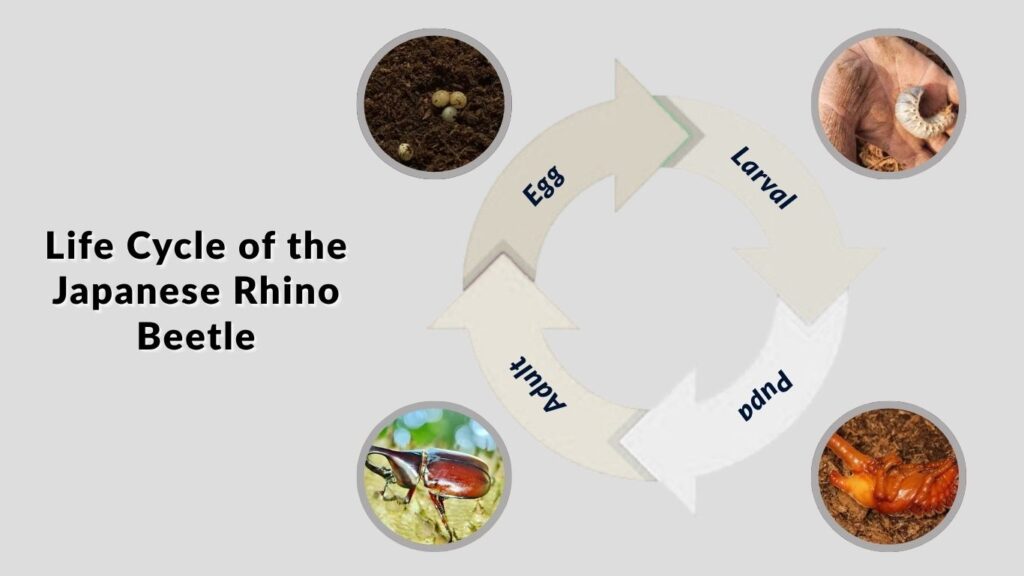
The Japanese rhino beetle has a complete life cycle with four stages: egg, larva, pupa, and adult. The adult is the stage people notice most, but the larval stage is the longest and most important for growth.
Egg Stage
Females lay eggs in soft, moist, humus-rich substrate. The eggs are small and hidden below the surface. In captivity, females need enough depth to dig and lay eggs safely. If the substrate is too dry or compacted, the eggs may not survive well.
Larval Stage
The larva is a white, C-shaped grub with a brown head. It feeds on decaying organic matter and grows through several stages. This stage usually lasts much longer than the adult stage. Good substrate, moisture, and low disturbance are important for healthy growth.
Pupal Stage
When fully grown, the larva makes a pupal chamber in the substrate. Inside this chamber, it changes into an adult beetle. This is a delicate stage. If the chamber is broken or the pupa is moved carelessly, the adult may emerge deformed or die.
Adult Stage
The adult beetle emerges when conditions are warm. Adults feed, mate, fight, fly, and reproduce. They are usually active for only a few months. This short adult period is why many people see them as seasonal insects.
Japanese Rhino Beetle Lifespan
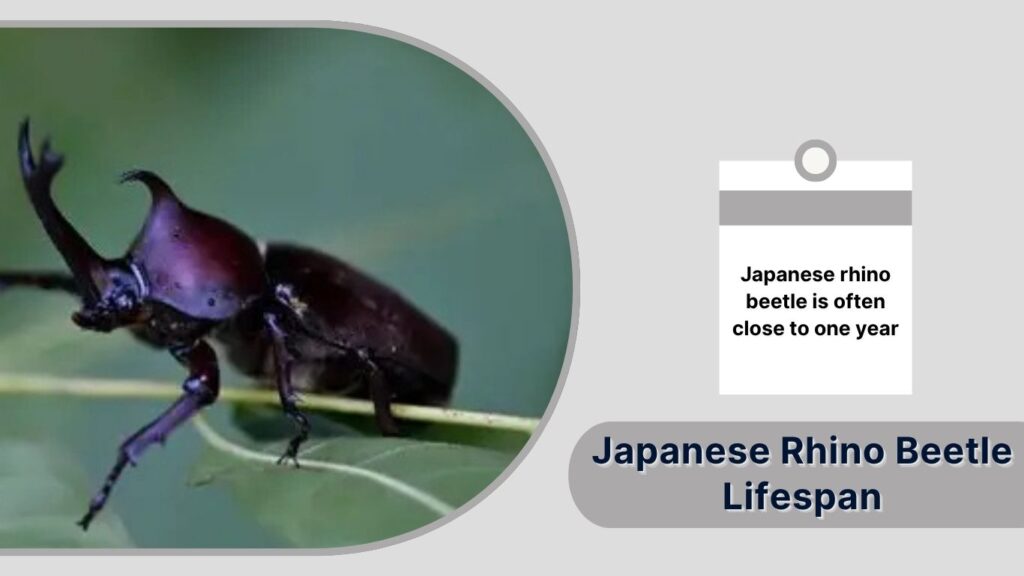
The full life of a Japanese rhino beetle is often close to one year, but most of that time is spent as a larva. The adult stage is much shorter and usually lasts only a few months. In many captive situations, adults may live around two to four months with good care.
Temperature, food, humidity, handling, and stress all affect lifespan. Adults kept in dry, hot, dirty, or overcrowded enclosures may die sooner. Larvae kept in poor substrate may grow slowly, remain small, or fail to develop properly.
A healthy beetle life starts with the larval stage. Good larval substrate helps produce a stronger adult. For adult beetles, the main goal is to provide clean food, safe climbing surfaces, and a stable enclosure.
Japanese Rhino Beetle Care
The Japanese rhino beetle can be a good pet insect for beginners, but it still needs proper care. It is best for observation rather than frequent handling. A simple enclosure, moist substrate, food, and climbing material are usually enough for adult care.
Basic Care Checklist
- Use a secure plastic or glass enclosure.
- Add several inches of slightly moist substrate.
- Provide bark, branches, or wood for climbing.
- Feed beetle jelly or safe ripe fruit.
- Remove old fruit before it molds.
- Keep the enclosure out of direct sunlight.
- Avoid keeping several males together in a small space.
- Mist lightly if the substrate becomes too dry.
- Do not flood the enclosure with water.
- Do not release captive beetles outside.
The lid must be secure because adults are strong and can push against light covers. Ventilation is also important, but the air holes should not allow escape. The substrate should feel slightly moist, not muddy or soaked.
Male vs Female Japanese Rhino Beetle
Male and female Japanese rhino beetles are easy to separate when they are adults. The male has a large forked horn, while the female has no long horn. This difference is one reason male beetles are more popular in displays and collections.
Main Differences
- Male: Has a large head horn and smaller thoracic horn.
- Female: Has no large horn and looks rounder.
- Male: Often fights other males for feeding space and mates.
- Female: Spends more time digging, especially when ready to lay eggs.
- Male: Usually looks more dramatic in photos and diagrams.
- Female: Important for breeding and egg production.
Both sexes need similar adult care. However, a mated female should have deeper substrate for egg laying. If you keep a male and female together, check food supply and space so the female is not constantly disturbed.
Japanese Rhino Beetle Fighting and Behavior
Male Japanese rhino beetles are famous for fighting. They use their horns to push, lift, and flip other males. These fights usually happen around food, territory, or access to females. The goal is not to kill the rival but to remove him from the feeding spot.
A larger horn can help a male win fights, but size is not the only factor. Some smaller males avoid direct fights and may use sneaky behavior to reach females. This makes their behavior more interesting than simple strength contests.
In captivity, males may fight if kept together. For safety, it is better to keep adult males separately or provide a larger enclosure with enough space, food, and hiding areas.
Can Japanese Rhino Beetles Fly?
Yes, adult Japanese rhino beetles can fly. Their hard wing covers open, and the thin flight wings unfold from underneath. Their flight can look heavy because their bodies are large and armored, but they are capable of flying in warm conditions.
They may become more active at night or in warm rooms. A pet beetle should never be left in an open container. If it flies indoors, it may hit walls, lights, windows, or fans. Always keep the enclosure closed when you are not directly observing it.
The wings are delicate compared with the hard outer body. Rough handling can damage them. If you need to move the beetle, let it walk onto your hand or a piece of bark instead of pulling it.
Are Japanese Rhino Beetles Dangerous?
Japanese rhino beetles are not dangerous to humans. They do not sting, they are not venomous, and they are not naturally aggressive toward people. The main thing you may feel is the grip of their claws, which can be sharp or uncomfortable.
Safe Handling Tips
- Hold the beetle close to a table or soft surface.
- Let it walk onto your hand instead of grabbing it hard.
- Do not pull if its claws grip your skin.
- Keep fingers away from moving legs if you are nervous.
- Wash hands before and after handling.
- Avoid handling newly emerged adults.
- Do not let children handle them without supervision.
They are strong insects, but they can still be injured by falls, squeezing, overheating, or stress. Gentle handling is always better than frequent handling.
Japanese Rhino Beetle for Sale and Legal Notes
Japanese rhino beetles are sold in some countries as pet insects, but rules are not the same everywhere. Live insects can be restricted because they may become pests or affect local ecosystems if released. Importing, shipping, or keeping them may require permits depending on your location.
Before buying one, check local agriculture, wildlife, and import rules. This is especially important in the United States, the United Kingdom, and other places where non-native live insects may be regulated. Do not buy from sellers who cannot explain the beetle’s origin or legal status.
If you cannot legally keep a Japanese rhino beetle, consider native beetles, preserved specimens, educational models, or observation content instead. Legal and responsible keeping protects both the hobby and the environment.
FAQs
How long do Japanese rhino beetles live?
The full life cycle is often close to one year, but adults usually live only a few months. Most of the life is spent as a larva feeding in decaying organic material. Adult lifespan depends on food, temperature, humidity, stress, and enclosure quality.
What do Japanese rhino beetles eat?
Adults eat tree sap, beetle jelly, and small amounts of ripe fruit. Larvae eat decaying wood, leaf mold, and humus-rich substrate. Adult fruit should be removed before it molds. Larvae need deep, aged substrate rather than fresh leaves or fresh wood chips.
Can a Japanese rhino beetle fly?
Yes, adults can fly. Their hard elytra open, and soft wings unfold underneath. They usually fly in warm conditions and may be active at night. Pet beetles should be kept in a secure enclosure because they can escape or injure themselves indoors.
Is a Japanese rhino beetle dangerous?
No, it is not venomous and does not sting. Its claws can grip skin strongly, which may feel sharp or uncomfortable. It should be handled gently and close to a surface. Children should handle it only with adult supervision.
Where do Japanese rhino beetles live?
They live in parts of East and Southeast Asia, especially Japan and nearby regions such as Korea, China, and Taiwan. Adults are often found in wooded areas near sap-feeding sites. Larvae live hidden in decaying wood, leaf litter, humus, or rich soil.