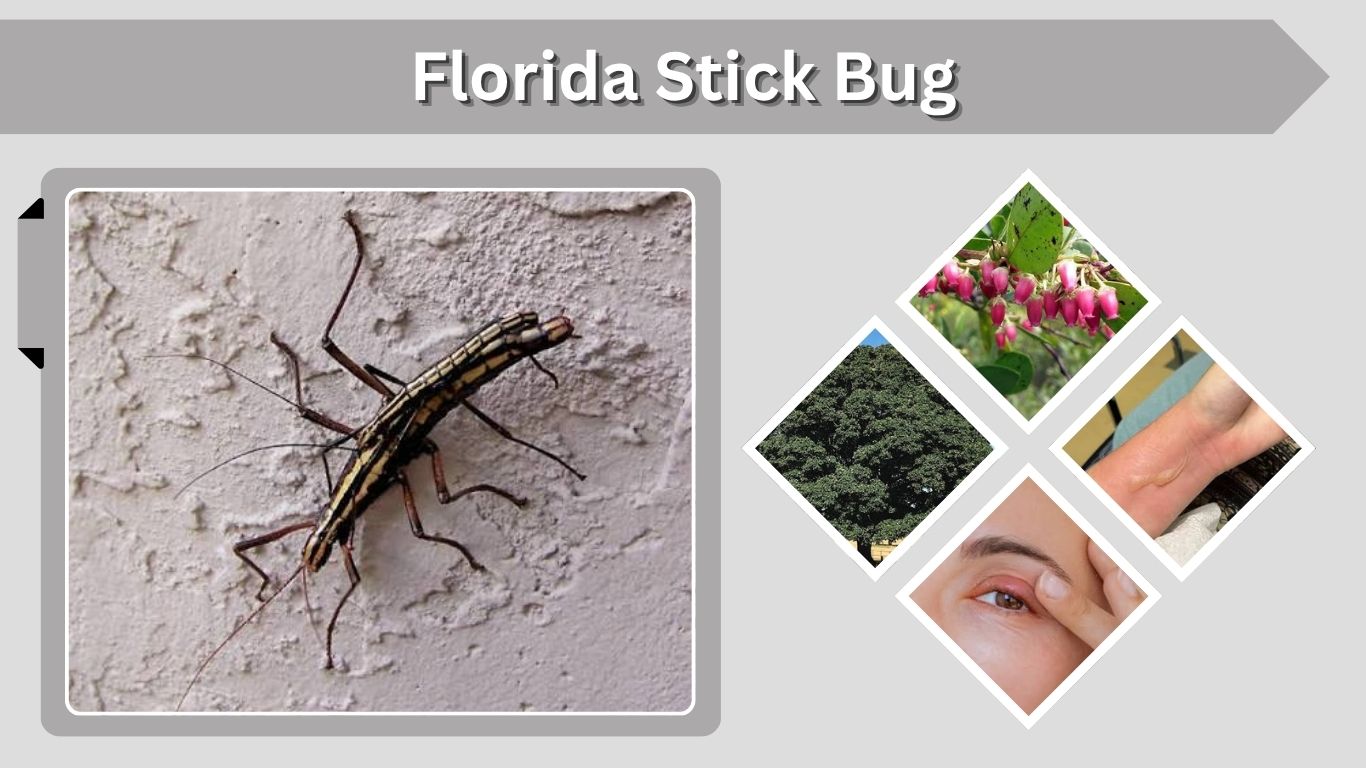
The Florida stick bug, or walking stick, is a long-bodied insect famous for resembling twigs, bark, and branches. The species most commonly associated with Florida is the two-striped walkingstick (Anisomorpha buprestoides). Unlike many harmless-looking walkingsticks, this species has an unusual defensive weapon: it can accurately spray an irritating chemical when threatened. Florida walking sticks are herbivores rather than predators, feeding primarily on leaves from trees and shrubs. They are especially noticeable during fall, when adults frequently appear in mating pairs.
What Is the Florida Walking Stick Bug?
The two-striped walkingstick is a member of the insect order Phasmatodea, a group famous for twig-like camouflage.
Its scientific name is Anisomorpha buprestoides.
Other names occasionally used for this species include:
- Two-striped walkingstick
- Southern two-striped walkingstick
- Stick bug
- Devil’s riding horse
- Musk mare
- Prairie alligator
Despite some intimidating nicknames, it does not hunt people, sting, or feed on blood.
| Feature | Florida Walking Stick |
| Scientific name | Anisomorpha buprestoides |
| Order | Phasmatodea |
| Diet | Herbivorous |
| Female size | About 2.7 inches average |
| Male size | About 1.7 inches average |
| Wings | Absent |
| Main defense | Irritating chemical spray |
| Activity | Often nocturnal |
| Most noticeable | Fall |
UF/IFAS describes A. buprestoides as Florida’s most common walkingstick.
What Does a Florida Stick Bug Look Like?
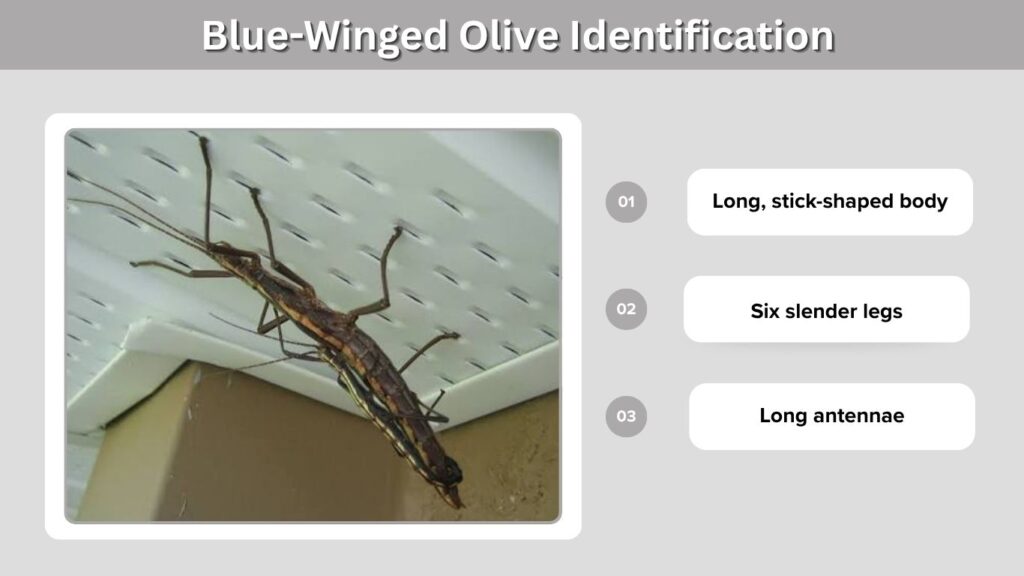
Florida’s two-striped walkingstick is relatively thick-bodied compared with many extremely thin walkingstick species.
Its usual color is brown, often with conspicuous dark longitudinal stripes extending along the body.
Identification Features
Look for:
- Long, stick-shaped body
- Six slender legs
- Long antennae
- Brown to dark coloration
- Black longitudinal stripes
- No functional wings
- Larger, heavier females
- Much smaller males
UF/IFAS reports average lengths of about 67.7 mm (2.7 inches) for females and 41.7 mm (1.6–1.7 inches) for males.
Some photographed Florida individuals appear considerably larger because their extended legs and antennae increase their overall apparent length.
Black and Yellow or Black Florida Stick Bugs
Color can vary geographically.
A particularly striking form occurs in the Ocala National Forest, where walkingsticks may show contrasting black-and-white markings rather than the usual brown coloration. UF/IFAS notes that this distinctive color form is associated with the Ocala National Forest scrub.
Lighting can also make brown individuals appear almost black, reddish, or yellowish.
Therefore, color alone should not be used for identification. Body shape and longitudinal striping provide better clues.
Where Are Stick Bugs Found in Florida?
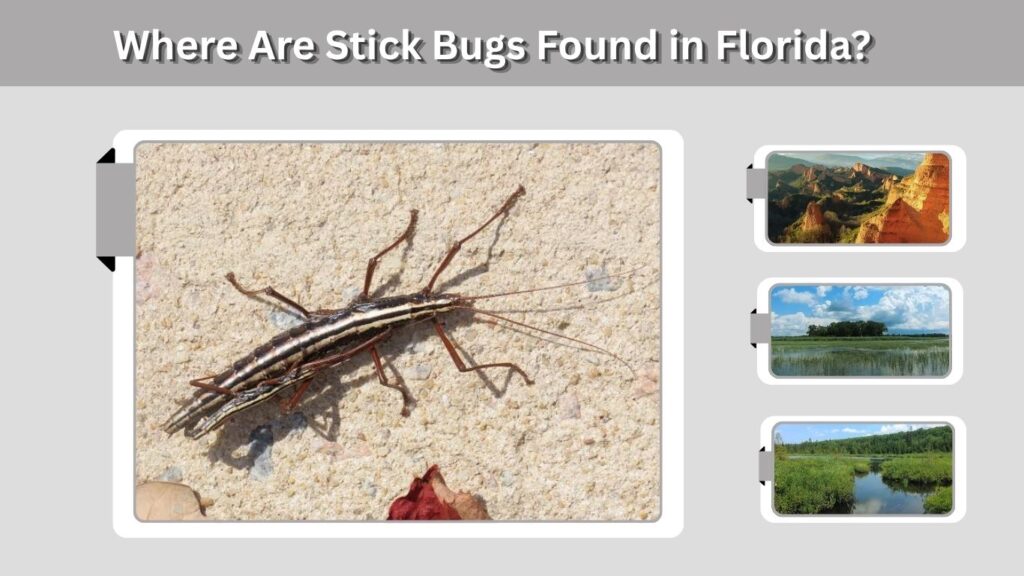
Two-striped walking sticks have been documented throughout many parts of Florida, including northern, central, southern, and Keys locations.
Florida records include counties such as:
- Alachua
- Broward
- Collier
- Escambia
- Lake
- Leon
- Marion
- Miami-Dade
- Monroe
- Orange
- Osceola
- St. Johns
Florida State Collection records extend south to Boca Chica Key in Monroe County.
Florida Stick Bug Habitat
They are commonly associated with wooded or shrubby areas containing suitable host plants.
You may find them around:
- Oak woodland
- Scrub habitat
- Forest edges
- Gardens
- Shrubs
- Tree trunks
- Loose bark
- Leaf litter
- Houses near natural vegetation
They sometimes gather beneath loose bark or other sheltered locations.
What Do Florida Walking Stick Bugs Eat?
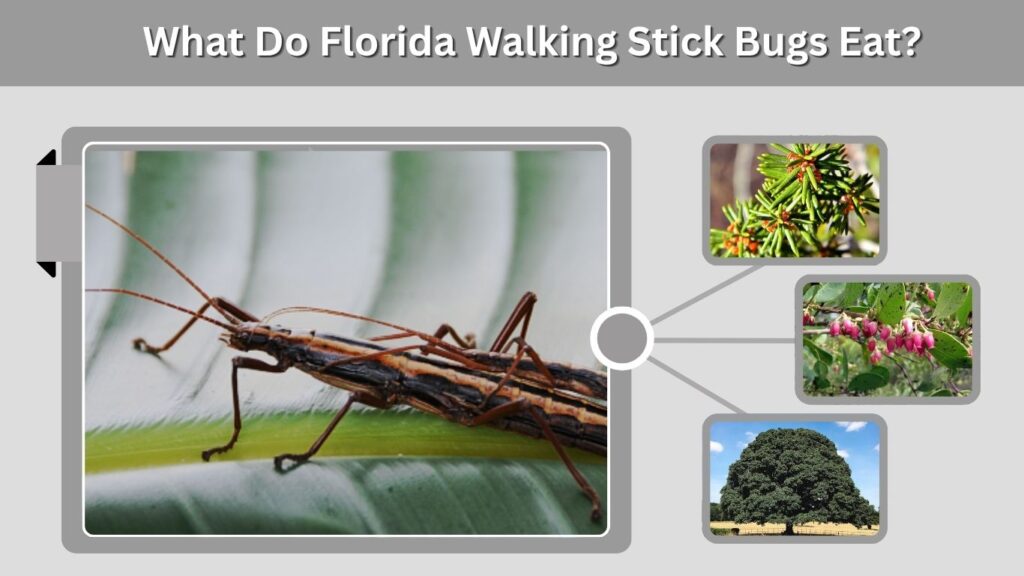
Florida walkingsticks are herbivores.
They feed on leaves rather than other insects.
Plants recorded as food include:
- Oak
- Florida rosemary
- Lyonia
- Crepe myrtle
- Roses
- Privet
Oak appears to be especially important for the distinctive Ocala population. Although walkingsticks may sometimes be found on palmettos, presence on a plant does not necessarily mean they are eating it.
A few walking sticks usually cause little concern, although dense concentrations may consume noticeable amounts of foliage.
Are Florida Stick Bugs Poisonous?
Calling them poisonous is not quite accurate, but Florida’s two-striped walkingstick can produce a powerful defensive chemical secretion.
Specialized glands near the front of the insect’s thorax release a milky spray containing defensive compounds.
The insect can direct this spray accurately toward a perceived threat.
Florida Stick Bug Spray
The spray can travel approximately 30–40 centimeters (12–16 inches) and is particularly irritating if it reaches the eyes or mucous membranes.
For that reason, avoid bringing your face close to the insect or trying to pick it up.
The spray is primarily intended to discourage predators such as birds, mammals, ants, and other animals.
Can a Florida Walking Stick Spray Your Eyes?
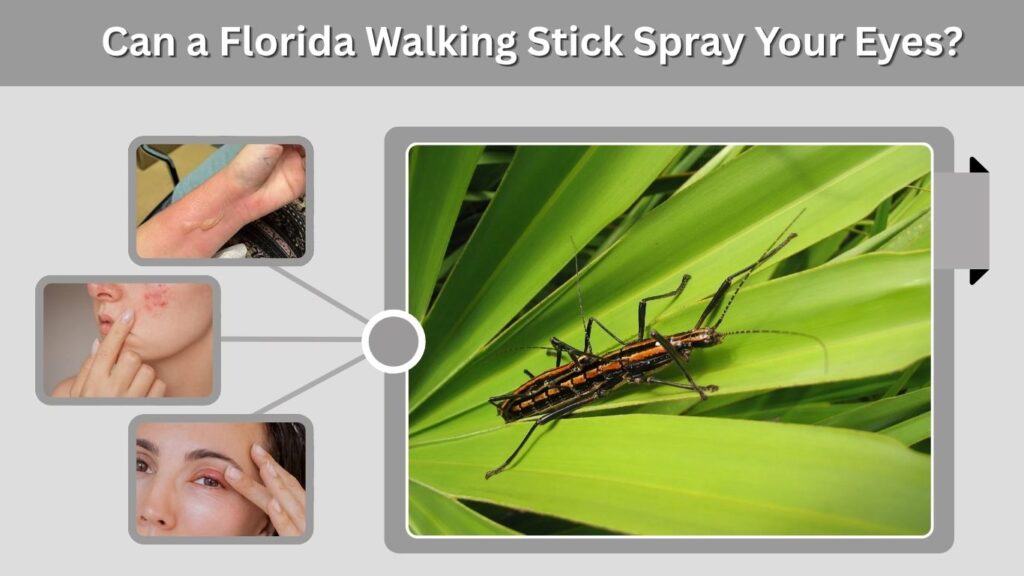
Yes.
This is the most important safety fact about Florida walkingsticks.
UF/IFAS documents human cases in which the defensive secretion entered the eye and caused symptoms including:
- Severe burning
- Eye pain
- Redness
- Light sensitivity
- Temporary blurred or reduced vision
If spray gets into an eye, immediately flush it thoroughly with plenty of clean water. More serious symptoms such as reduced vision or significant light sensitivity warrant medical evaluation.
Can Florida Stick Bugs Harm Dogs or Cats?
Pets should be prevented from biting, pawing, or closely investigating these insects.
UF/IFAS describes a veterinary case involving a dog that developed a corneal injury following exposure to the walkingstick’s defensive spray, although some of the damage may have resulted from the dog rubbing the irritated eye.
The insect is unlikely to chase or intentionally attack a pet. Problems generally occur when the walking stick feels physically threatened.
Do Florida Walking Stick Bugs Bite?
Walkingsticks have chewing mouthparts because they eat leaves, but biting people is not their normal defensive strategy.
The two-striped walkingstick is much better known for spraying irritating chemicals.
If one is found outside, the safest choice is simply to leave it alone.
If it must be moved, avoid squeezing it and keep it well away from your eyes and face.
Florida Stick Bug Mating
One unusual sight in Florida is a large walkingstick carrying a much smaller individual on its back.
This is usually a female with a male attached.
Females are significantly larger than males, making mating pairs look as though a tiny insect is riding a much larger one. Florida observations frequently document males remaining on females for extended periods.
Adults are particularly abundant during fall, which is also an important egg-laying period.
Florida Walking Stick Eggs
The two-striped walkingstick has an interesting egg-laying strategy.
Observations from Ocala National Forest found females digging small pits in sandy soil, depositing approximately 8–10 eggs, covering them with sand, and then moving to another location to repeat the process.
This differs from many other walkingstick species that simply drop eggs from vegetation.
Young walkingsticks emerge as nymphs resembling miniature adults.
Florida Walking Stick Life Cycle
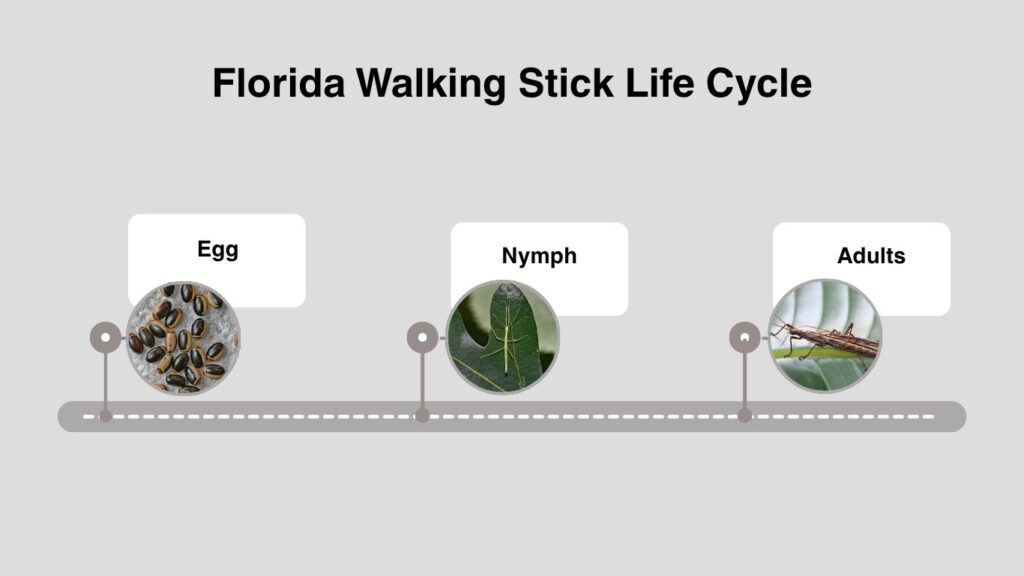
Walkingsticks undergo incomplete metamorphosis:
Egg → Nymph → Adult
There is no caterpillar or pupal stage.
Nymphs hatch looking somewhat like small adults and become larger through repeated molts.
Interestingly, even newly hatched Anisomorpha buprestoides possess functional defensive glands, meaning their chemical defense begins very early in life.
Why Do Florida Stick Bugs Look Like Sticks?
Their twig-like appearance is a form of camouflage.
A brown walkingstick resting motionless against bark or branches can be extremely difficult for predators to recognize.
Useful adaptations include:
- Long, narrow body
- Bark-like coloration
- Slow movement
- Remaining motionless when threatened
- Alignment with branches
- Defensive chemical spray
Camouflage represents the first line of defense. The spray provides additional protection if camouflage fails.
Are Florida Stick Bugs Dangerous?
Florida walkingsticks are not aggressive, but the two-striped walkingstick deserves more caution than many other walkingstick species.
The main concern isn’t a bite or sting—it is the defensive spray.
Avoid handling one, especially near your face, and teach children not to pick up unfamiliar walkingsticks in Florida.
They are otherwise fascinating native herbivores that generally cause little trouble when left undisturbed.
FAQs
1. Are there walking stick bugs in Florida?
Yes. Florida is well known for the two-striped walkingstick (Anisomorpha buprestoides), which UF/IFAS describes as the state’s most common stick insect. It occurs across many parts of Florida and is especially noticeable during fall.
2. Are Florida stick bugs poisonous?
They are not poisonous in the typical sense, but the two-striped walkingstick produces an irritating defensive secretion. The chemical can cause intense pain and irritation if sprayed into a person’s eyes or onto sensitive mucous membranes.
3. How big do Florida walking stick bugs get?
Females average approximately 2.7 inches in body length, while males average around 1.7 inches. Females are noticeably heavier and larger, and extended legs and antennae can make the insects appear considerably longer.
4. What do Florida stick bugs eat?
Florida walkingsticks are herbivores that feed on leaves. Recorded host plants include oak, rosemary, lyonia, crepe myrtle, roses, and privet. They do not hunt insects, bite pets for food, or feed on human blood.
5. Why are two Florida walking sticks stuck together?
A small walkingstick riding on a much larger one is usually a mating pair. The larger insect is the female, while the much smaller and thinner male remains attached to her back during mating.