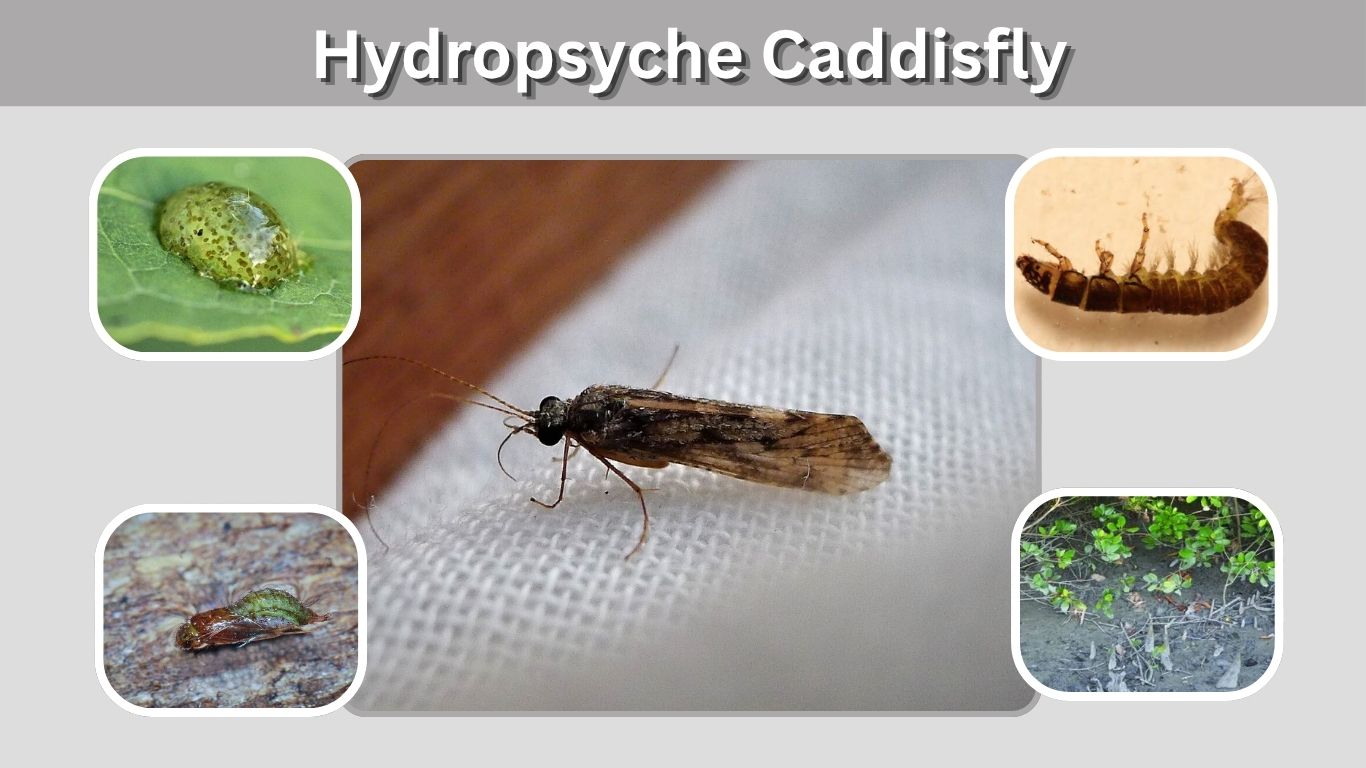
Hydropsyche is a genus of net-spinning caddisflies best known for its aquatic larvae and remarkable underwater silk nets. Instead of carrying portable cases like many other caddisfly larvae, Hydropsyche larvae construct fixed retreats on rocks and spin nets that capture food drifting in flowing water. They are common components of stream and river ecosystems and provide food for fish and other predators. Their distinctive larvae, feeding behavior, life cycle, pollution tolerance, and importance to fly fishing make Hydropsyche particularly interesting freshwater insects.
What Is Hydropsyche?
Hydropsyche belongs to the caddisfly order Trichoptera and family Hydropsychidae, commonly called net-spinning or common netspinner caddisflies. It is a large genus whose immature stages are predominantly aquatic. Larvae specialize in living in flowing freshwater, where they attach retreats and feeding nets to stable underwater surfaces.
Hydropsyche Classification
The basic classification is:
- Kingdom: Animalia
- Phylum: Arthropoda
- Class: Insecta
- Order: Trichoptera
- Family: Hydropsychidae
- Genus: Hydropsyche
The genus contains numerous species, and individual species can differ considerably in distribution, stream preference, pollution tolerance, and seasonal development.
Hydropsyche Caddisfly or Caddis Fly?
Both terms may appear in everyday searches, but “caddisfly” is the usual spelling. Hydropsyche refers to a genus rather than a single species.
Names such as Hydropsyche betteni, H. contubernalis, H. pellucidula, H. siltalai, and H. occidentalis refer to individual species within this broader group.
Hydropsyche Larvae Identification
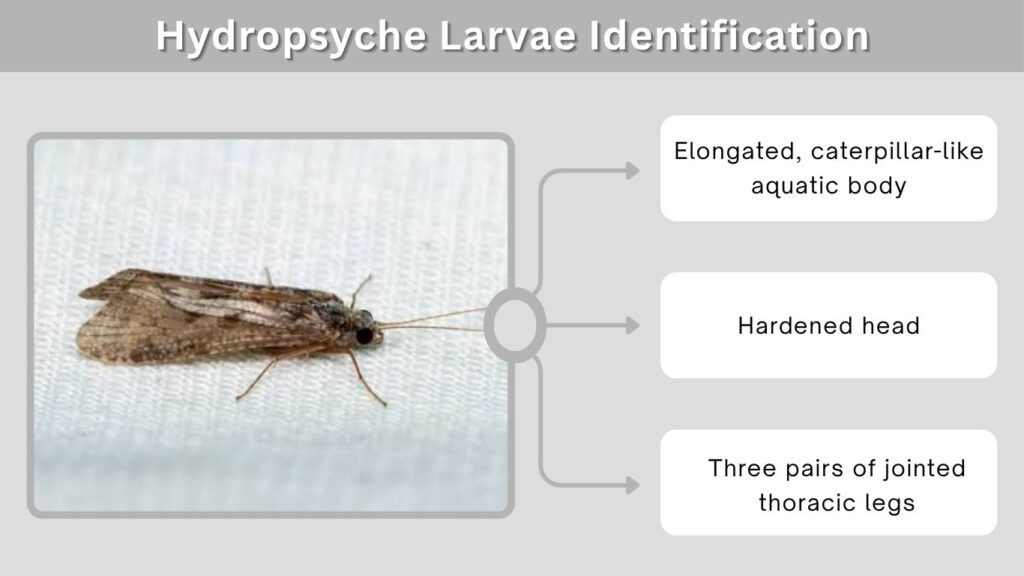
The larval stage is the most recognizable stage of Hydropsyche. Larvae have soft, elongated abdomens but more heavily hardened plates across their thorax. They also possess abdominal gills and strong anal prolegs that help them cling to substrates in flowing water. These features are useful when distinguishing hydropsychid larvae from case-building caddisflies.
Key Identification Features
Look for these characteristics:
- Elongated, caterpillar-like aquatic body
- Hardened head
- Three pairs of jointed thoracic legs
- Hardened plates across all three thoracic segments
- Branched gills along the underside of the abdomen
- Strong anal prolegs with terminal hooks
- Tufts or fans of hairs on the anal prolegs
- No portable stick or stone case
Because species-level identification can require small anatomical details, identifying an individual simply as Hydropsyche may require careful examination rather than relying only on body color.
Is a Hydropsyche Larva a Nymph?
The term “Hydropsyche nymph” is sometimes used informally, particularly around fishing, but scientifically it is a larva, not a true nymph.
Caddisflies undergo complete metamorphosis through egg, larva, pupa, and adult stages. Insects undergoing incomplete metamorphosis, such as mayflies and stoneflies, have nymphs instead.
Hydropsyche Net and Larval Shelter
One of the most impressive features of Hydropsyche larvae is their ability to manufacture silk underwater. A larva constructs a stationary retreat using silk together with detritus and mineral fragments. Near the retreat’s upstream entrance, it produces a silken net positioned where flowing water can carry suspended food into it.
How to Identify a Hydropsyche Shelter
A typical shelter may have:
- A fixed position between or against rocks
- Silk holding mineral and organic material together
- An opening facing flowing water
- A fine silk capture net
- A larva hidden within or beside the retreat
- Placement in areas with a noticeable current
Unlike portable-case caddisflies, Hydropsyche larvae normally leave their retreats to feed or maintain their nets but do not drag the structure around with them.
How the Net Works
The silk functions much like a small underwater filter. Current passes through the mesh while suspended organic particles become trapped.
The larva periodically removes edible material from the net. Different hydropsychid species can construct nets with different mesh sizes, allowing them to exploit different particle sizes and flow conditions.
Hydropsyche Habitat
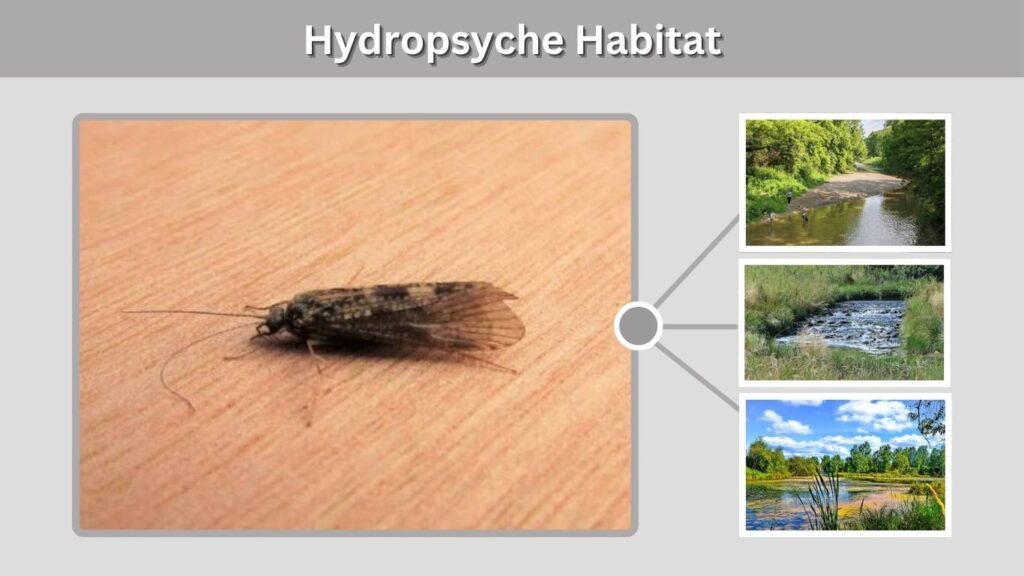
Hydropsyche larvae are strongly associated with running water. Streams and rivers provide the current needed for efficient filter feeding. Larvae often occupy rocky bottoms, where stable stones offer locations for retreats and nets. Habitat requirements vary among species, so current speed, substrate, water chemistry, temperature, and food availability can influence distribution.
Where Hydropsyche Larvae Live
Typical locations include:
- Streams
- Creeks
- Rivers
- Riffles
- Rocky riverbeds
- Gravel bottoms
- Submerged logs
- Large stones and boulders
- Other stable surfaces exposed to current
Some hydropsychid caddisflies may occur along freshwater lake shorelines, but flowing-water habitats are especially characteristic of the family.
Do Hydropsyche Larvae Live in Lakes?
Some relatives within Hydropsychidae can inhabit suitable lake margins, but Hydropsyche is primarily associated with flowing-water environments. Species should therefore be considered individually rather than assuming every member of the genus requires exactly the same habitat.
For example, ecological research shows that different Hydropsyche groups occupy different sections of stream and river networks.
What Does Hydropsyche Eat?
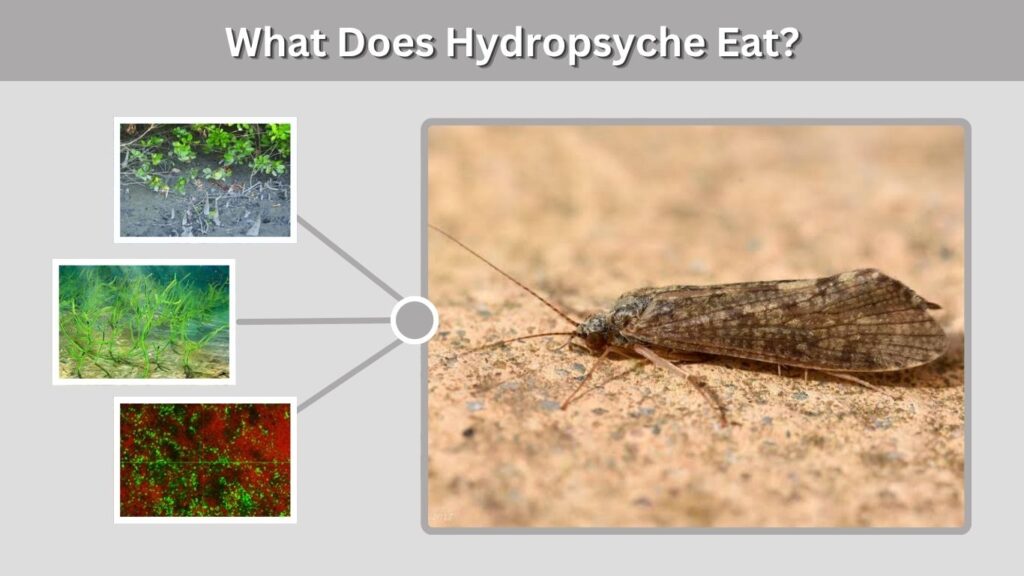
Most Hydropsyche larvae function primarily as collector-filterers. Their nets capture fine organic material transported downstream. However, their diets are not limited to plant debris. Hydropsychid larvae may consume animal material and can also scrape algae or other growth from underwater surfaces.
Common Foods
Their diet may include:
- Fine organic particles
- Leaf detritus
- Algae
- Biofilm
- Tiny drifting organisms
- Small animal fragments
- Small aquatic invertebrates
This flexible diet allows different species to act as filterers, grazers, and sometimes predators within stream food webs.
Hydropsyche Life Cycle
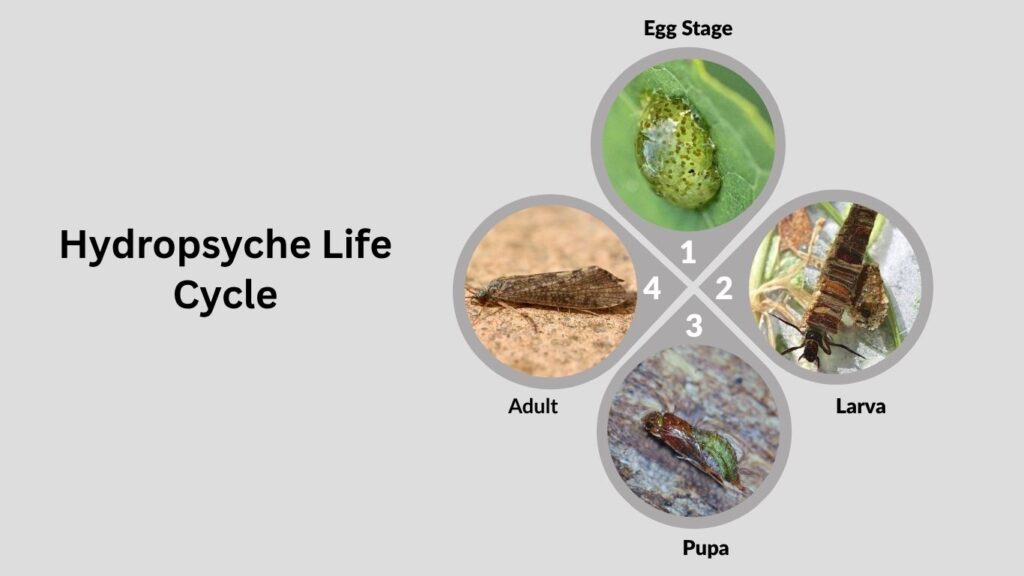
Like other caddisflies, Hydropsyche undergoes complete metamorphosis. Much of its life is spent underwater as a larva. After growing through the larval period, it pupates underwater before eventually becoming a winged adult. Developmental timing varies considerably by species, geographic location, temperature, and other environmental conditions.
Four Life Cycle Stages
- Egg: Females deposit eggs associated with freshwater habitats.
- Larva: The aquatic larva grows, feeds, and constructs nets and retreats.
- Pupa: Mature larvae pupate underwater in protected structures.
- Adult: Winged caddisflies emerge and reproduce.
Some Hydropsyche populations produce one generation per year, while research has found two generations per year in certain species and locations.
Hydropsyche Pupa
Before becoming an adult, the mature larva enters the pupal stage. During this period, the insect develops adult structures including functional wings.
Once development is complete, the mature insect leaves the aquatic pupal environment and emerges as an adult. The adult stage is terrestrial and focused largely on reproduction.
Hydropsyche Species
The genus contains many species spread across different regions. Closely related species can be difficult to separate as larvae without examining anatomical characters, which is why professional identification keys are often necessary.
Notable Hydropsyche Species
- Hydropsyche betteni – Widespread across parts of Canada and the eastern United States.
- Hydropsyche contubernalis – A river-associated species whose larvae spin feeding nets among suitable substrates.
- Hydropsyche pellucidula – Associated with flowing streams and rivers and found across a range of coarse substrates.
- Hydropsyche siltalai – Associated particularly with stream habitats in parts of its European range.
- Hydropsyche occidentalis – A North American species included in ecological studies of hydropsychid feeding and habitat use.
Hydropsyche and Pollution Tolerance
Caddisflies are commonly used in freshwater biological monitoring, but it is inaccurate to classify every Hydropsyche species as equally sensitive or equally tolerant. Pollution-tolerance values vary substantially among hydropsychid species and geographic assessment systems.
Are Hydropsyche Pollution Tolerant?
Some species can tolerate environmental disturbance better than highly sensitive aquatic insects, while others have much lower pollution tolerance.
For this reason, scientists consider species composition and the entire macroinvertebrate community rather than treating the presence of Hydropsyche alone as proof that water is either clean or polluted.
Hydropsyche Fly Patterns and Fly Fishing
Hydropsyche larvae are important prey for freshwater fish, making them relevant to fly anglers. Artificial patterns are designed to imitate the larval, pupal, and adult stages at different points during caddisfly development.
Hydropsyche Patterns
Common imitation styles include:
- Green or olive caddis larvae
- Net-spinning caddis larvae
- Caddis pupae
- Emerging caddis patterns
- Winged adult caddisflies
Calling these flies “Hydropsyche nymph patterns” is common fishing terminology, although “larva pattern” is biologically more accurate.
FAQs
1. What is Hydropsyche?
Hydropsyche is a genus of caddisflies in the family Hydropsychidae. Its aquatic larvae are known for constructing stationary retreats and silk nets in flowing water.
2. Do Hydropsyche larvae build cases?
They do not normally carry portable cases like case-building caddisflies. Instead, they construct fixed retreats attached to underwater substrates.
3. What do Hydropsyche larvae eat?
They mainly filter fine organic particles from flowing water, but depending on species they may also eat algae and small animal material.
4. Where can Hydropsyche larvae be found?
They are especially associated with streams and rivers, where larvae attach their retreats to rocks and other stable underwater surfaces exposed to current.
5. Are Hydropsyche larvae dangerous?
No. They are aquatic insects adapted to feeding and living in freshwater streams and are not considered dangerous to people.