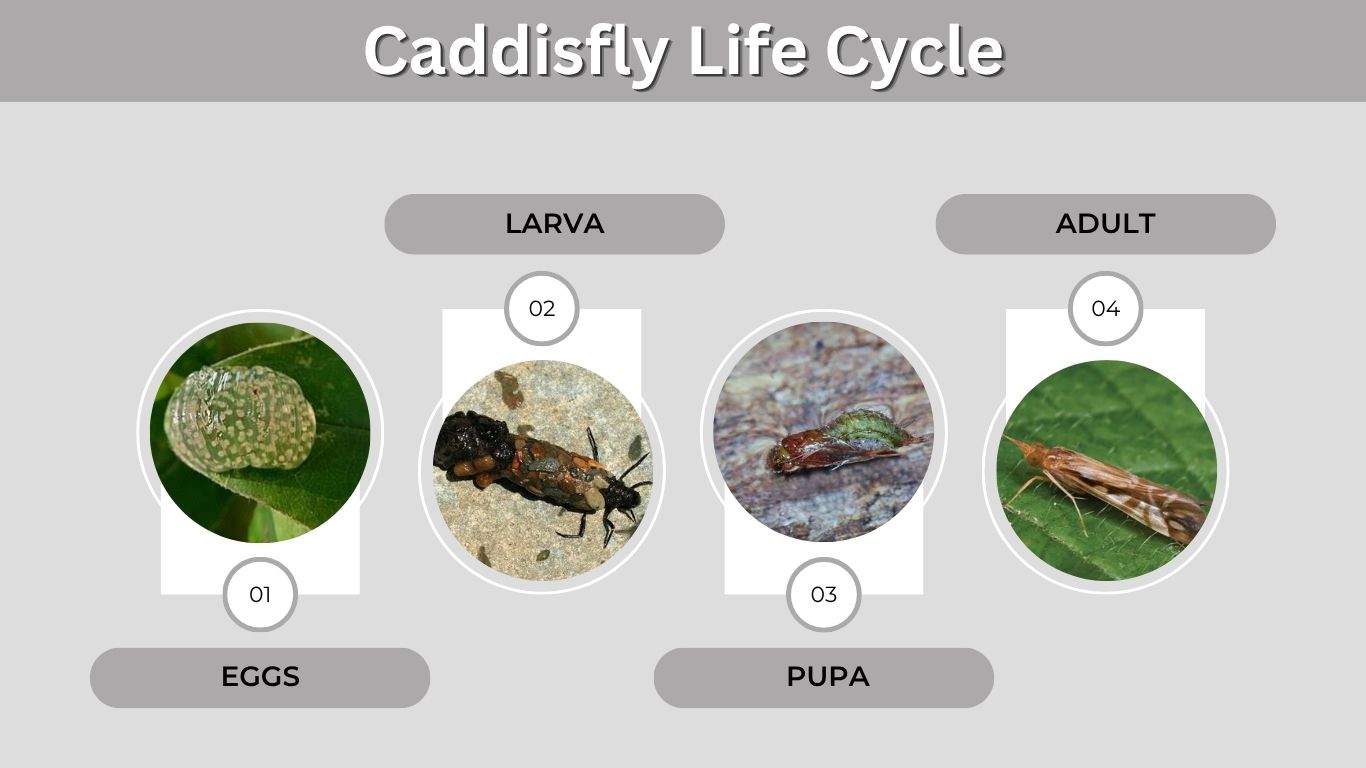
The caddisfly life cycle is a fascinating process that takes place mostly in freshwater. Caddisflies undergo complete metamorphosis, passing through four distinct stages: egg, larva, pupa, and adult. The larval stage is usually the longest and most recognizable because many species build protective cases from sand, stones, leaves, or sticks. Others spin underwater nets or live freely. Understanding each stage of the caddisfly life cycle helps explain their importance in aquatic ecosystems and why they are so valuable to fish and other freshwater animals.
What Is the Caddisfly Life Cycle?
Caddisflies belong to the insect order Trichoptera and experience complete metamorphosis. Their development begins with eggs laid in or near water and continues through an aquatic larval and pupal period. Eventually, the insect emerges from the water as a winged adult. Depending on the species, climate, and water temperature, the complete cycle may take several months or about a year.
Four Main Stages
The caddisfly life cycle consists of:
- Egg
- Larva
- Pupa
- Adult
Most of the insect’s growth occurs during the underwater larval stage. Adults usually live for a much shorter period and mainly focus on reproduction.
Stage 1: Caddisfly Eggs
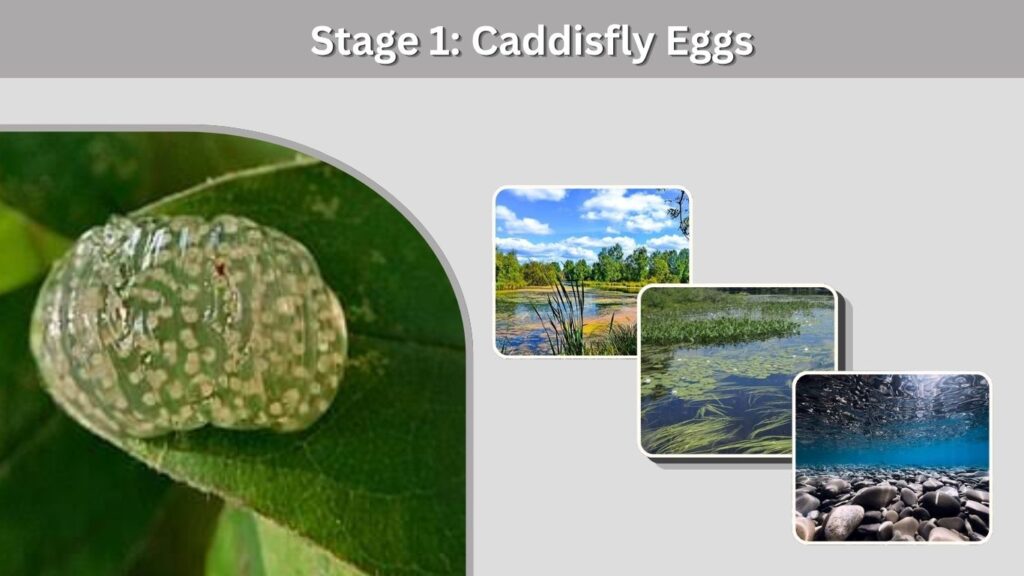
The life cycle begins after adult caddisflies mate. Females typically lay their eggs in gelatinous masses either directly in water or on vegetation, rocks, or other surfaces close to freshwater. Some females dive below the surface to attach eggs to submerged objects.
Where Are the Eggs Laid?
Caddisfly eggs may be found in:
- Streams and rivers
- Lakes and ponds
- Aquatic vegetation
- Submerged stones
- Woody debris
- Wet surfaces near the water
The exact egg-laying behavior depends on the caddisfly species.
Egg Development
The developing embryo remains protected inside the egg until conditions are suitable for hatching. Water temperature has a major influence on development speed. Warmer conditions generally accelerate growth, while colder temperatures can slow it considerably.
Once the egg hatches, a tiny caddisfly larva enters the freshwater environment and begins feeding almost immediately.
Stage 2: Caddisfly Larvae
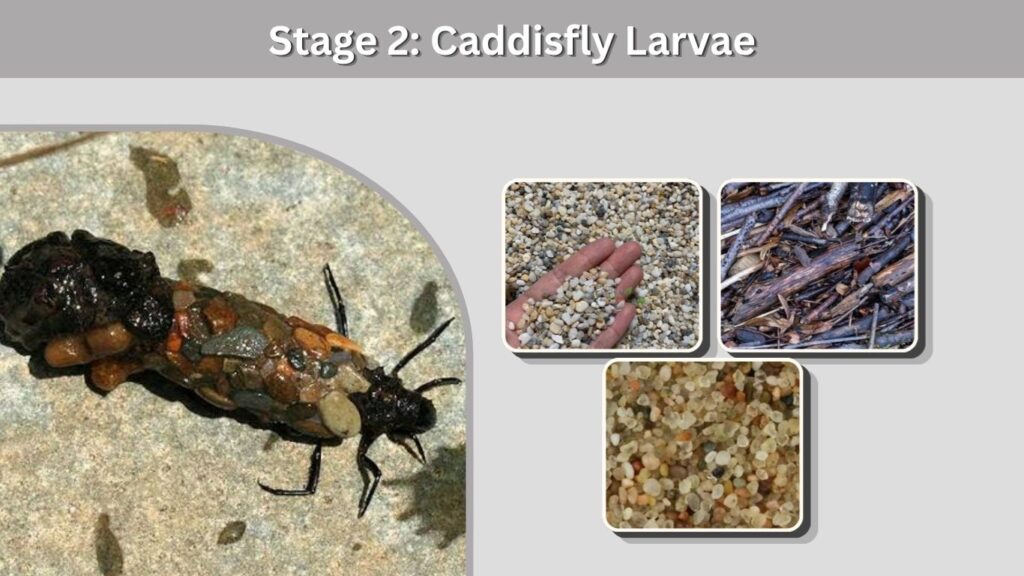
The larval stage is the longest and most important part of the caddisfly life cycle. Larvae live underwater and feed continuously as they grow. They molt several times before reaching maturity. Depending on species, larvae may construct portable cases, build fixed retreats and nets, or crawl freely across the bottom.
Cased Caddisfly Larvae
Many species build portable cases by using silk to attach materials found in their surroundings. Common construction materials include:
- Sand grains
- Small stones
- Twigs
- Leaves
- Bark fragments
- Plant stems
- Tiny shells
The larva extends its head and legs from the front opening while crawling and feeding.
As it grows, it adds new material to the case so the structure remains large enough for its body.
Net-Spinning Caddisfly Larvae
Some larvae do not carry cases. Instead, they build silken retreats on rocks and create nets that capture organic particles drifting through flowing water.
These larvae commonly live in streams where currents continually transport food past their feeding structures.
Free-Living Larvae
Other caddisfly larvae move freely across rocks, gravel, and vegetation without carrying a permanent case. Some of these species are predators that hunt smaller aquatic animals.
The variety of larval lifestyles makes caddisflies one of the most diverse groups of freshwater insects.
What Do Caddisfly Larvae Eat?
Diet varies among species and determines much of their behavior. Some larvae scrape algae from rocks, while others shred decaying leaves or filter particles from flowing water. Predatory species may attack small aquatic invertebrates.
Common Larval Foods
Caddisfly larvae may consume:
- Algae
- Biofilm
- Decaying leaves
- Plant fragments
- Organic debris
- Fine suspended particles
- Fungi
- Small aquatic invertebrates
Their feeding activity helps break down organic material and recycle nutrients throughout freshwater ecosystems.
Stage 3: Caddisfly Pupa
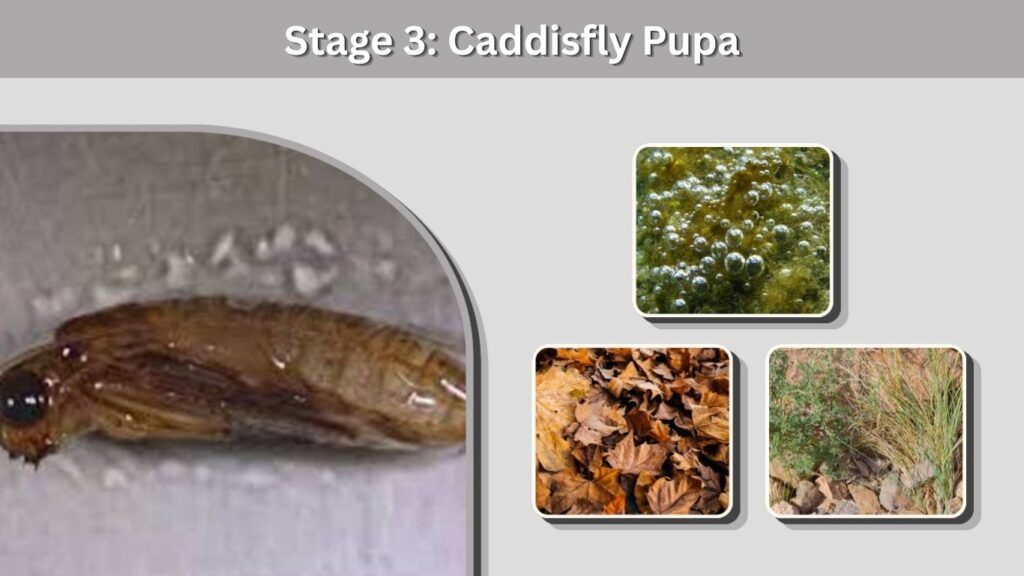
When the larva reaches full size, it prepares for pupation. Case-building species usually modify and secure their existing shelters, while other species construct special pupal retreats from silk, stones, or other materials.
Inside this protected structure, the larva transforms into a pupa.
What Happens During Pupation?
During the pupal stage, the insect undergoes dramatic internal and external changes. Adult features such as wings, antennae, and reproductive structures develop while the larval body is reorganized.
The pupa remains underwater throughout most of this transformation.
When development is complete, it cuts or pushes its way out of the pupal shelter.
How Does the Caddisfly Reach the Surface?
A mature pupa often swims or crawls toward the water surface. After reaching the surface, the insect sheds its pupal skin and becomes a winged adult.
Some may climb onto rocks, plants, logs, or other objects before completing emergence.
This transition is especially important for fish because emerging caddisflies can become concentrated near the surface.
Stage 4: Adult Caddisfly
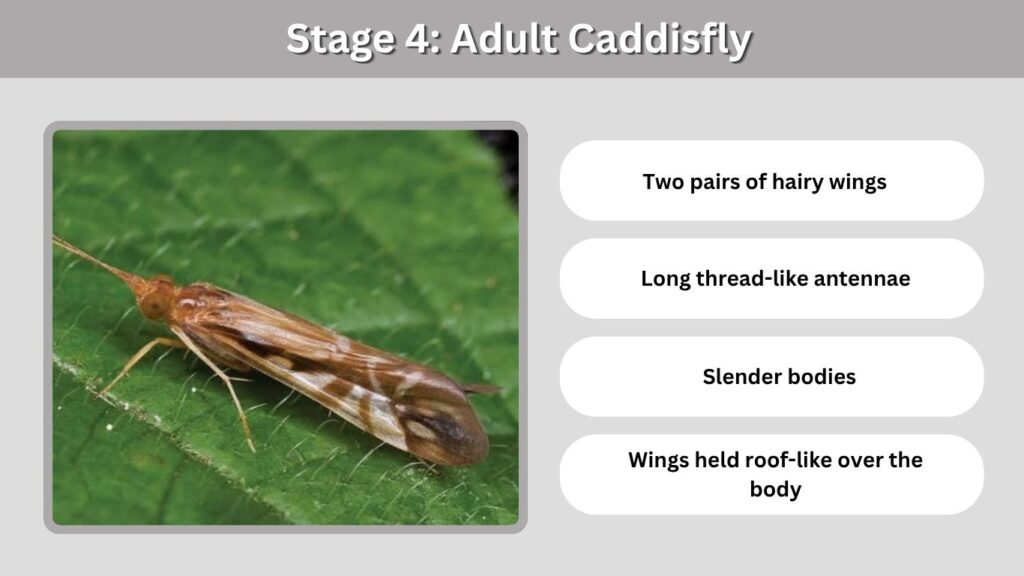
Adult caddisflies are small winged insects that often resemble moths. Their wings are typically covered with fine hairs rather than scales, which is one feature separating them from true moths.
Adults generally remain close to the freshwater habitat where they developed.
Adult Caddisfly Characteristics
Typical adult characteristics include:
- Two pairs of hairy wings
- Long thread-like antennae
- Slender bodies
- Wings held roof-like over the body
- Brown, tan, gray, or yellowish coloration
- Strong attraction to lights in some species
Adult caddisflies usually do not cause problems for people. They do not sting and are generally considered harmless.
Adult Reproduction
The main purpose of the adult stage is reproduction. Males and females locate mates near streams, rivers, lakes, or ponds.
After mating, females deposit their eggs, beginning a new generation.
Adults may live from only several days to a few weeks, depending on species and environmental conditions.
Caddisfly Life Cycle Timeline
The timing of development differs greatly among species. Temperature, food supply, water flow, seasonal conditions, and geographic location all influence how quickly the insect progresses through each stage.
Typical Timeline
A simplified timeline may look like this:
- Egg stage: Several days to several weeks
- Larval stage: Several months
- Pupal stage: A few weeks
- Adult stage: Several days to a few weeks
Many temperate caddisflies complete one generation each year. However, some species can develop more quickly, while others require longer periods.
Cold-water species may spend much of the year as larvae before emerging when seasonal conditions become favorable.
Case-Building Caddisfly Life Cycle
Case-building species follow the same four basic developmental stages as other caddisflies, but their shelters make the larval stage especially distinctive. Construction often begins when the larva is young and continues throughout its growth.
From Case to Pupa
The larva constantly maintains and enlarges its shelter. Before pupation, it usually attaches the case securely to a rock, plant, or other underwater surface.
The openings may be partly closed while still allowing water circulation.
The larva then becomes a pupa inside the shelter before emerging later as a mature insect.
Net-Spinning Caddisfly Life Cycle
Net-spinning caddisflies also undergo egg, larva, pupa, and adult stages. However, their larvae usually live inside fixed silken retreats rather than portable cases.
Net-Spinning Larval Stage
The larva builds silk nets in flowing water to collect food. Organic particles carried by currents become trapped in these nets and are eaten by the larva.
When mature, the larva builds a stronger pupal shelter, often incorporating small stones or debris.
Following pupation, the mature insect leaves the retreat and travels toward the surface.
Caddisfly Life Cycle and Fly Fishing
The different stages of the caddisfly life cycle are extremely important to freshwater anglers because trout and other fish feed heavily on these insects. Fly-fishing patterns are often designed to imitate larvae, pupae, emerging insects, and adults.
Common Caddisfly Fly Patterns
Fly anglers commonly imitate:
- Cased larvae
- Free-living larvae
- Caddis pupae
- Emerging caddisflies
- Adult caddisflies
- Egg-laying adults
Understanding when each stage is present can help anglers choose a fly that resembles the insects fish are currently eating.
Why the Caddisfly Life Cycle Is Important
Caddisflies are an essential part of freshwater food webs. Their larvae consume algae, leaves, organic debris, and small organisms while also becoming prey for fish and other aquatic predators.
Because different caddisfly species have varying tolerances to pollution and low oxygen, their populations are also useful when assessing freshwater ecosystem health.
Their emergence additionally moves nutrients from aquatic environments into terrestrial ecosystems, where adult caddisflies become food for birds, bats, spiders, and other predators.
FAQs
1. What are the four stages of the caddisfly life cycle?
Caddisflies develop through four stages: egg, larva, pupa, and adult. This developmental process is known as complete metamorphosis.
2. How long does a caddisfly life cycle take?
Many species complete their life cycle in approximately one year, although development can be shorter or longer depending on species, water temperature, food, and climate.
3. How long do caddisflies remain larvae?
The larval stage often lasts several months and is normally the longest part of their life cycle. During this time, larvae feed, grow, and molt repeatedly.
4. Do caddisfly larvae turn into pupae underwater?
Yes. Caddisfly larvae normally pupate underwater inside protective cases or silken shelters before emerging toward the surface as mature insects.
5. What happens after an adult caddisfly emerges?
The adult remains near freshwater, searches for a mate, reproduces, and eventually lays eggs. These eggs hatch into new aquatic larvae, restarting the caddisfly life cycle.