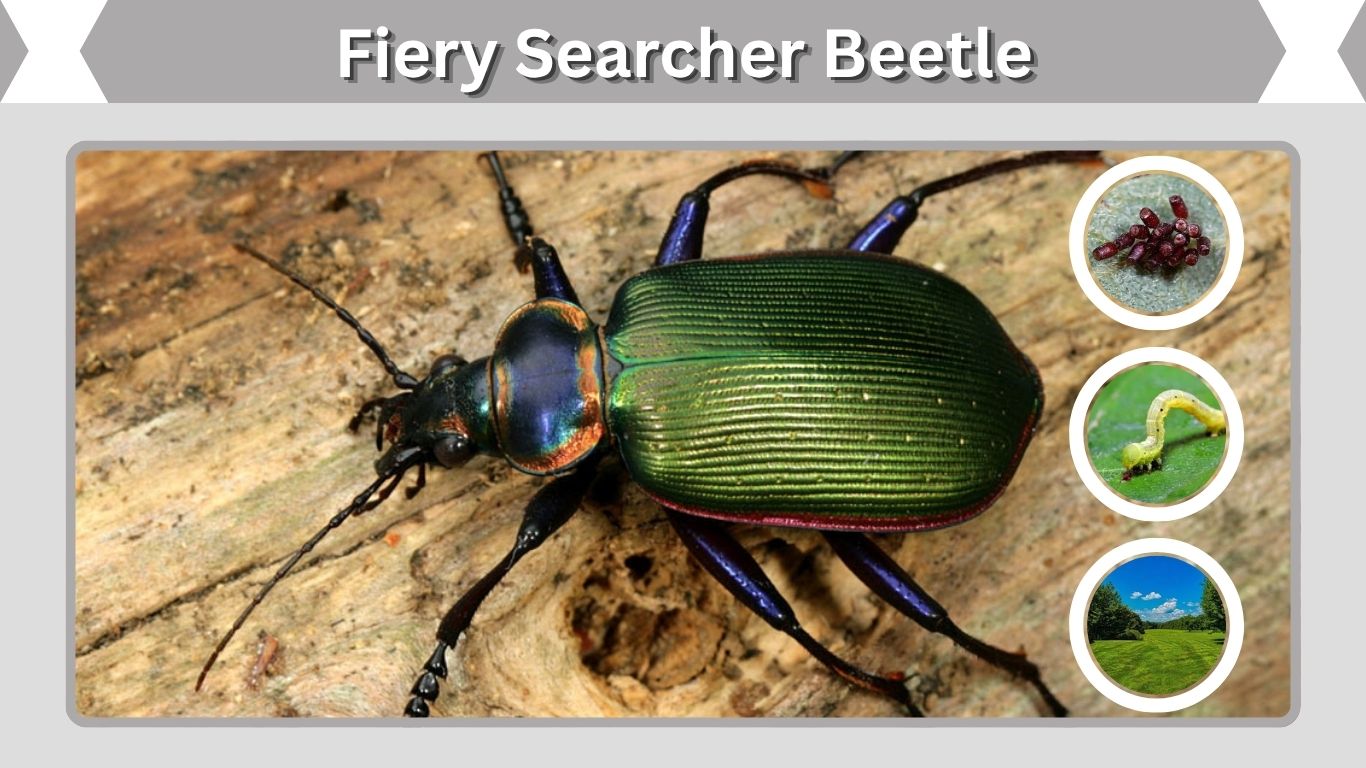
The fiery searcher is a large, metallic ground beetle known for hunting caterpillars in gardens, fields, and forests. Its green wing covers, reddish-gold borders, blue-violet legs, and powerful jaws make it one of North America’s most recognizable beetles. Although it may bite when handled and can release a strong-smelling defensive fluid, it is not normally a household pest. Both adults and larvae are beneficial predators that help control caterpillars capable of damaging trees and garden plants.
What Is a Fiery Searcher?
The fiery searcher’s scientific name is Calosoma scrutator. It belongs to the ground beetle family Carabidae and is also commonly called the caterpillar hunter.
Unlike many ground beetles that hunt mainly on the soil surface, fiery searchers can climb shrubs and trees to find caterpillars. They usually hide during the day and become more active after dark.
| Feature | Description |
| Scientific name | Calosoma scrutator |
| Family | Carabidae |
| Adult length | Approximately 25–35 mm |
| Main color | Metallic green with red, gold, or purple edges |
| Primary food | Caterpillars and other insect larvae |
| Activity | Mostly nocturnal |
| Human risk | May pinch when handled |
| Garden role | Beneficial predator |
Fiery Searcher Beetle Identification
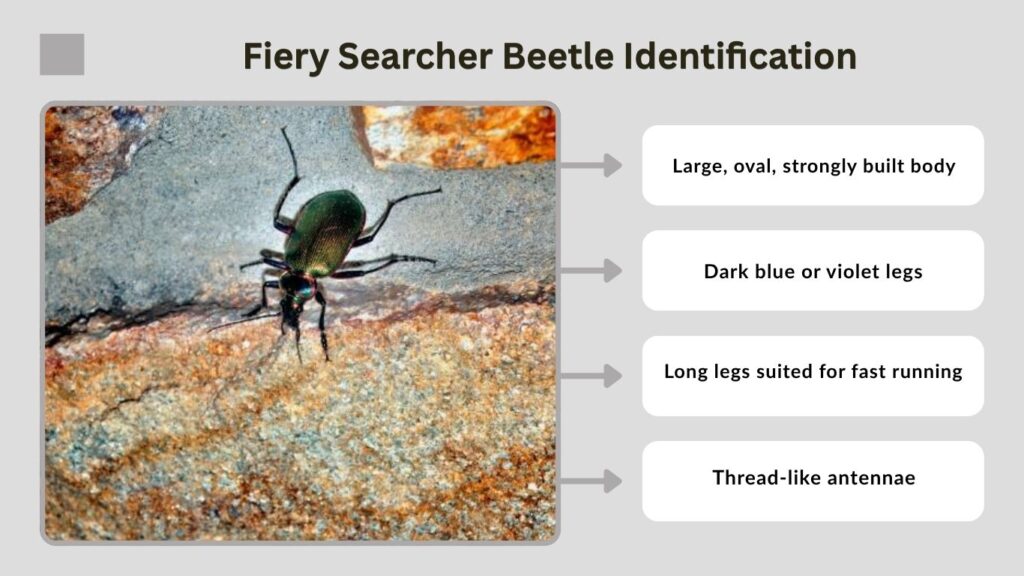
Adult fiery searchers are large, robust beetles measuring approximately 25–35 mm long. Their hardened wing covers are bright metallic green with deep lengthwise grooves. The outer margins may reflect reddish-gold, purple, or copper colors.
Key Identification Features
Look for the following characteristics:
- Large, oval, strongly built body
- Metallic green, finely ridged wing covers
- Red, gold, or purple borders around the body
- Broad blue-violet pronotum behind the head
- Dark blue or violet legs
- Black head with strong curved jaws
- Long legs suited for fast running
- Thread-like antennae
Males can be distinguished from females by their curved middle legs and a reddish patch of hairs on the inner surface. Females have straighter middle legs and lack this patch.
Fiery Searcher Larvae
The larvae do not resemble the colorful adults. Newly hatched larvae are pale but soon become dark brown or black. They have elongated, segmented bodies, strong jaws, and paired appendages at the end of the abdomen.
Fiery searcher larvae pass through three growth stages. They actively hunt caterpillars both during the day and at night, becoming larger and more powerful after each molt.
Where Are Fiery Searcher Beetles Found?
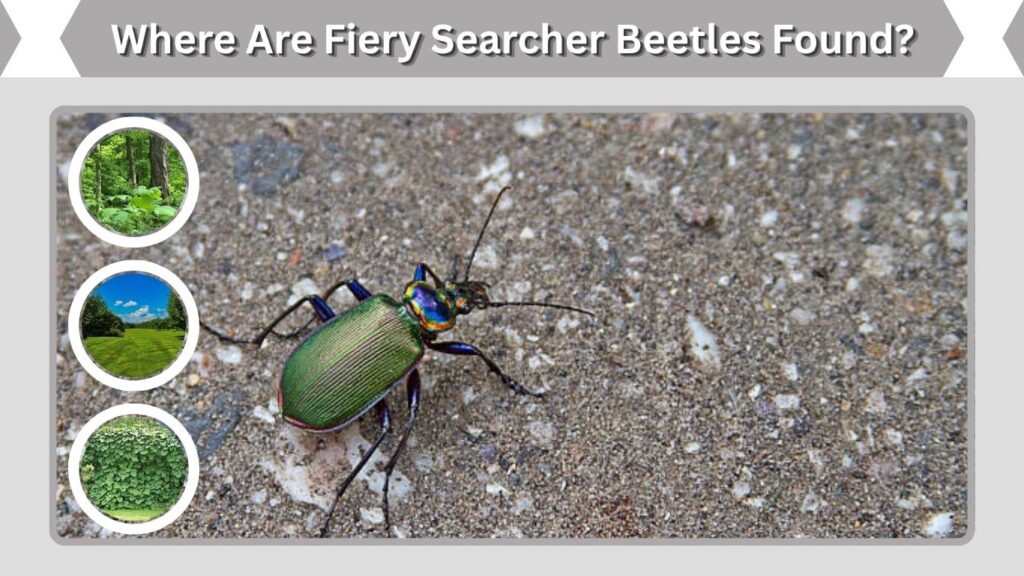
Fiery searchers occur throughout the continental United States but are most abundant in eastern regions. Their recorded range also includes southern Canada, Mexico, Guatemala, and Venezuela.
They are usually observed between April and November, with the greatest activity occurring from May through August.
Preferred Habitat
Common fiery searcher habitats include:
- Gardens
- Open fields
- Deciduous forests
- Woodland edges
- Parks and yards
- Areas affected by caterpillar outbreaks
During daylight hours, adults may hide beneath logs, stones, loose bark, leaf litter, or inside soil crevices. They emerge at night to search for prey on the ground, shrubs, and trees.
Can Fiery Searcher Beetles Fly?
Yes, adults have functional wings and can fly. However, flight is reportedly uncommon. They usually travel by running across the ground or climbing plants and tree trunks while hunting.
What Does a Fiery Searcher Beetle Eat?
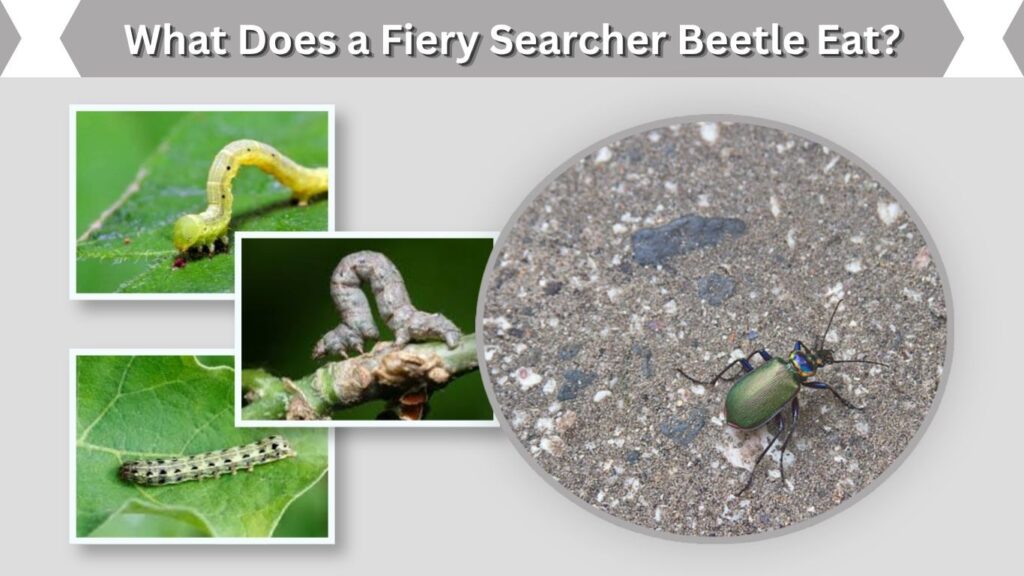
Fiery searchers are carnivorous. Both adults and larvae mainly eat moth and butterfly caterpillars rather than plants.
Their common prey includes:
- Tent caterpillars
- Spongy moth caterpillars and pupae
- Cankerworms
- Inchworms
- Cutworms
- Other forest moth larvae
- Some immature beetles
- Some fly larvae
An individual larva may consume approximately 50 caterpillars while developing. An adult can eat hundreds of caterpillars during its lifetime.
How They Hunt
Fiery searchers use their speed, strong legs, and curved mandibles to overpower prey. They may chase caterpillars across the ground or climb trees to reach them among leaves and branches.
The jaws include grasping and crushing areas that help the beetle hold and break apart soft-bodied prey. Their hunting behavior explains the common names “caterpillar hunter” and “searcher.”
Are Fiery Searcher Beetles Beneficial?
Fiery searchers are beneficial insects because they naturally reduce populations of leaf-eating caterpillars. Tent caterpillars, spongy moth larvae, and other moth caterpillars can defoliate trees and damage ornamental plants when their populations become large.
Because these beetles provide natural pest control, gardeners should normally leave them undisturbed. Broad-spectrum insecticides may kill fiery searchers along with the pests they hunt.
Do They Damage Plants?
Fiery searchers do not normally eat leaves, roots, wood, or garden produce. Their presence around damaged plants may mean they are searching for the caterpillars responsible for the damage.
Finding one in a garden is generally a positive sign rather than evidence of a beetle infestation.
Does the Fiery Searcher Beetle Bite?
A fiery searcher can bite or pinch when it is picked up, trapped, or handled roughly. Its mandibles are designed to capture struggling caterpillars, so the pinch may be painful.
The beetle does not actively seek people to bite. It normally attempts to run away and uses its jaws only when it feels threatened. Observe it without handling it, especially with bare hands.
What to Do After a Bite
Wash the area with soap and clean water. Apply a cold compress if there is minor pain or swelling, and avoid scratching the skin.
Seek medical advice if pain becomes severe, redness continues spreading, the wound shows signs of infection, or an unusual allergic reaction develops.
Why Does a Fiery Searcher Smell Bad?
When disturbed, a fiery searcher may release a strong-smelling defensive fluid from glands near the end of its abdomen. The odor is commonly described as musky, rancid, or unpleasant and can remain on the skin after contact.
This secretion helps discourage predators such as birds and small mammals. Avoid squeezing the beetle, and wash exposed skin if the defensive fluid is released.
Fiery Searcher Life Cycle
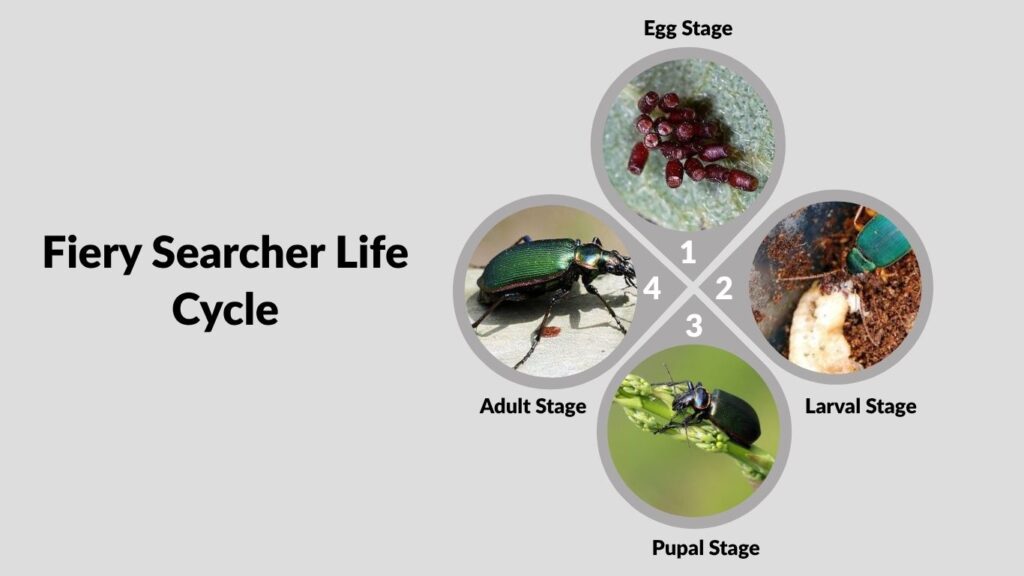
The fiery searcher undergoes complete metamorphosis through the egg, larva, pupa, and adult stages.
Egg Stage
Females lay individual white or slightly yellow eggs in soil during early summer. Depending on temperature, the eggs usually hatch within 3–15 days.
Larval Stage
The larvae pass through three instars and immediately begin hunting. The first two stages last several days each, while the final stage generally lasts 9–15 days.
Once fully developed, the larva burrows about 20–25 cm into soft soil and constructs a small earthen chamber.
Pupal and Adult Stages
Pupation occurs inside the underground chamber and lasts approximately 10–15 days. The emerging adult digs to the surface and begins searching for prey and mates.
The full life cycle can be completed within one year. Adults live an average of about two years, although some have reportedly survived for as long as four years.
Should You Keep a Fiery Searcher as a Pet?
Fiery searchers are occasionally sold or kept by beetle enthusiasts, but they are active predators rather than easy display pets. They need suitable soil, hiding places, ventilation, and a regular supply of live insect prey.
Wild beetles are more valuable in their natural habitat, where they control caterpillars. Local wildlife-collection rules should also be checked before collecting, transporting, buying, or selling native insects.
FAQs
Is a fiery searcher beetle dangerous?
It is not normally dangerous, but it can deliver a painful pinch when handled. It may also release an unpleasant defensive fluid. The beetle does not chase or attack people and is best observed without touching or restraining it.
Are fiery searcher beetles poisonous?
They produce a strong-smelling defensive secretion that discourages predators, but ordinary outdoor encounters are not considered a serious poisoning threat. Avoid getting the fluid in your eyes or mouth, wash exposed skin, and do not allow pets or children to eat the beetle.
Why is it called a caterpillar hunter?
Both adults and larvae actively hunt caterpillars. They run across the ground and climb shrubs or trees to capture tent caterpillars, spongy moth larvae, cankerworms, and other leaf-feeding insects. This predatory diet makes them useful natural pest controllers.
What should I do if I find one inside my house?
Cover the beetle with a container, slide stiff paper underneath, and release it outside near vegetation. Avoid picking it up with bare fingers because it may pinch or discharge its defensive odor. Indoor sightings are usually accidental rather than signs of an infestation.
What animals eat fiery searcher beetles?
Despite their size, jaws, and defensive odor, fiery searchers are eaten by insect-eating birds, toads, skunks, foxes, raccoons, and shrews. Their foul-smelling secretion may discourage some attacks, but it does not protect them from every predator.