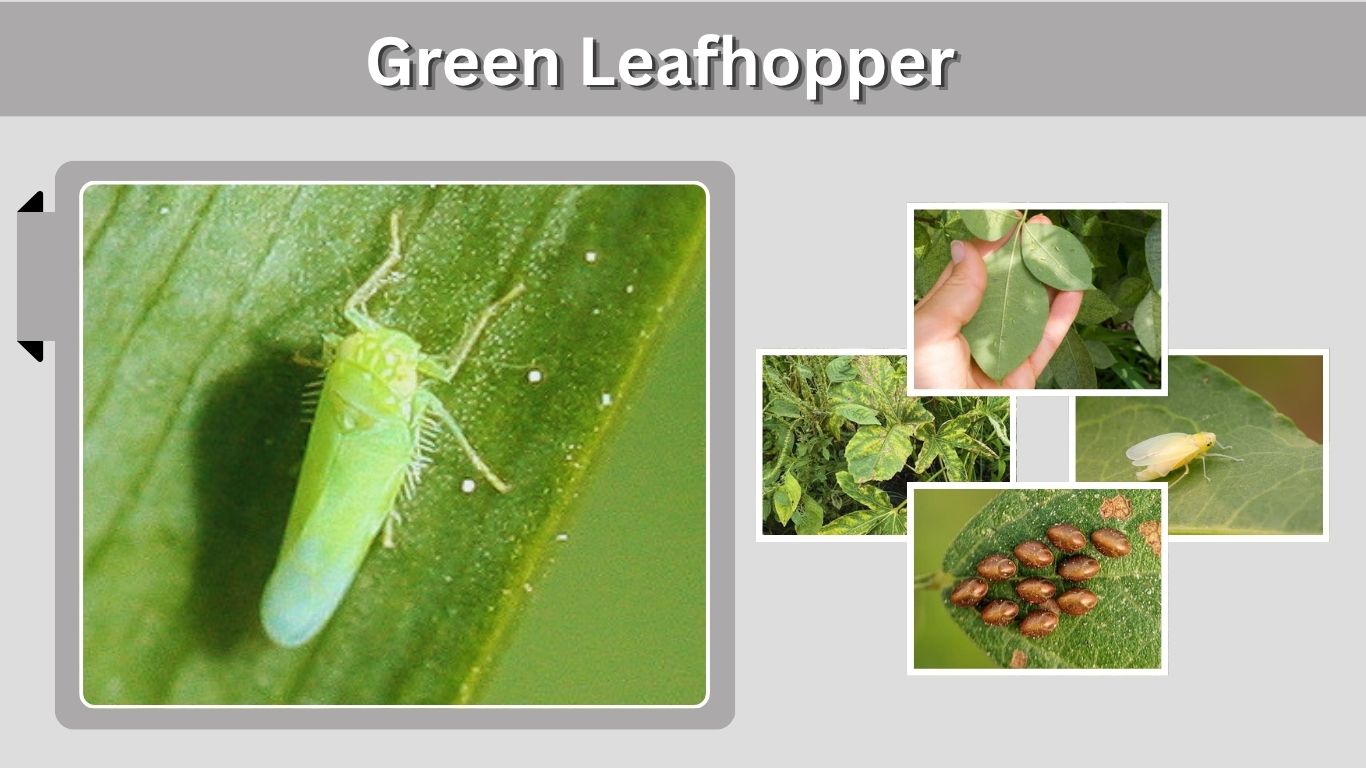
The green leafhopper is a small, active insect commonly found on grasses, garden plants, crops, and rice fields. Its bright green body helps it blend into foliage, while powerful hind legs allow it to jump quickly when disturbed. Most green leafhoppers feed by sucking plant fluids, and large populations may weaken crops or spread plant diseases. Although they are not considered dangerous to people, they can become important agricultural pests. Identifying their appearance, life cycle, feeding habits, damage, and control methods makes infestations easier to manage.
What Is a Green Leafhopper?
Green leafhopper is a broad name used for several green-colored leafhopper species belonging to the family Cicadellidae. These insects are part of the order Hemiptera and possess piercing-sucking mouthparts. Some species live on grasses and garden plants, while others specialize on economically important crops such as rice, tea, vegetables, and ornamental plants.
Green Leafhopper Identification
A typical green leafhopper may have:
- A small, wedge-shaped body
- Bright green or yellow-green coloration
- Six slender legs
- Large hind legs adapted for jumping
- Wings folded over the back
- A relatively broad head
- Piercing-sucking mouthparts
- Fast jumping or flying behavior
Exact markings vary depending on the species, age, and sex.
Green Leafhopper Size
Most green leafhoppers are very small and often measure only a few millimeters long. Their tiny size allows them to remain unnoticed on leaf surfaces.
When disturbed, they can jump rapidly to another leaf or fly away. Their movement is often easier to notice than their bodies.
Green Leafhopper Family and Classification
Green leafhoppers belong to:
- Order: Hemiptera
- Suborder: Auchenorrhyncha
- Family: Cicadellidae
Cicadellidae contains thousands of species worldwide. Because many unrelated species are green, the phrase “green leafhopper” does not refer to only one insect.
Green Leafhopper Nymphs and Eggs
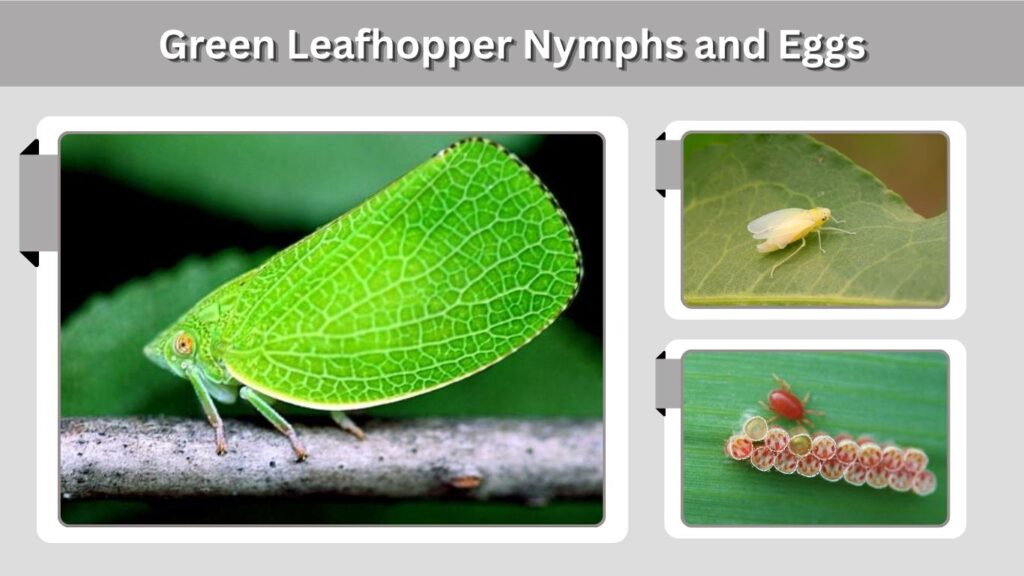
Green leafhoppers develop through incomplete metamorphosis. Their life cycle does not include the worm-like larval stage seen in butterflies or beetles. Instead, eggs hatch into nymphs that already resemble miniature adults. As nymphs grow, they molt several times before becoming fully winged adults capable of dispersing between host plants.
What Does a Green Leafhopper Nymph Look Like?
Green leafhopper nymphs are usually small, wingless, and pale green to yellow-green. They have long legs and can move surprisingly quickly across leaves.
Unlike adults, young nymphs do not have fully developed wings. Wing pads gradually become more noticeable as they approach maturity.
Green Leafhopper Eggs
Female leafhoppers generally place eggs within plant tissue rather than leaving them exposed.
Common egg-laying sites include:
- Leaf veins
- Soft stems
- Leaf sheaths
- Tender plant tissue
- Suitable host crop tissues
Placing eggs inside plants provides some protection from environmental conditions and predators.
Juvenile Tiny Green Leafhoppers
Very small green insects running sideways or jumping from leaves may be juvenile leafhoppers. Their color often provides excellent camouflage.
Nymphs feed on plant fluids much like adults. As they develop through successive molts, their body size increases and adult wings gradually form.
Green Leafhopper Life Cycle
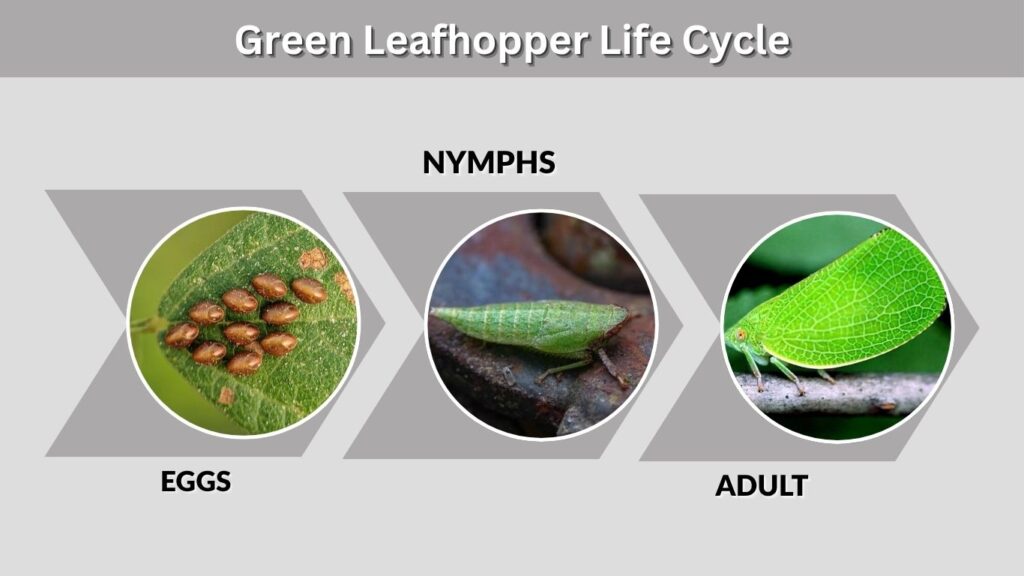
The green leafhopper life cycle consists of egg, nymph, and adult stages. Development time varies considerably among species and depends on temperature, host plants, season, and environmental conditions. In warm climates, some species can complete several generations within one growing season, allowing populations to increase rapidly when food and weather conditions are favorable.
Egg to Adult
The basic developmental stages include:
- Egg: Deposited in plant tissue.
- Early nymph: Small and wingless.
- Growing nymph: Passes through several molts.
- Late nymph: Develops visible wing pads.
- Adult: Gains functional wings and reproductive ability.
Adults mate, and females begin another generation by laying eggs in suitable plants.
How Long Do Green Leafhoppers Live?
Lifespan differs by species. Some adults survive for only several weeks, while environmental conditions can extend or shorten development and adult survival.
Temperature strongly influences activity. Warm weather generally increases feeding and reproduction, while cool conditions can slow development.
What Do Green Leafhoppers Eat?
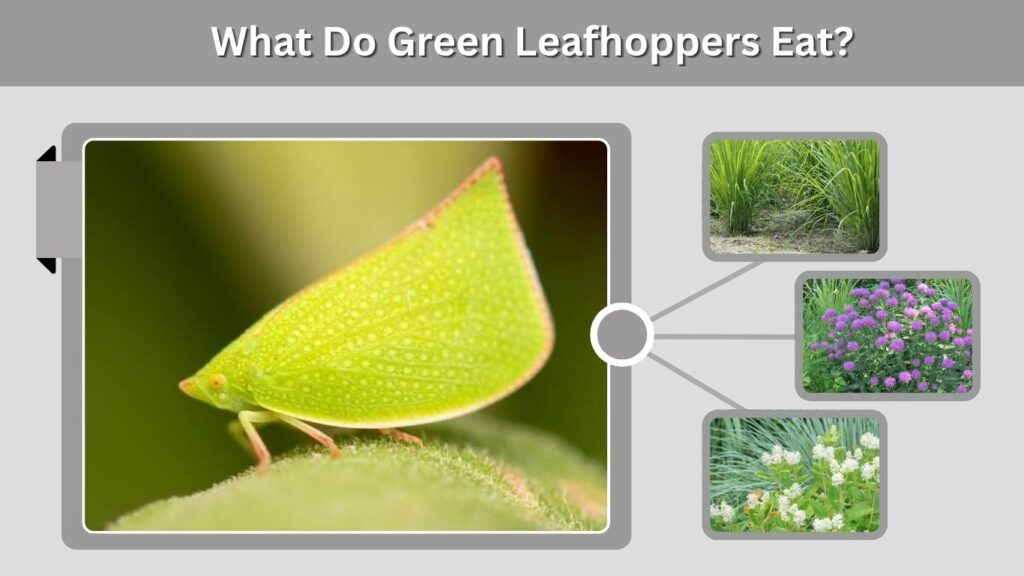
Green leafhoppers are plant feeders. They use needle-like mouthparts to penetrate plant tissues and draw out sap or other fluids. Different species prefer different hosts, which is why certain leafhoppers are closely associated with rice, tea, vegetables, grasses, or ornamental plants. Heavy feeding can interfere with normal plant growth and contribute to visible damage.
Common Host Plants
Green leafhoppers may occur on:
- Rice
- Grasses
- Tea plants
- Vegetables
- Herbs
- Ornamental plants
- Garden shrubs
- Weeds
- Agricultural crops
The preferred plant depends on the particular leafhopper species.
Green Leafhopper Mouthparts
Green leafhoppers have piercing-sucking mouthparts rather than chewing jaws designed to remove chunks of foliage.
They insert their mouthparts into plant tissue and feed on internal fluids. Because of this, their damage usually appears as discoloration, yellowing, or weakening rather than large holes.
Green Leafhopper in Rice
Several green leafhopper species are associated with rice fields. One important example is Nephotettix virescens, commonly known as the green leafhopper of rice in parts of Asia.
Rice leafhoppers are important because some species can transmit serious plant pathogens while feeding.
Green Leafhopper Damage
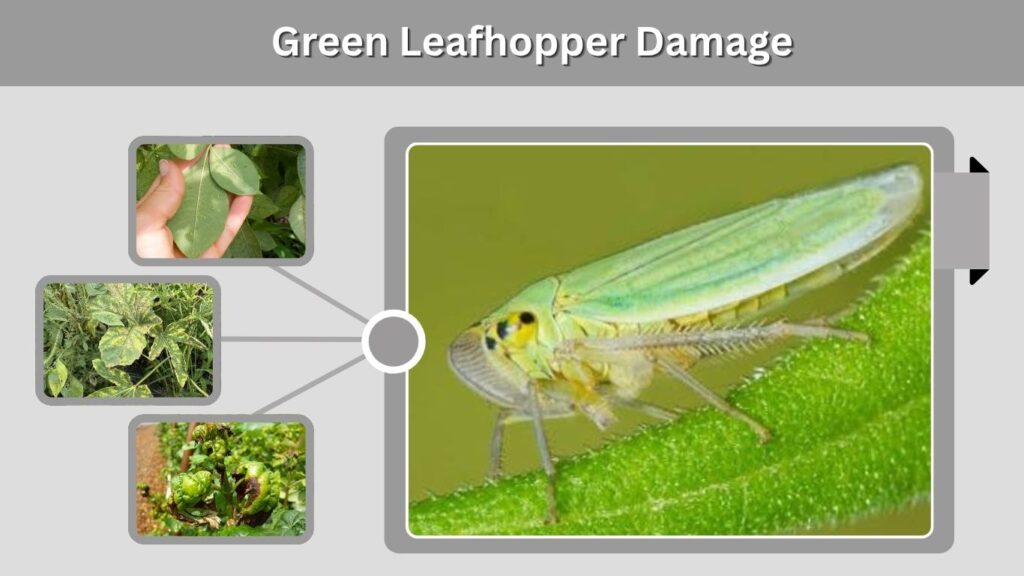
A small number of green leafhoppers may produce little visible damage, but populations can multiply under suitable conditions. Heavy feeding removes plant fluids and damages cells. Some species are even more important because they can carry disease-causing organisms between plants, making management especially important in agricultural crops.
Signs of Green Leafhopper Damage
Possible symptoms include:
- Pale spots on leaves
- Yellowing foliage
- Reduced plant vigor
- Brown or scorched leaf edges
- Curling leaves
- Stunted growth
- Drying foliage
- Reduced crop performance
Symptoms differ according to the plant and leafhopper species involved.
Rice Green Leafhopper Damage
Rice can be affected directly through feeding and indirectly through disease transmission.
Large populations may weaken young rice plants, while disease-carrying leafhoppers can spread pathogens between plants as they move through a field. Because of this, agricultural management often focuses on both population levels and disease risk.
Tea Green Leafhopper Damage
Leafhoppers associated with tea can feed on young shoots and leaves. Repeated feeding may interfere with healthy shoot development and reduce the quality of affected foliage.
Monitoring tender growth is useful because young plant tissues are frequently attractive to sap-feeding insects.
How to Get Rid of Green Leafhoppers
Green leafhopper control works best when infestations are detected early. The most appropriate method depends on whether the insects occur on a few garden plants or across a large agricultural crop. Maintaining healthy plants, reducing unnecessary pest habitat, encouraging natural enemies, and applying appropriate treatments when needed can all contribute to population management.
Natural Green Leafhopper Control
Helpful approaches include:
- Remove heavily infested leaves when practical.
- Control weeds surrounding vulnerable plants.
- Encourage spiders and beneficial predatory insects.
- Spray sturdy garden plants with water to dislodge insects.
- Inspect leaf undersides regularly.
- Avoid excessive nitrogen fertilization.
- Remove badly affected plant material.
- Keep plants properly watered and healthy.
Natural predators can help prevent low populations from becoming serious infestations.
Insecticide for Green Leafhoppers
For severe infestations, an insecticide labeled for leafhoppers and the specific crop or ornamental plant may be appropriate.
Always follow the product label carefully. Correct timing is important because young nymphs may be easier to manage than highly mobile adults. Agricultural recommendations can also differ by region and crop.
Managing Green Leafhoppers in Rice
Rice management may include field monitoring, resistant varieties where available, proper planting practices, conservation of natural enemies, and carefully timed control measures.
Unnecessary insecticide use should be avoided because it may eliminate beneficial predators and contribute to resistance in pest populations.
Tiny Green Leafhopper in the House
Occasionally, tiny green leafhoppers enter homes accidentally. They may come through open doors, windows, or screens, especially when outdoor vegetation grows close to the building. Indoor sightings usually do not indicate that the insects are breeding inside the house.
Why Green Leafhoppers Come Indoors
They may enter because of:
- Attraction to lights
- Open windows
- Nearby garden vegetation
- Accidental transport on plants
- Seasonal movement
- Gaps around doors or screens
Removing individual insects and improving window or door screening is usually sufficient.
Do Green Leafhoppers Bite?
Green leafhoppers do not normally bite humans. Their mouthparts are specialized for feeding on plants rather than taking blood from people.
A leafhopper landing on skin is generally harmless and is usually trying to escape rather than feed.
Are Tiny Green Leafhoppers Dangerous?
Tiny green leafhoppers are not considered dangerous household insects. They do not infest food, clothing, furniture, or people.
Their main importance is outdoors, where certain species can damage plants or transmit plant diseases.
Red-Eyed and Scarlet Green Leafhoppers
Some leafhopper species have green bodies combined with colorful markings. Red eyes, scarlet stripes, or contrasting patches can make these insects especially noticeable. Color alone, however, is not always enough for exact identification because different leafhopper species can have similar combinations of green, red, yellow, or blue.
Red-Eyed Green Leafhopper
A leafhopper described as red-eyed and green typically has a predominantly green body combined with conspicuous reddish eyes or facial markings.
Several species can fit this general description, so location, size, host plant, and wing patterns should also be considered when attempting identification.
Scarlet and Green Leafhopper
Scarlet-and-green leafhoppers display a colorful mixture of red or scarlet markings and green areas.
Despite their bright appearance, they generally share the basic leafhopper lifestyle of feeding on plants, jumping when disturbed, and using vegetation for feeding and reproduction.
FAQs
Are green leafhoppers harmful to plants?
Yes, some green leafhoppers can harm plants, especially when present in large populations. They remove plant fluids while feeding, which may cause yellowing, spotting, poor growth, or leaf damage. Certain species can also transmit plant pathogens between susceptible crops.
Do green leafhoppers bite humans?
Green leafhoppers do not normally bite humans. They are plant-feeding insects with mouthparts adapted to penetrate plant tissues. If one lands on your skin, it will usually jump or fly away rather than attempt to feed.
What is the scientific name of the rice green leafhopper?
One important rice green leafhopper is Nephotettix virescens. However, several related Nephotettix species may occur in rice-growing regions. Correct identification is important because species distribution and their ability to transmit plant diseases can vary.
How do I identify a green leafhopper?
Look for a tiny wedge-shaped green insect with wings folded over its back and enlarged hind legs. Leafhoppers usually jump quickly when disturbed. Nymphs resemble smaller wingless adults and are commonly seen moving across the undersides of leaves.
How can I control green leafhoppers naturally?
Regularly inspect plants, remove heavily infested material, manage weeds, encourage beneficial predators, and maintain healthy growing conditions. Small garden infestations may also be reduced by spraying sturdy plants with water. More serious agricultural infestations may require crop-specific integrated pest management.