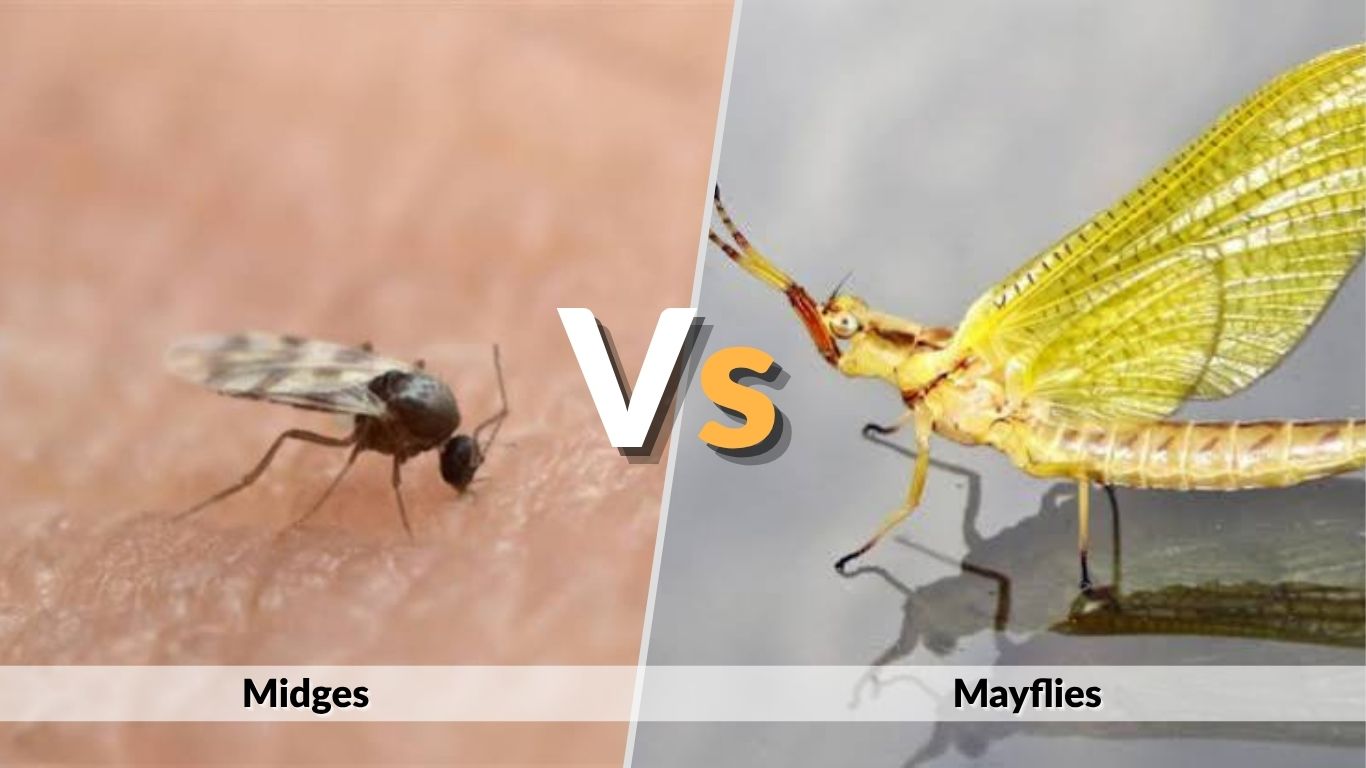
Midges and mayflies are small flying insects commonly found near lakes, rivers, ponds, and streams. Both can emerge from water in large numbers and gather around outdoor lights, so they are often mistaken for each other. However, midges are mosquito-like flies with one pair of wings and no tail filaments, while mayflies have upright wings and two or three long tails. Their aquatic young, life cycles, behavior, and environmental importance also differ.
What Is the Main Difference Between Midges and Mayflies?
The easiest way to tell them apart is to examine their wings and tails. Adult midges have one functional pair of wings and resemble mosquitoes. Adult mayflies normally have two pairs of wings held upright over the body and two or three long tail filaments.
| Feature | Midge | Mayfly |
| Insect order | Diptera | Ephemeroptera |
| Adult shape | Mosquito-like | Slender with long tails |
| Wings | One pair | Two pairs |
| Resting wing position | Flat or angled over body | Held upright |
| Tail filaments | None | Two or three |
| Aquatic young | Worm-like larva | Legged nymph |
| Biting | Most aquatic midges do not bite | Does not bite |
| Adult lifespan | Usually several days or longer | Often hours to a few days |
| Main activity | Swarming and mating | Mating and egg laying |
Midge Identification
The term “midge” can describe several families of small flies, but aquatic comparisons usually involve non-biting midges in the family Chironomidae. Adults are generally between 1/16 and 1/2 inch long and may be tan, greenish, gray, brown, or nearly black.
What Do Midges Look Like?
- Slender, mosquito-like body
- One pair of narrow wings
- Long, delicate legs
- No tail filaments
- Short mouthparts that do not pierce skin
- Males often have feathery antennae
- Frequently rest with the front legs raised
- May gather in large mating swarms
Non-biting midges are commonly active around dawn and dusk and are strongly attracted to lights. Large numbers may be annoying, but they do not damage buildings or harm people.
Mayfly Identification
Mayflies belong to the order Ephemeroptera. Adults have slender bodies, delicate wings, and obvious tail filaments extending from the abdomen. Their large front wings are usually held vertically when the insect rests, while the hind wings are much smaller or absent in some species.
What Do Mayflies Look Like?
- Slender, soft body
- Two or three long tails
- Large triangular front wings
- Small hind wings in most species
- Wings held upright while resting
- Short antennae
- Large eyes, especially in males
- Usually pale yellow, tan, brown, gray, or olive
Mayflies cannot fold their wings flat across the abdomen in the same manner as most flies. Their upright wings and long tails make adults relatively easy to separate from midges.
Midge Larvae vs. Mayfly Nymphs
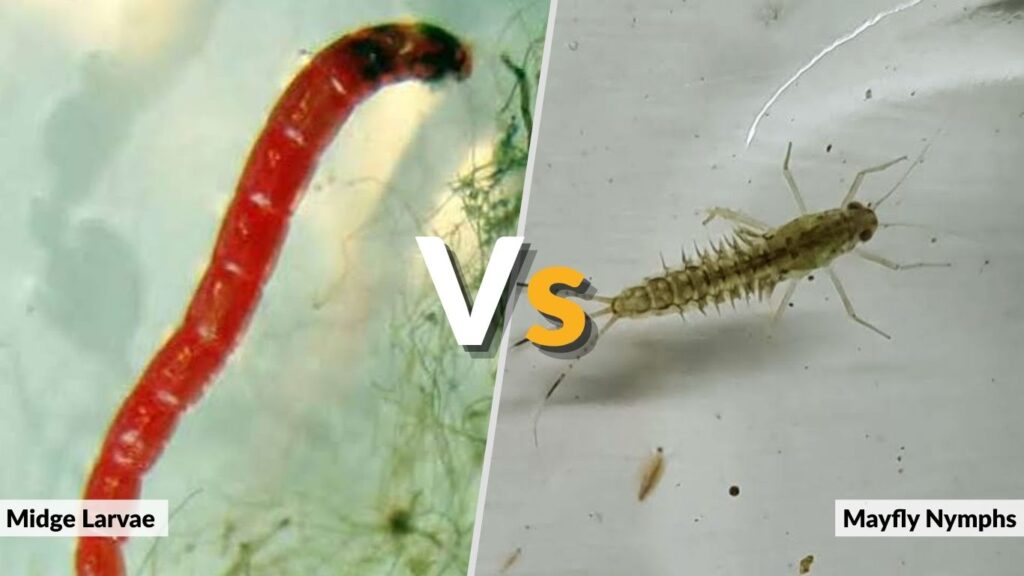
Both insects spend their immature stages in water, but their young look completely different.
Midge Larvae
Midge larvae are narrow, worm-like animals with defined head capsules. They do not have the six long walking legs seen on mayfly nymphs, although small prolegs may occur near the front and rear of the body.
Some species are red and commonly called bloodworms. Their reddish color comes from hemoglobin-like pigments that help them survive in water or sediment containing relatively little oxygen.
Chironomid larvae generally measure about 2–20 mm and occur in ponds, wetlands, streams, temporary pools, and other wet habitats.
Mayfly Nymphs
Mayfly nymphs resemble small, wingless insects rather than worms. They have six legs, developing wing pads, external abdominal gills, and usually three tails, although some species have two.
They may crawl over plants, cling to rocks, swim through pools, or burrow into soft sediment. Their body shape reflects the habitat in which they live.
Habitat Differences
Both groups depend on aquatic environments during development, but midges tolerate a wider variety of conditions.
Midge larvae occur in nearly every type of aquatic habitat, including lakes, rivers, wetlands, temporary pools, plant-held water, and organically rich sediment. Many consume algae and decomposing material, while some species are predators.
Mayfly nymphs live in freshwater streams, rivers, lakes, and ponds. Many species are associated with clean, well-oxygenated water, although pollution tolerance differs among families and species. Mayflies are frequently included in biological surveys because changes in their abundance and diversity can help reveal water-quality conditions.
What Do Midges and Mayflies Eat?
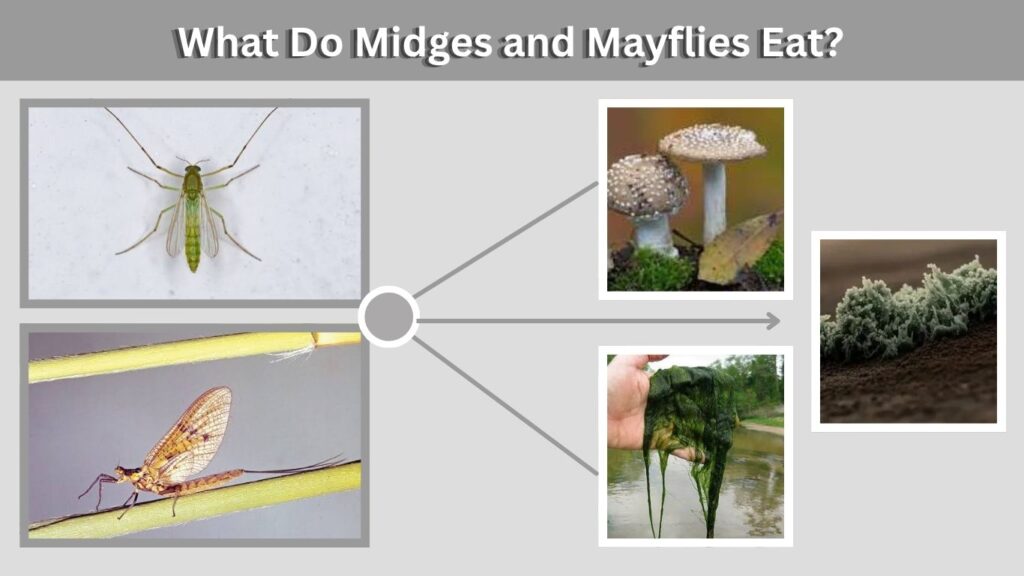
Midge larvae usually consume algae, bacteria, fungi, decaying plants, and organic particles within sediment. Some filter food from water, while predatory species capture smaller aquatic animals. They are an important connection between microscopic food sources and fish or other predators.
Mayfly nymphs mainly scrape algae from rocks or collect decomposing plant material and fine organic debris. A smaller number are predatory. Adult mayflies have reduced digestive systems and generally eat little or nothing during their brief winged lives.
Adult non-biting midges may feed on nectar or other sugary liquids, although their primary adult activities are mating and laying eggs.
Life Cycle Comparison
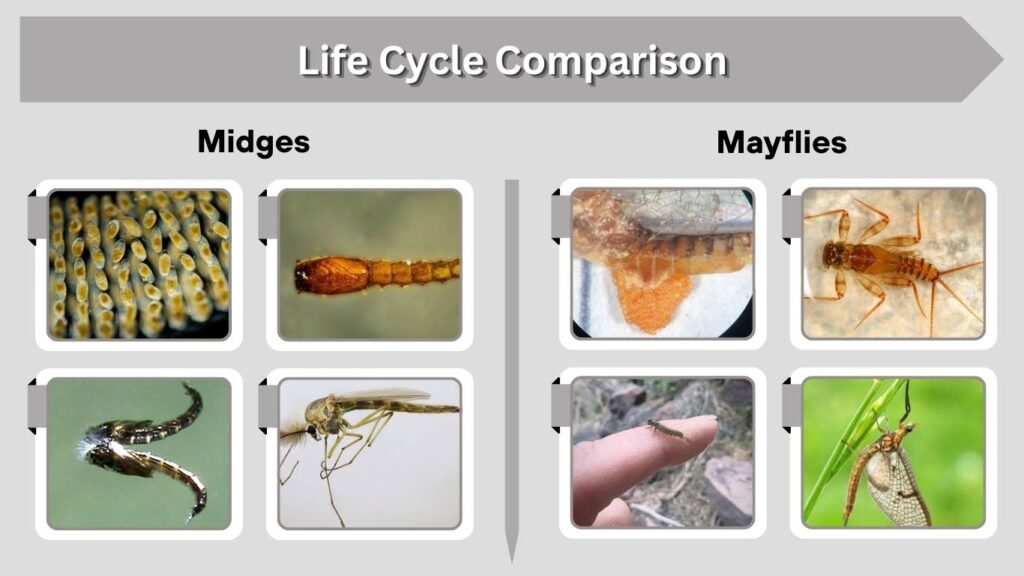
Midges undergo complete metamorphosis:
Egg → larva → pupa → adult
Females lay eggs on or near water. The larvae grow underwater, pupate, and then rise to the surface as adults. Several generations may occur during favorable weather.
Mayflies undergo incomplete metamorphosis but have an unusual extra winged stage:
Egg → nymph → subimago → adult
The aquatic nymph rises toward the surface and molts into a winged subimago, called a dun by anglers. It later molts again into the mature adult or imago. Mayflies are the only living insects known to molt again after developing functional wings.
Do Midges or Mayflies Bite?
Most midges encountered in large swarms near water are non-biting chironomids. They resemble mosquitoes but lack the piercing mouthparts needed to take blood.
However, “midge” is a broad common name, and biting midges belong to a different family. Identification is therefore important before assuming that every tiny fly is harmless.
Mayflies do not bite or sting. Adult mouthparts are reduced, and the insects are focused almost entirely on mating and reproduction.
Midge Swarms vs. Mayfly Hatches
Male midges often form compact swarms above lawns, shorelines, roads, trees, or other visual markers. Females enter the swarm to mate. These clouds may remain in one area and appear to move up and down.
Mayfly hatches usually involve large numbers emerging from a lake or river within a short period. Adults may cover buildings, bridges, boats, roads, and lights. Unlike compact midge mating swarms, mayfly events often produce widespread accumulations of insects and shed exoskeletons.
Neither event normally indicates a household infestation because both insects developed outdoors in water.
Midges vs. Mayflies in Fly Fishing
Both are important foods for trout and other freshwater fish.
Midge fly patterns are generally very small and imitate slender larvae, pupae, or tiny adults. They are especially useful when few larger insects are active.
Mayfly patterns imitate nymphs, emerging duns, winged adults, or spent spinners. Mayfly nymphs often have visible tails and more defined legs, while midge larvae are usually represented by simple, thin, segmented bodies.
Fish may feed heavily on either insect, so anglers should observe the size, shape, color, and stage of the natural insects before choosing a fly.
Midges vs. Mayflies vs. Mosquitoes
| Feature | Midge | Mayfly | Mosquito |
| Wings | One pair | Two pairs | One pair |
| Long tails | No | Yes | No |
| Long biting proboscis | No in non-biting species | No | Present in females |
| Antennae | Often feathery in males | Short | Feathery in males |
| Resting wings | Over body | Upright | Angled over body |
| Aquatic young | Worm-like | Legged nymph | Larva with no true legs |
Non-biting midges are most easily confused with mosquitoes. Looking for a long proboscis, body posture, antenna shape, and biting behavior can help separate them.
FAQs
Are midges smaller than mayflies?
Midges are generally smaller and more delicate, although size ranges overlap. Some midges reach about half an inch, while mayflies range from very small species to adults over an inch long. Wings and tails provide more reliable identification than size alone.
Why are midges and mayflies attracted to lights?
Artificial lights interfere with their natural orientation and attract large numbers of adults after emergence. Buildings close to productive lakes, rivers, and wetlands usually experience the largest gatherings.
Do midges and mayflies live in the same water?
They can occur in the same lake, river, or stream. Midges generally tolerate a broader range of oxygen levels and sediment conditions, while many mayfly species favor cleaner, well-oxygenated freshwater.
Which insect has three tails?
Mayfly adults and nymphs usually have three tail filaments, although some species have two. Midges never have long tails extending from the abdomen.
Are midges or mayflies harmful?
Non-biting midges and mayflies are harmless to people, pets, buildings, and plants. They may create temporary nuisance swarms, but they are valuable food for fish, birds, bats, and other wildlife.