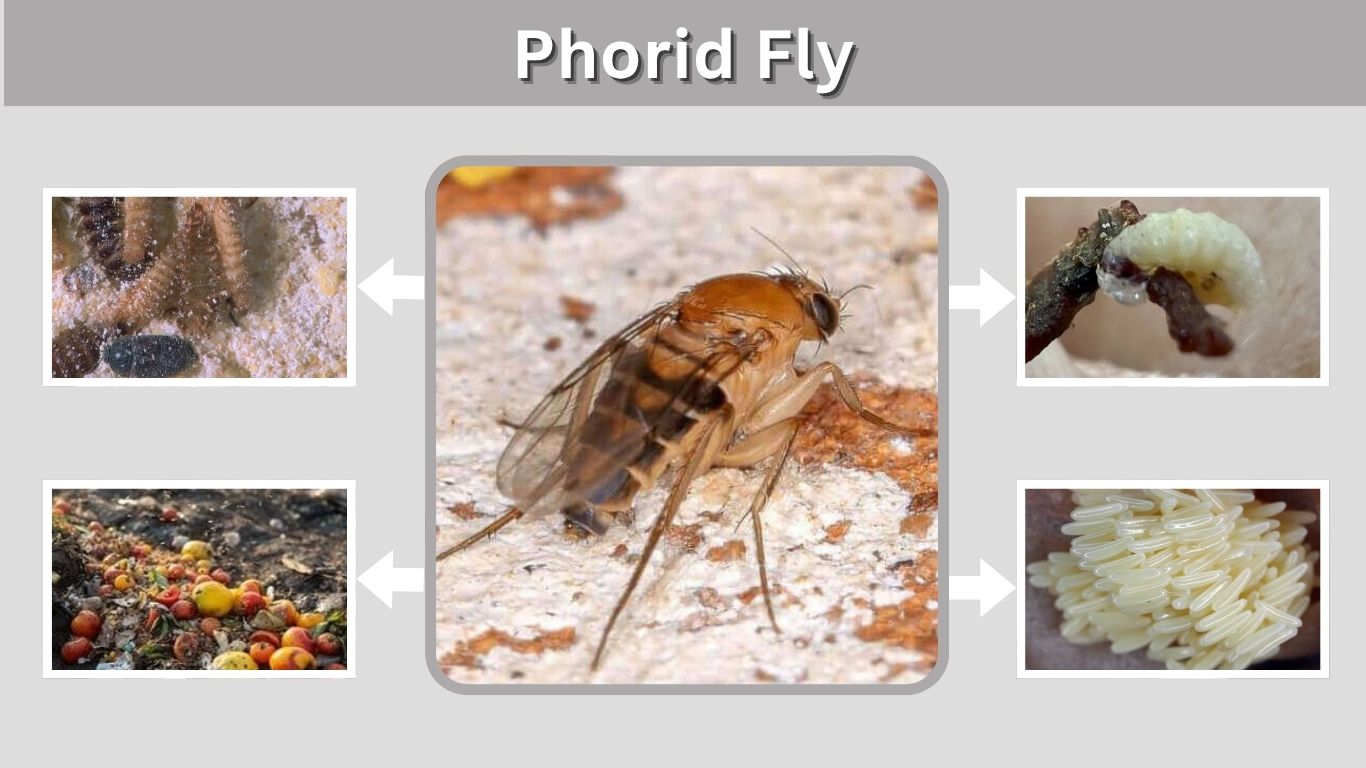
The phorid fly is a tiny, humpbacked fly commonly found around decaying organic matter, garbage, drains, sewage leaks, and spoiled food. Often called a scuttle fly, it is recognizable by its habit of rapidly running across surfaces before flying. Household infestations can be difficult to eliminate because larvae may develop in hidden sources such as plumbing leaks or contaminated soil beneath floors. This guide explains phorid fly identification, size, eggs, larvae, life cycle, traps, health concerns, and effective ways to eliminate an infestation.
What Is a Phorid Fly?
Phorid flies belong to the family Phoridae, which contains thousands of species with remarkably diverse lifestyles. One common household species is Megaselia scalaris. Some phorids feed on decomposing material, while others are parasites of insects such as ants. Household species become pests when they find moist organic material suitable for laying eggs and raising larvae.
Phorid Fly Identification
Look for these characteristics:
- About 1/16–1/8 inch long
- Brown, tan, yellowish, or dark body
- Distinctive humpbacked thorax
- Dark rather than bright-red eyes
- Small head
- Clear wings with relatively few veins
- Rapid, jerky running behavior
- Often runs before taking flight
This unusual running behavior explains the name scuttle fly. The University of Minnesota describes household phorids as roughly 1/8 inch long with a conspicuous hump and erratic running movements.
How Big Is a Phorid Fly?
Most household phorid flies are only a few millimeters long. Megaselia scalaris is typically around 1/16–1/8 inch, making it comparable in size to a fruit fly.
Their small size allows them to enter tiny cracks and makes identifying them without magnification difficult.
Where Do Phorid Flies Come From?
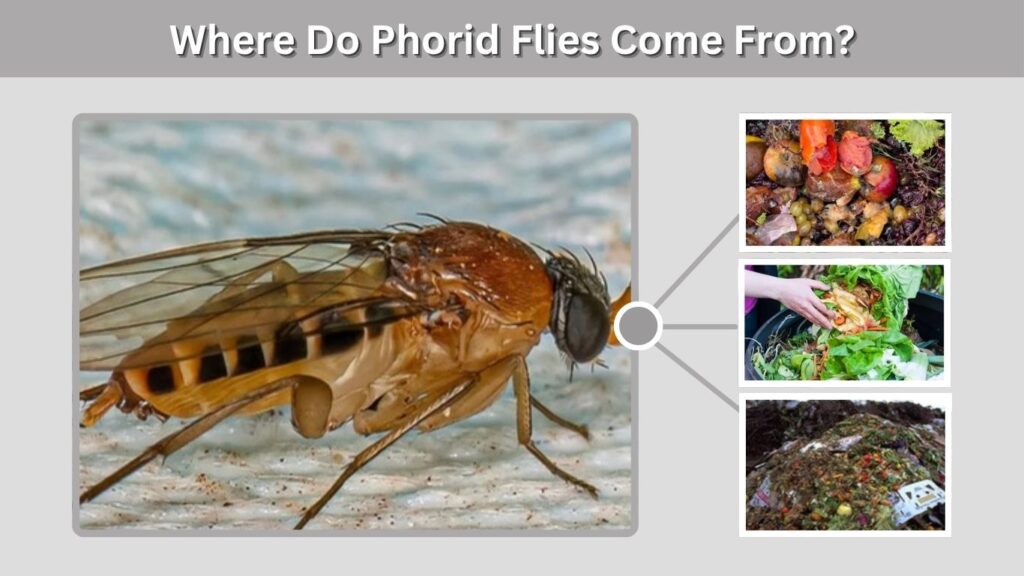
Phorid flies reproduce wherever they can find moist, decaying material. Sometimes the source is obvious, such as rotting vegetables. More serious infestations can originate from broken wastewater pipes beneath a building, where sewage-contaminated soil provides enormous amounts of breeding material.
Common Breeding Sources
Check areas containing:
- Rotting fruit or vegetables
- Garbage and food residue
- Dirty garbage disposals
- Organic buildup in drains
- Pet waste or dirty litter boxes
- Dead rodents or other animals
- Refrigerator drip pans
- Moist material beneath appliances
- Sewage leaks
- Broken drainpipes
- Contaminated soil beneath floors
Phorid flies do not build a conventional nest. When people refer to a phorid fly nest, they usually mean the moist breeding material where females are laying eggs and larvae are feeding.
Phorid Fly Eggs and Larvae
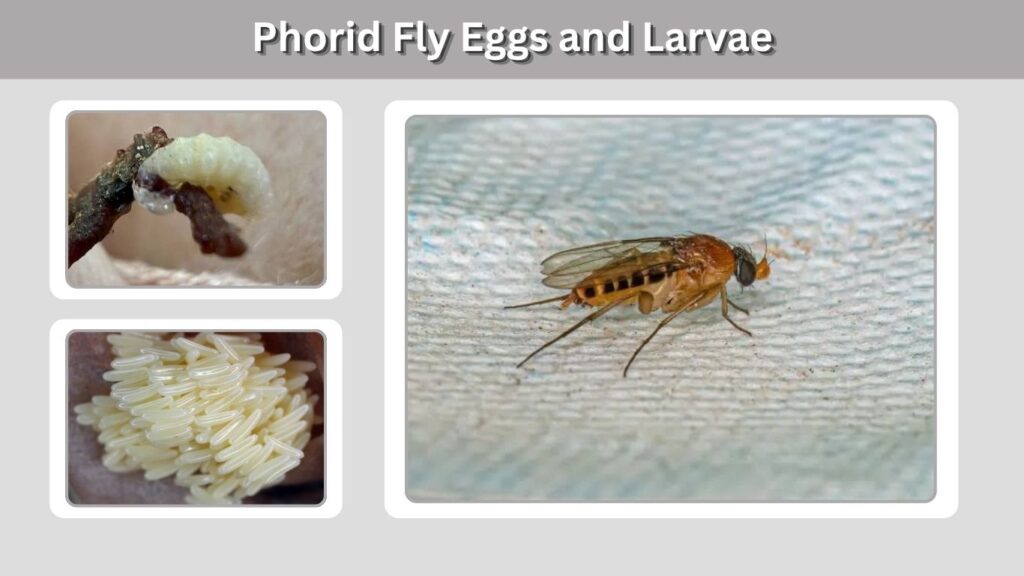
Removing adults without addressing eggs and larvae rarely solves an infestation. Females are attracted to odors from decomposing organic material and deposit their eggs where newly hatched larvae will immediately have access to food.
What Do Phorid Fly Eggs Look Like?
Phorid fly eggs are extremely small and normally difficult to notice without magnification. Depending on the species, they are generally pale and elongated or oval.
They can be hidden in:
- Decaying food
- Sewage
- Animal waste
- Wet organic residue
- Fungal material
- Other decomposing substances
Because the eggs are so small, finding them is less useful than locating and eliminating the material where they were deposited.
What Do Phorid Fly Larvae Look Like?
Phorid larvae are tiny maggot-like organisms. They are generally pale, cream-colored, or nearly transparent when young.
The larvae lack legs and feed directly inside the breeding material. Depending on the species, food can include decomposing vegetation, animal matter, fungi, sewage, or other organic substances.
Eventually, the mature larva stops feeding and changes into a pupa before the adult fly emerges.
Phorid Fly Life Cycle
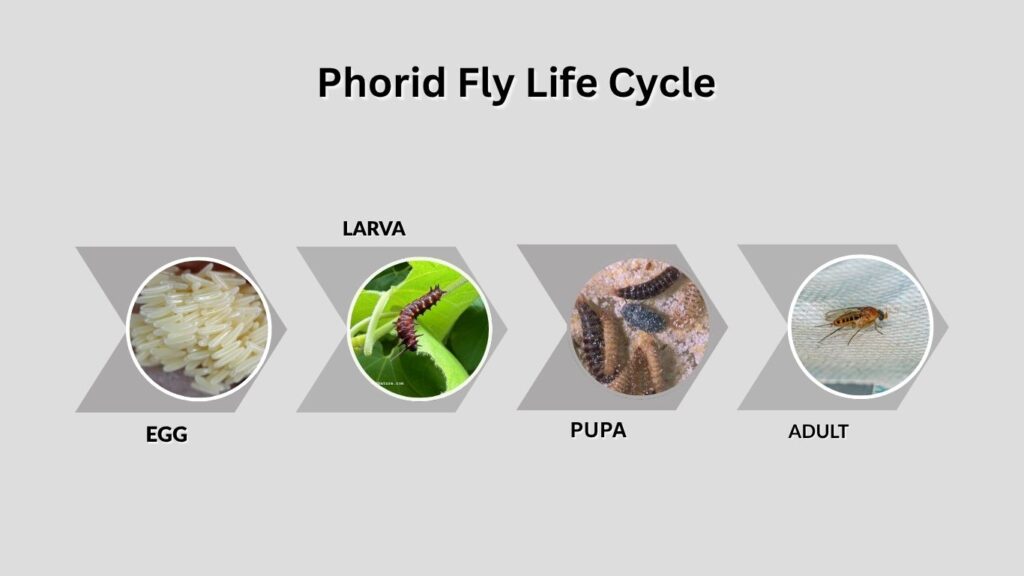
Phorid flies undergo complete metamorphosis through four stages: egg, larva, pupa, and adult. Development time varies substantially among species and with temperature, food, and moisture. A commonly encountered household species can complete its entire egg-to-adult development in roughly two to five weeks under suitable conditions.
Four Life Cycle Stages
The cycle consists of:
- Egg: Deposited in suitable organic material.
- Larva: Maggot feeds and grows.
- Pupa: The insect transforms inside a protective pupal case.
- Adult: Adults mate, and females search for new egg-laying sites.
For comparison, the specialized mushroom phorid Megaselia halterata completes egg-to-adult development in around 25–30 days at about 70°F. Development is strongly influenced by temperature.
Phorid Fly vs Fruit Fly
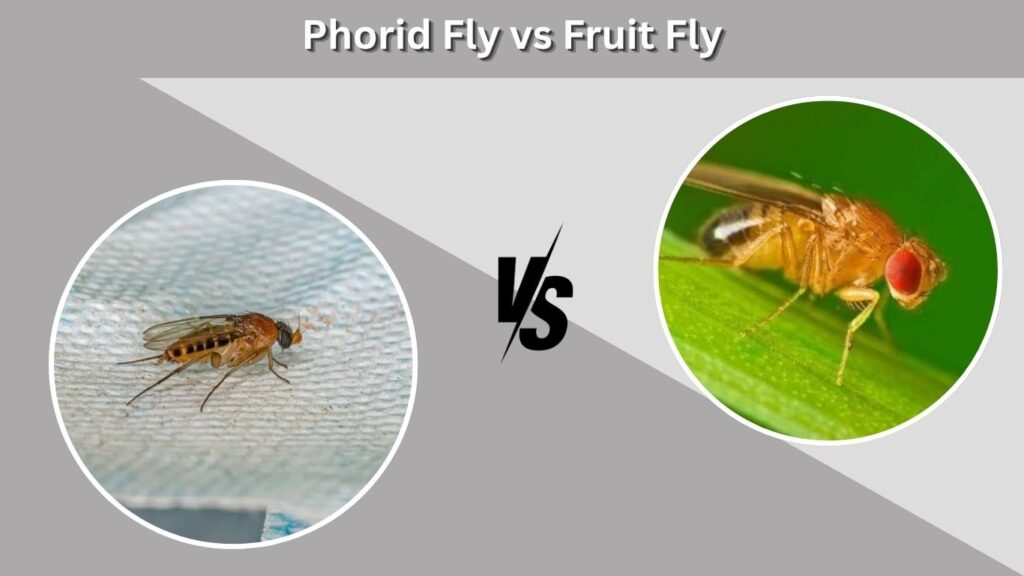
Fruit flies and phorid flies are easy to confuse because both are tiny and occur around food. However, their appearance and behavior provide several useful identification clues.
Main Differences
Phorid fly:
- Strongly humpbacked profile
- Usually dark eyes
- Frequently runs across surfaces
- Can breed in sewage and decomposing animal material
- Often associated with hidden plumbing problems
Fruit fly:
- Usually lacks the pronounced hump
- Many common species have red or reddish eyes
- Frequently hovers around fruit and drinks
- Strongly associated with fermenting produce
- Often breeds around sugary or yeasty food residue
If tiny flies repeatedly run across countertops instead of simply hovering around fruit, phorid flies become a stronger possibility.
Phorid Fly vs Drain Fly and Fungus Gnat
Phorid flies are also confused with drain flies and fungus gnats. All three can occur indoors, but their appearance and preferred breeding habitats differ considerably.
How to Tell Them Apart
Drain flies have fuzzy bodies and broad, hairy, moth-like wings. Their larvae commonly develop inside gelatinous organic buildup in drains.
Fungus gnats have slender mosquito-like bodies, long legs, and long antennae. Their larvae commonly live in continuously moist potting soil.
Phorid flies have compact humpbacked bodies and characteristically run or scuttle across surfaces.
Finding the correct insect is important because treating houseplant soil will not eliminate a phorid population breeding beneath a leaking sewer pipe.
Do Phorid Flies Bite?
Phorid flies are not normally considered biting household flies. Their presence is primarily a nuisance and sanitation concern rather than a biting problem.
Are Phorid Flies Dangerous?
Household phorids may contact decomposing organic matter, so sanitation is important. University of Minnesota Extension notes that they can potentially mechanically carry bacteria, although they are generally considered nuisance insects rather than a major health threat.
Rare medical reports have involved larvae of Megaselia scalaris in human myiasis, but this is very different from ordinary phorid flies flying around a kitchen. Penn State notes that cases involving M. scalaris have been documented, including wound-related myiasis.
What If Phorid Fly Eggs Are Accidentally Ingested?
Accidentally swallowing a tiny amount of contaminated food does not mean a person will automatically develop an infestation.
However, rare cases of intestinal myiasis involving Megaselia have been documented in medical literature. Intestinal myiasis can occur when viable fly eggs or larvae in contaminated food survive passage through the digestive system, but it is uncommon.
Someone with persistent unexplained gastrointestinal symptoms or visible larvae in stool should seek medical evaluation rather than trying to diagnose the species at home.
How to Get Rid of Phorid Flies
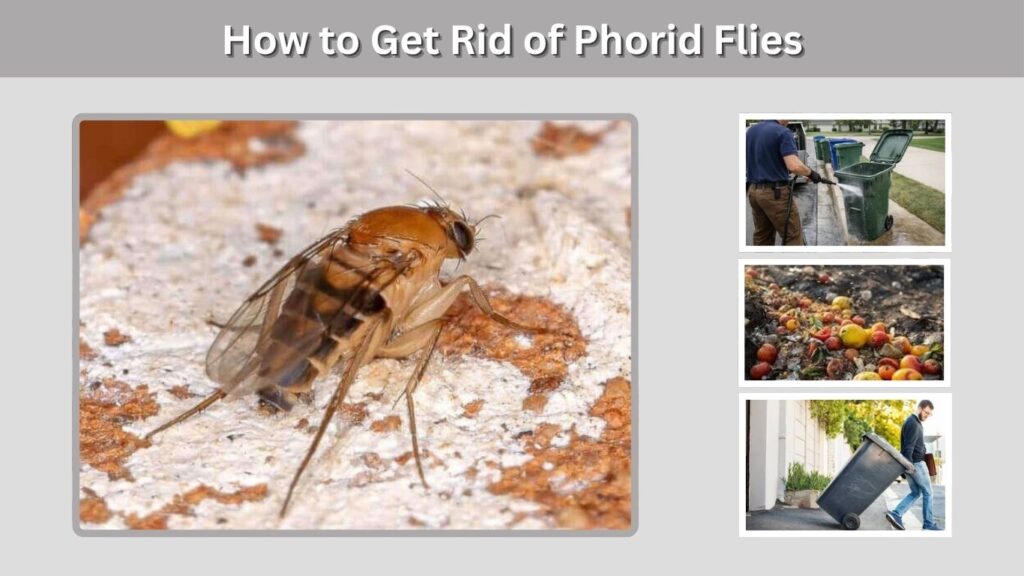
Successful control depends overwhelmingly on finding the larval breeding site. Spraying adults may reduce visible flies for a short time but does not stop eggs and larvae already developing elsewhere.
Best Phorid Fly Control Methods
Start by:
- Discarding rotting food.
- Clean garbage containers.
- Wash recycling bins.
- Clean beneath refrigerators and appliances.
- Remove pet waste promptly.
- Clean garbage disposals.
- Investigate drains.
- Repair leaking plumbing.
- Look for dead animals.
- Check beneath floors if sewage odors are present.
Mississippi State Extension emphasizes that insecticides are usually of little value unless the breeding source is eliminated. Severe infestations associated with broken sewer lines can continue until the plumbing defect and contaminated material are corrected.
Phorid Fly Traps
Traps are useful for monitoring and temporarily reducing adults, but they should support source elimination rather than replace it.
DIY Phorid Fly Trap
Sticky cards placed where flies are active can help determine which rooms have the greatest activity.
Small baited traps may capture some adults attracted to fermenting material, but their effectiveness varies because phorid species respond differently to odors.
Use traps primarily to monitor whether numbers are declining after sanitation and repairs.
If hundreds of new flies continue appearing, the hidden breeding source remains active.
Does Drain Cleaner Kill Phorid Flies?
A drain cleaner can help only when the flies are actually breeding in organic material associated with that drain.
Biological Drain Cleaners
Microbial or enzyme-based cleaners can help digest accumulated organic matter rather than simply killing exposed adults. Mississippi State Extension recommends microbial cleaners for eliminating decomposing residue in drains and crevices in settings such as commercial kitchens.
However, no drain cleaner will fix a broken sewer pipe beneath a concrete slab. Persistent phorid flies accompanied by wastewater odors may require professional plumbing inspection.
Phorid Flies and Fire Ants
Not every phorid fly is a household pest. Some species in the genus Pseudacteon are specialized parasites of ants.
Parasitic Phorid Flies
Female Pseudacteon flies attack fire ants and deposit eggs associated with their hosts. The larvae develop as parasitoids, ultimately killing the ant.
Several species have been deliberately introduced in the southeastern United States as biological-control agents against imported fire ants.
These ant-parasitizing species should not be confused with household phorid flies breeding in garbage or sewage.
FAQs
Do phorid flies bite humans?
No. Household phorid flies are not normally considered biting flies. Their primary importance is as nuisance insects associated with decomposing organic material.
How long do phorid flies live?
Longevity varies by species and environmental conditions. Development from egg to adult can take roughly 14–37 days in common household phorids, while adult longevity also varies considerably.
What is the best phorid fly trap?
Sticky traps are useful for monitoring adults, but there is no trap that substitutes for eliminating the breeding site. Source removal provides the most effective long-term control.
Why do phorid flies keep coming back?
Persistent flies usually mean eggs and larvae are still developing in hidden organic material, sewage, decaying food, waste, or another breeding source.
Can pest control eliminate a phorid fly infestation?
Yes, but successful extermination requires locating the source. When sewage or plumbing problems are involved, a pest professional may need to work alongside a plumber to permanently stop the infestation.