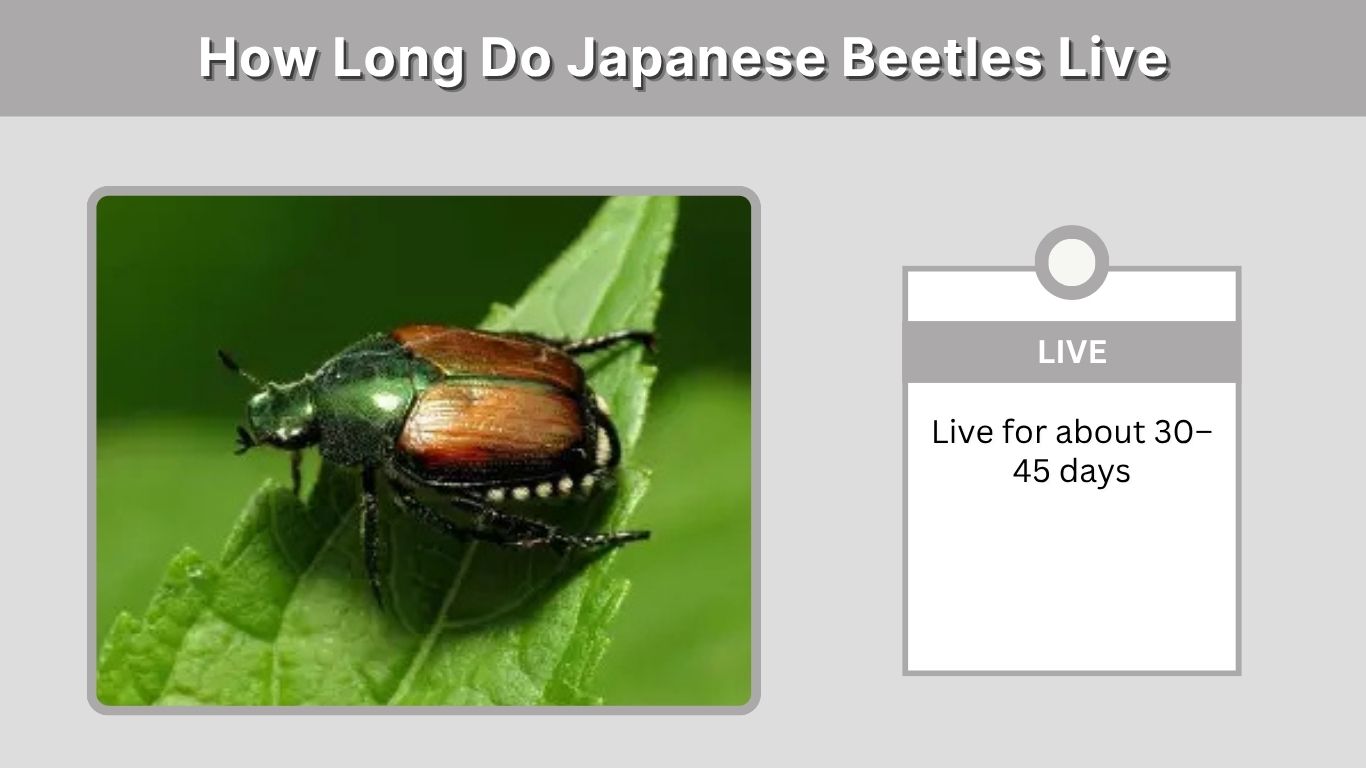
Adult Japanese beetles usually live for about 30–45 days, although some may survive for up to two months under favorable conditions. Their adult life is brief, but the complete life cycle typically lasts about one year. Most of that time is spent underground as a white grub. Temperature, moisture, food availability, predators, and pesticide exposure can all affect survival. Understanding each life stage helps gardeners predict when beetles will appear and choose the right time to protect plants or manage lawn grubs.
How Long Do Adult Japanese Beetles Live?
An adult Japanese beetle generally lives for approximately four to six weeks. During this period, it feeds, mates, and lays eggs. Individual lifespan varies according to environmental conditions and access to suitable plants.
Adults usually emerge from the soil in early to midsummer. In many regions, activity peaks from late June through August, although emergence may begin earlier or later depending on local temperature and climate.
Factors That Affect Adult Lifespan
Several conditions can shorten or extend the life of an adult Japanese beetle:
- Availability of suitable host plants
- Temperature and humidity
- Drought or heavy rainfall
- Predators and parasites
- Pesticide exposure
- Physical injury
- Access to moisture
- Competition with other beetles
Warm summer weather supports feeding and reproduction. However, extremely hot, dry conditions may reduce plant quality and shorten survival.
How Long Is the Japanese Beetle Life Cycle?
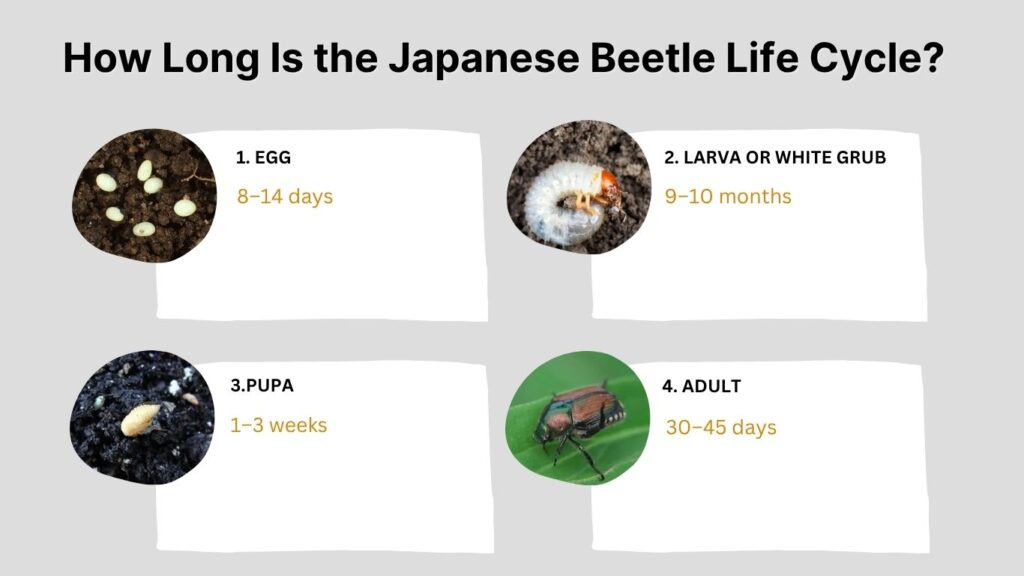
Although adults live for only a few weeks, the complete Japanese beetle life cycle normally takes approximately one year. Most Japanese beetles produce one generation annually.
| Life stage | Approximate duration |
| Egg | 8–14 days |
| Larva or white grub | 9–10 months |
| Pupa | 1–3 weeks |
| Adult | 30–45 days |
| Complete life cycle | About one year |
The exact timing changes with soil temperature, moisture, latitude, and seasonal weather.
Egg Stage
After mating, a female burrows several inches into moist soil and deposits small groups of eggs. She may leave the soil to feed before returning to lay more eggs.
The eggs usually hatch within 8–14 days. Adequate soil moisture is important because eggs can dry out and die during severe drought.
A female may lay approximately 40–60 eggs during her adult life. However, she normally deposits them over several visits rather than laying every egg at once.
Larval Stage
Newly hatched larvae are commonly called white grubs. They have creamy white bodies, brown heads, and a curled C-shaped appearance.
The larvae feed on grass roots and organic material in the soil. This stage lasts much longer than any other part of the life cycle, generally continuing for nine or ten months.
Young grubs remain relatively close to the surface while feeding during late summer and early fall. As temperatures drop, they move deeper underground to avoid freezing conditions.
Winter Survival
Japanese beetles normally survive winter as partially developed grubs below the soil surface. They become largely inactive but do not necessarily remain completely motionless throughout the entire season.
When soil temperatures warm in spring, the grubs move closer to the surface and resume feeding on grass roots. Heavy infestations may cause sections of lawn to become yellow, brown, or loose enough to pull back like a carpet.
Pupal Stage
After completing their larval development, grubs create small chambers in the soil and transform into pupae. This stage commonly lasts between one and three weeks.
During pupation, the insect changes from a soft-bodied grub into an adult beetle with wings, legs, and hardened body coverings.
Adult Stage
New adults emerge from the soil during summer and begin feeding soon afterward. They gather on favored plants such as roses, grapes, raspberries, fruit trees, beans, linden trees, and ornamental flowers.
Adults spend their short lives feeding and reproducing. Damaged plants and feeding beetles release odors that may attract additional Japanese beetles, causing large groups to form on the same plant.
When Do Japanese Beetles Die?
Most adult Japanese beetles die by late summer or early fall. They do not normally survive through winter as adults.
Their seasonal decline may be caused by:
- Natural aging
- Cooler nighttime temperatures
- Reduced food quality
- Predation
- Disease
- Pesticide treatments
- Physical damage
- Dry environmental conditions
Even after the visible adult beetles disappear, their offspring may remain underground as grubs. Therefore, the end of adult activity does not mean the infestation has completely disappeared.
How Long Do Japanese Beetles Live Without Food?
There is no single dependable survival period for a Japanese beetle without food. Temperature, humidity, hydration, age, and physical condition all influence how long an individual can survive.
An adult deprived of food may survive for several days, especially in cool and humid conditions. However, it will usually become weak and die sooner than a beetle with access to leaves, flowers, or fruit.
Food deprivation is not a practical garden-control strategy because Japanese beetles can fly between properties and feed on hundreds of plant species. Removing one favored plant may simply cause them to move to another nearby host.
Can Japanese Beetles Live Without Water?
Japanese beetles obtain much of their moisture from the plants they eat. They do not normally need a separate source of standing water.
However, dry conditions can reduce their survival by dehydrating both the beetles and their food plants. Soil moisture is particularly important for eggs and young grubs.
How Long Do Japanese Beetles Stay on Plants?
A beetle may remain on a suitable plant for hours or return repeatedly over several days. Large groups often feed on the upper leaves and flowers during warm, sunny weather.
They may become less active during cool mornings, evenings, rain, or strong wind. This is why early morning is often the easiest time to remove them by hand. Beetles can be knocked into a container of soapy water before they become warm enough to fly quickly.
How Many Generations Occur Each Year?
Japanese beetles usually complete one generation per year. Adults that appear during summer developed from eggs laid the previous year.
The basic annual pattern is:
- Adults emerge and mate during summer.
- Females lay eggs in the soil.
- Eggs hatch into white grubs.
- Grubs feed during late summer and fall.
- Grubs overwinter underground.
- Feeding resumes in spring.
- Grubs pupate and emerge as adults.
This predictable cycle allows gardeners to target adults during summer and grubs during the appropriate soil-treatment period.
Why Japanese Beetle Infestations Seem to Last So Long
An individual adult may live for only a month, but not every beetle emerges on the same day. New adults can continue appearing from the soil for several weeks.
As a result, a garden may experience visible activity for six to eight weeks or longer. Early-emerging beetles may die while newly emerged adults continue feeding.
Japanese beetles can also fly into a yard from surrounding properties. Treating one lawn will not necessarily prevent adults from arriving from nearby fields, gardens, parks, or untreated lawns.
Japanese Beetles vs. Other Beetles
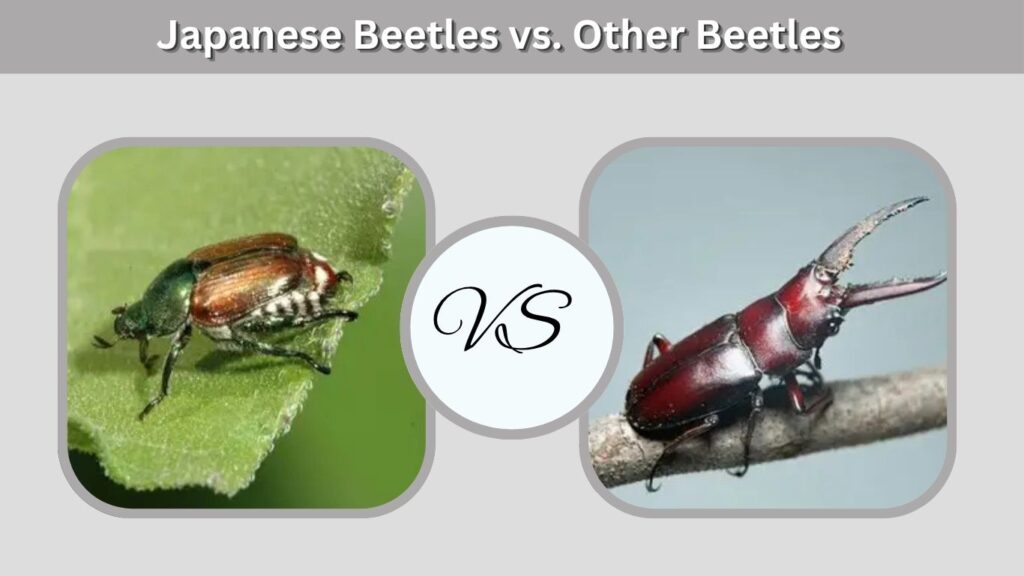
Several unrelated insects have similar common names, but their lifespans and habits are different.
Asian Lady Beetles
The phrase “Japanese lady beetle” is often used incorrectly for the multicolored Asian lady beetle. This is a small, rounded beneficial predator that feeds mainly on aphids. It is not the same insect as the plant-eating Japanese beetle.
Japanese Rhinoceros Beetles
Japanese rhinoceros beetles are much larger and have prominent horns. Their adult lifespan is commonly only a few months, while their immature development takes considerably longer.
Japanese Stag Beetles
Japanese stag beetles have large jaws, particularly in males. Their life cycle and care requirements differ from those of Japanese beetles, which are metallic green insects with copper-colored wing covers.
FAQs
What is the average lifespan of a Japanese beetle?
An adult Japanese beetle normally lives for approximately 30–45 days. Some individuals may survive for up to two months under favorable conditions. Its complete life cycle lasts about one year because it spends most of its life underground as a larva.
How long do Japanese beetles remain active in summer?
Japanese beetle activity usually continues for six to eight weeks. However, an individual beetle lives for only part of that period. The season seems longer because adults emerge at different times and additional beetles may fly into the garden.
Do adult Japanese beetles survive the winter?
No. Adult Japanese beetles generally die by late summer or early fall. The species survives winter mainly as white grubs beneath the soil, where the larvae remain protected until temperatures rise and feeding resumes in spring.
How long can Japanese beetles live without food?
An exact period has not been firmly established because survival depends on temperature, humidity, hydration, and beetle health. An adult may survive for several days without eating, but it generally becomes weak and dies sooner than a beetle with access to plants.
Do Japanese beetles come back every year?
They may return annually when local conditions support their development. Grubs overwinter underground and become adults the following summer. Additional adults can also fly into the area from neighboring lawns, gardens, fields, or parks.