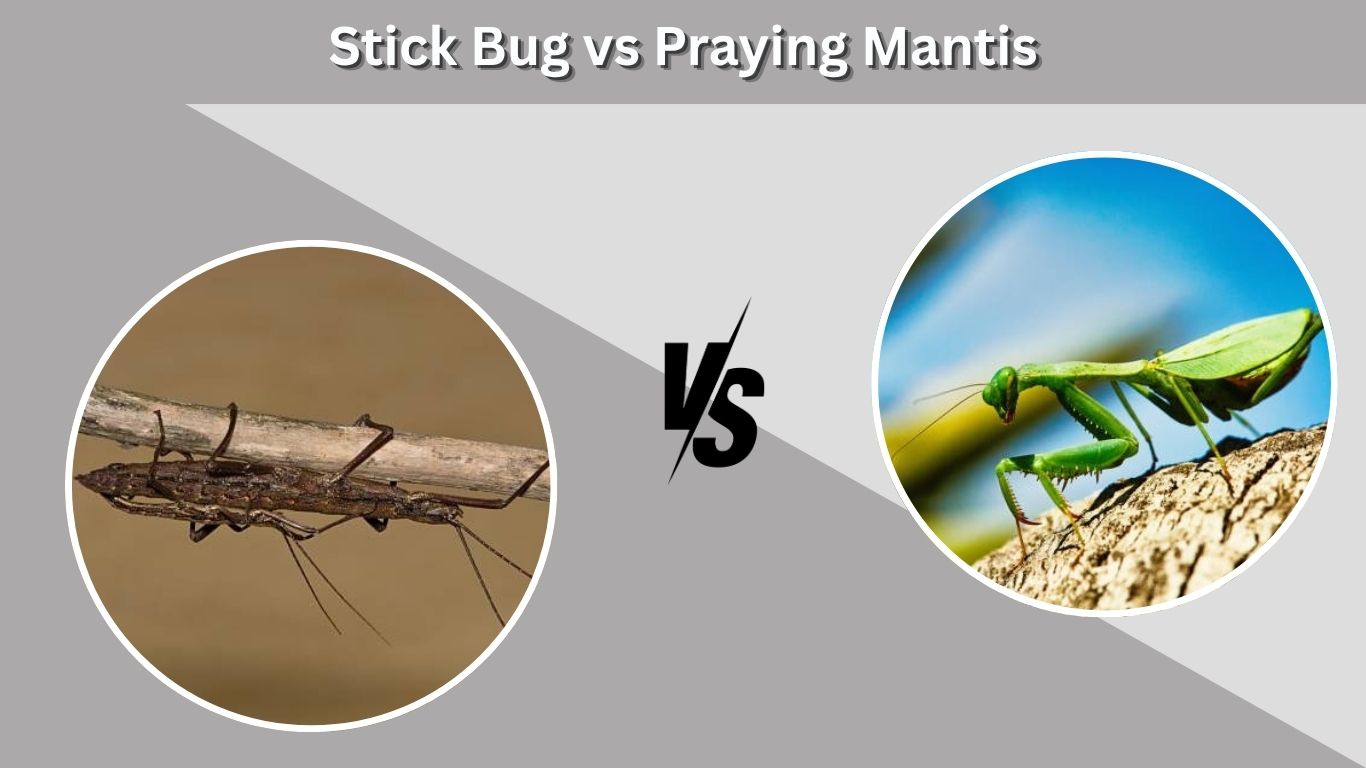
A stick bug vs praying mantis comparison can be confusing because both insects have long bodies, thin legs, and excellent camouflage. However, they belong to different insect groups and live very different lifestyles. Stick bugs are peaceful herbivores that mainly eat leaves, while praying mantises are predators equipped with powerful front legs for catching prey. They also differ in head shape, movement, defense, diet, and hunting behavior. This guide explains how to identify each insect and quickly tell a walking stick from a praying mantis.
Stick Bug vs Praying Mantis: Quick Comparison
Stick bugs and praying mantises may appear similar from a distance, especially when resting on vegetation. Both can blend into branches and leaves, but their anatomy and behavior provide easy identification clues. Stick bugs usually resemble straight twigs, while mantises have triangular heads and distinctive folded front legs designed for capturing prey.
Main Differences
- Diet: Stick bugs eat plants; praying mantises eat animals.
- Front legs: Stick bugs have normal walking legs; mantises have grasping forelegs.
- Head: Stick bugs generally have small heads; mantises have broad triangular heads.
- Body: Stick bugs resemble twigs; mantises have more angular bodies.
- Behavior: Stick bugs rely heavily on camouflage; mantises actively hunt.
- Movement: Stick bugs often move slowly; mantises can strike extremely quickly.
- Temperament: Stick bugs are generally passive; mantises are predatory.
- Defense: Stick insects freeze or escape; mantises may display or strike.
These differences make identification much easier once you know what features to examine.
Appearance and Identification
Body shape is usually the fastest way to distinguish these insects. Walking sticks evolved to resemble twigs, stems, or leaves, allowing them to disappear visually among vegetation. Praying mantises also use camouflage, but their body is designed for ambush hunting. Their large eyes, flexible neck, and specialized front legs immediately separate them from true stick insects.
How to Identify a Stick Bug
Common stick bug identification features include:
- Long, narrow body
- Twig-like appearance
- Six relatively similar legs
- Small head compared with body
- Long antennae in many species
- Brown, green, gray, or tan coloration
- Slow, swaying movements
- No large grasping front legs
Some species have wings, spines, or leaf-like extensions.
Stick insects belong to the order Phasmatodea and include thousands of species ranging from tiny insects to some of the longest insects on Earth.
How to Identify a Praying Mantis
A praying mantis usually has a more recognizable predatory appearance. Its most noticeable feature is the pair of enlarged front legs that fold together in front of the body.
The head is triangular and highly mobile, allowing the mantis to turn and visually track prey. Large compound eyes provide excellent vision for hunting.
Mantises often have elongated bodies and may also resemble leaves, sticks, flowers, or bark depending on the species.
Stick Bug vs Praying Mantis Size
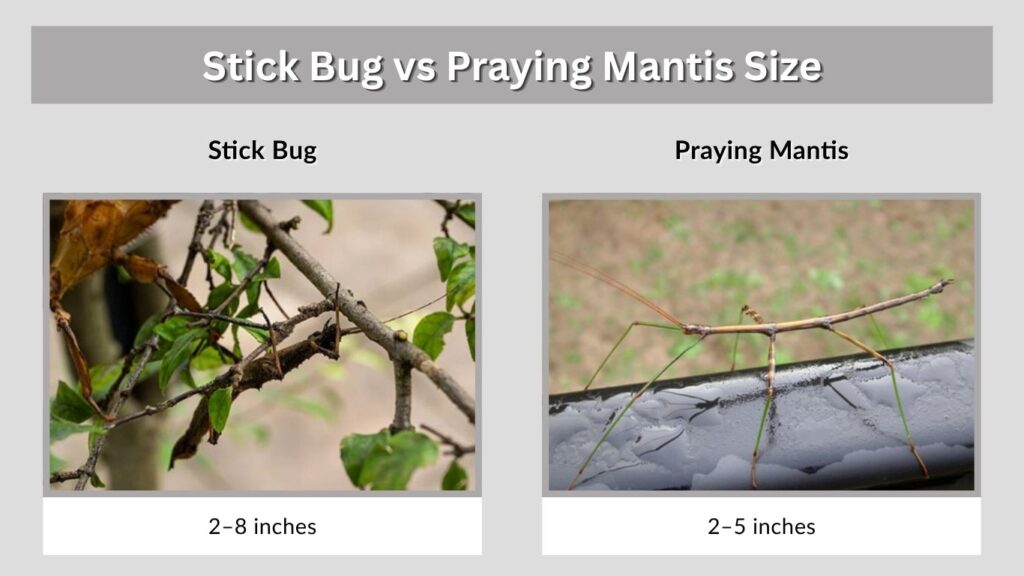
Both groups include species of dramatically different sizes. Some stick insects are only a few inches long, while giant tropical species can reach impressive lengths. Mantises are generally shorter overall, although many are thicker-bodied and more heavily built than walking sticks of similar length.
Typical Size Comparison
| Feature | Stick Bug | Praying Mantis |
| Typical length | 2–8 inches | 2–5 inches |
| Largest species | Can exceed 10 inches | Usually under 7 inches |
| Body shape | Very thin and elongated | Thicker and more angular |
| Front legs | Similar to other legs | Enlarged for catching prey |
| Overall appearance | Twig-like | Predatory and triangular |
Stick insects include some of the world’s longest insects when body and extended legs are considered.
However, length does not make them stronger predators because stick bugs do not hunt other animals.
Stick Bug vs Praying Mantis Diet
Diet represents one of the biggest differences between these insects. Stick bugs are herbivores, while praying mantises are carnivorous predators. Their mouthparts, movement, and overall behavior have evolved around these completely different feeding strategies.
What Do Stick Bugs Eat?
Walking sticks mainly consume leaves from trees, shrubs, and other vegetation.
Their diet can include:
- Oak leaves
- Bramble
- Rose leaves
- Eucalyptus
- Privet
- Blackberry leaves
- Other suitable foliage
The preferred food varies depending on the stick insect species.
They normally feed slowly, chewing along leaf edges during the evening or nighttime.
What Do Praying Mantises Eat?
Praying mantises actively hunt living prey.
Their diet may include crickets, flies, moths, grasshoppers, beetles, caterpillars, spiders, and other insects.
Large mantises may occasionally capture small vertebrates if the opportunity arises, although insects make up most of their natural diet.
A mantis waits quietly until prey comes within range, then launches its front legs forward in an extremely fast strike.
Behavior and Movement
Stick bugs and mantises both depend on remaining unnoticed, but they use camouflage for different purposes. Walking sticks primarily hide to avoid predators, whereas praying mantises hide both from predators and from the animals they intend to catch.
How Stick Bugs Behave
Stick bugs generally move slowly and deliberately.
Many sway their bodies from side to side while walking, possibly helping them resemble vegetation moving in the wind.
When threatened, they may:
- Remain completely motionless
- Drop to the ground
- Sway like a branch
- Spread their wings
- Kick with their legs
- Release defensive chemicals
- Shed a leg and escape in some circumstances
Most walking sticks prefer avoiding confrontation.
How Praying Mantises Behave
Praying mantises spend much of their time watching their surroundings and waiting for prey.
Their flexible neck allows the head to rotate far more freely than that of a stick bug.
When threatened, some mantises make themselves look larger by raising their wings, spreading their forelegs, or displaying bright colors hidden beneath their wings.
A large mantis may also strike or attempt to bite when handled roughly.
Which Is More Dangerous?
Neither insect normally presents a serious danger to people. However, a praying mantis has stronger jaws and more powerful front legs, so it is generally better equipped to defend itself physically. Stick bugs mostly depend on camouflage and escape, though a few species have strong defensive sprays or spiny legs.
Danger to Humans
A comparison of their defensive abilities includes:
- Stick bug bite: Very uncommon
- Mantis bite: Possible when threatened
- Stick bug sting: None
- Mantis sting: None
- Stick bug chemical defense: Present in some species
- Mantis grasping legs: Can pinch or scratch
- Serious danger to humans: Very low for both
Most encounters require no concern as long as the insects are left alone.
Stick Mantis vs Stick Bug
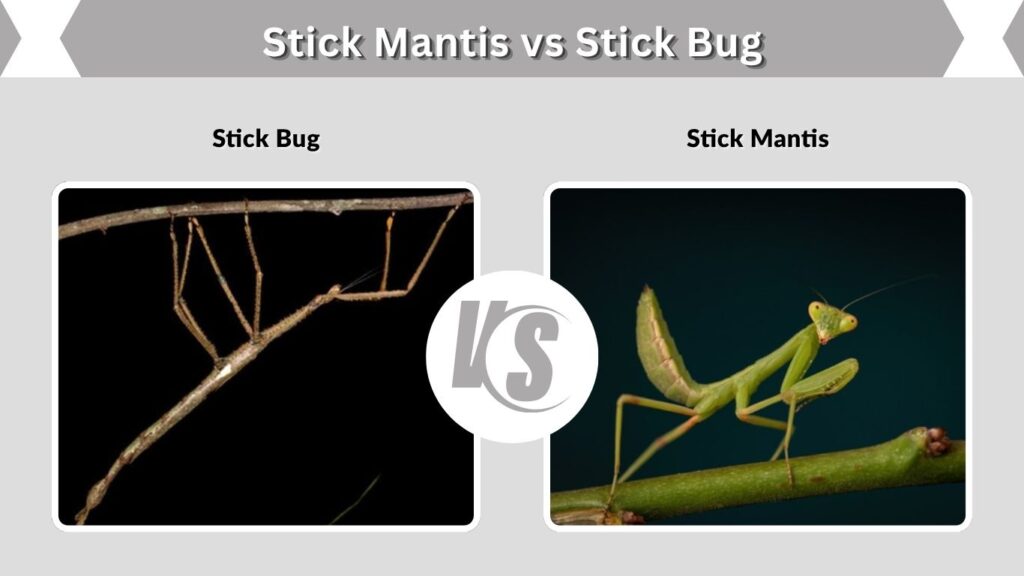
The term stick mantis can create additional confusion. Stick mantises are praying mantises that evolved unusually thin bodies resembling twigs. They can look remarkably similar to true walking sticks.
Despite their appearance, they remain mantises and therefore possess the characteristics of predatory insects.
How to Tell Them Apart
Look closely at the front legs and head.
A stick mantis has:
- Large grasping front legs
- Triangular or mantis-shaped head
- Large prominent eyes
- Predatory behavior
- Flexible neck
- Forward-facing hunting posture
A true stick bug usually has six legs of similar structure and lacks specialized raptorial forelegs.
Watching feeding behavior also provides an obvious answer. A stick mantis captures insects, while a walking stick eats foliage.
Can a Praying Mantis Eat a Stick Bug?
A sufficiently large praying mantis may attack and eat a smaller stick insect if it encounters one and considers it suitable prey.
Mantises are opportunistic predators and do not restrict themselves to one type of insect.
Who Would Win?
Several factors would influence an encounter:
- Relative body size
- Species
- Defensive spines
- Speed
- Position of the insects
- Whether the mantis can grab the stick bug
- Defensive chemicals produced by the stick insect
A mantis generally has the advantage in a direct predatory encounter because its forelegs and jaws are designed for capturing animals.
However, stick bugs survive mainly by avoiding detection rather than fighting predators.
Habitat Differences
Both insects commonly live among vegetation, so their ranges can overlap. Stick insects tend to remain closely associated with the plants they feed on, whereas mantises may move between different plants while searching for hunting locations.
Where They Live
Stick bugs commonly occupy forests, woodlands, grasslands, gardens, and tropical vegetation.
Praying mantises can also live in gardens, forests, meadows, shrublands, and agricultural areas.
Tropical regions contain especially high diversity of both groups.
Their similar preference for vegetation explains why people occasionally mistake one for the other.
Stick Bug vs Praying Mantis as Pets
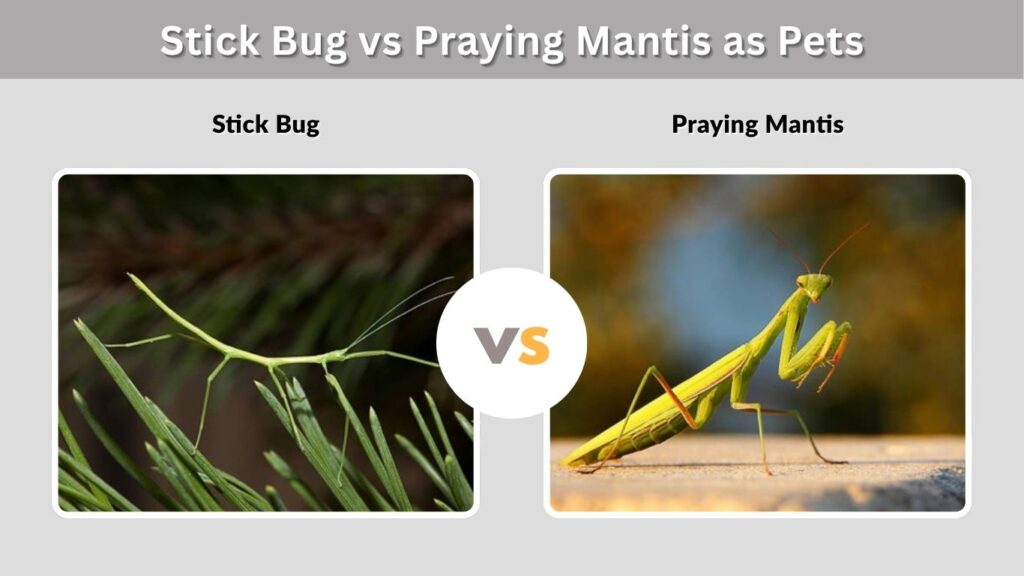
Both insects are kept in captivity, but their care requirements are different. Stick insects generally need fresh host plants, while mantises require regular supplies of live prey.
Stick bugs are often considered easier for beginners because many species are calm and relatively simple to feed.
Main Pet Differences
Stick bugs typically require:
- Fresh leaves
- Vertical climbing space
- Suitable humidity
- Good ventilation
- Gentle handling
Praying mantises typically require:
- Live feeder insects
- Vertical molting space
- Proper humidity
- Secure enclosure
- Individual housing for many species
Both can be fascinating observation pets, but mantises require owners who are comfortable feeding live insects.
FAQs
Is a Stick Bug the Same as a Praying Mantis?
No. Stick bugs belong to the order Phasmatodea, while praying mantises belong to Mantodea. Stick bugs are plant-eating insects that resemble twigs, whereas mantises are predators with specialized front legs used for capturing insects and other small prey.
Which Is Bigger, a Stick Bug or Praying Mantis?
Stick insects are generally capable of reaching greater lengths than praying mantises. Some giant stick insects exceed 10 inches, while most mantises measure approximately 2 to 5 inches. However, mantises often have thicker, more muscular bodies.
Can a Praying Mantis Eat a Stick Bug?
Yes. A large praying mantis may capture and eat a smaller stick insect if given the opportunity. Mantises are opportunistic predators, while walking sticks rely primarily on camouflage and defensive behavior to avoid being detected by predators.
Are Stick Bugs More Dangerous Than Mantises?
Usually not. Both present very little danger to humans, but mantises possess stronger jaws and grasping front legs. Some stick insects can spray irritating defensive chemicals, so the exact level of risk depends on the particular species involved.
How Do You Tell a Stick Mantis From a Stick Bug?
Check the front legs first. A stick mantis has enlarged, folded forelegs designed for capturing prey, along with a triangular head and prominent eyes. A true stick bug has more uniform walking legs and a body primarily adapted to resemble vegetation.