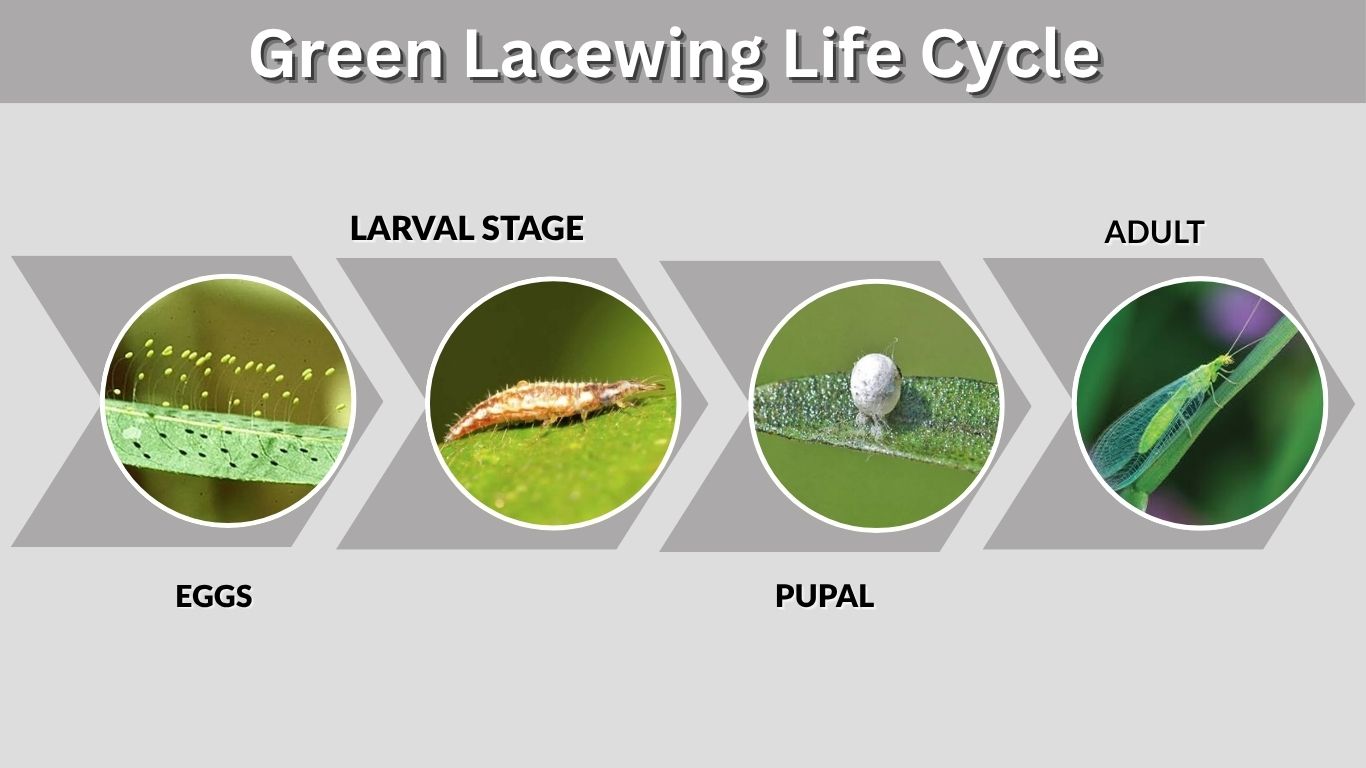
The green lacewing life cycle includes four distinct stages: egg, larva, pupa, and adult. This means green lacewings undergo complete metamorphosis, with each stage looking and behaving very differently. Their larvae are especially important because they actively hunt aphids, mites, whiteflies, and other soft-bodied pests, earning them the nickname “aphid lions.” After several larval stages, they form a silken cocoon, become pupae, and finally emerge as delicate winged adults. The entire process can take several weeks, depending on species, temperature, food, and environmental conditions.
Green Lacewing Life Cycle Stages
Green lacewings belong to the family Chrysopidae. Their development follows a complete life cycle, meaning immature lacewings do not simply resemble miniature adults. Instead, they pass through dramatic changes from stalked eggs to predatory larvae, enclosed pupae, and finally winged adults.
Four Main Life Stages
- Egg: Laid individually or in groups on thin stalks
- Larva: Active predator commonly called an aphid lion
- Pupa: Develops inside a small silken cocoon
- Adult: Green, winged insect that reproduces and lays eggs
The duration of each stage varies with temperature, species, food availability, and season.
Stage 1: Green Lacewing Eggs
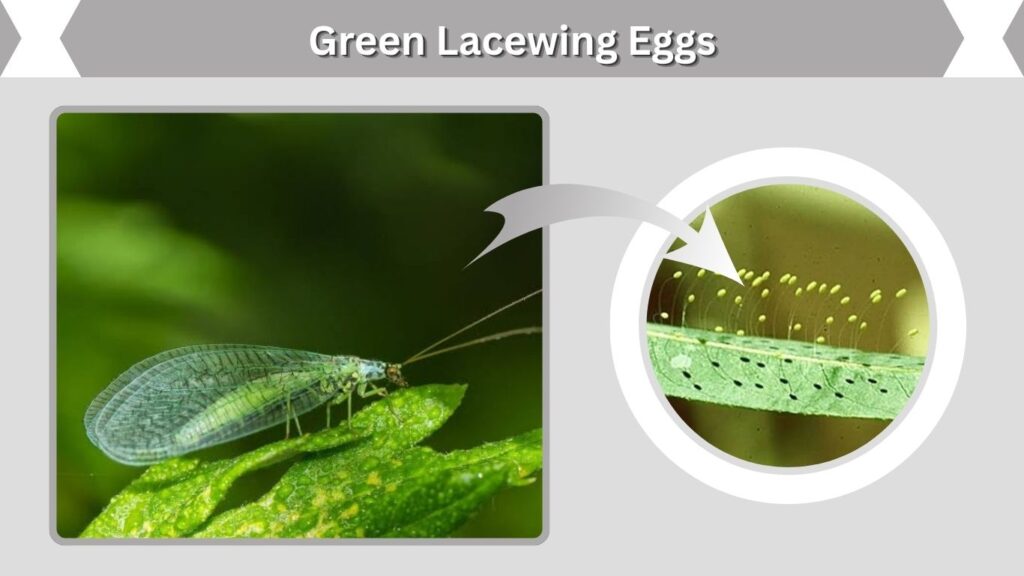
The green lacewing life cycle begins when an adult female lays eggs on vegetation. Lacewing eggs are particularly easy to recognize because many species attach each egg to the end of a long, slender stalk.
What Do Green Lacewing Eggs Look Like?
Fresh eggs are typically pale green or whitish and oval-shaped. As they develop, they may become darker.
The stalk raises the egg away from the leaf surface. This unusual arrangement may help reduce the chance that newly hatched lacewing larvae encounter and eat nearby eggs.
Females commonly place eggs near aphid colonies or other areas where young larvae are likely to find food soon after hatching.
How Long Do Green Lacewing Eggs Take to Hatch?
Under warm conditions, eggs may hatch in roughly three to ten days. Development tends to be faster when temperatures are suitable and slower under cooler conditions.
A tiny lacewing larva emerges from the egg and soon begins searching for prey.
Stage 2: Green Lacewing Larvae
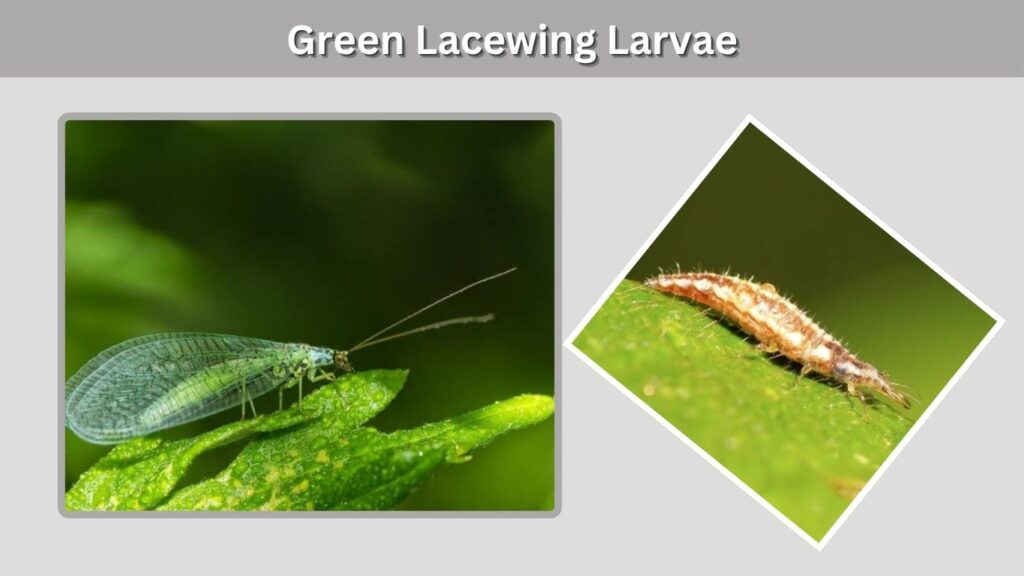
The larval stage is the most important part of the green lacewing life cycle for pest control. Lacewing larvae look nothing like the delicate adults. They have elongated bodies and prominent curved mouthparts used to capture and feed on other small arthropods.
Green Lacewing Larvae Identification
- Elongated, somewhat flattened body
- Brown, gray, cream, or mottled coloration
- Six visible legs
- Large curved, sickle-shaped mouthparts
- Active crawling behavior
- No functional wings
- May carry debris on the back in some species
Because of their aggressive predatory behavior, larvae are commonly known as aphid lions.
What Do Green Lacewing Larvae Eat?
Green lacewing larvae commonly prey on aphids, but their diet is much broader. They may also eat whiteflies, thrips, spider mites, mealybugs, insect eggs, scale crawlers, and small caterpillars.
The larva grabs prey with its curved mouthparts and feeds on the body fluids.
Aphid-infested plants can therefore provide ideal feeding grounds for developing larvae.
Green Lacewing Larvae Life Cycle
Green lacewing larvae typically pass through three larval instars. An instar is a developmental period between molts.
After growing too large for its outer covering, the larva molts and enters the next stage. Throughout these instars, it continues hunting.
The larval period commonly lasts around two to three weeks under favorable conditions, although temperature and prey availability can significantly alter the timing.
Stage 3: Green Lacewing Pupa
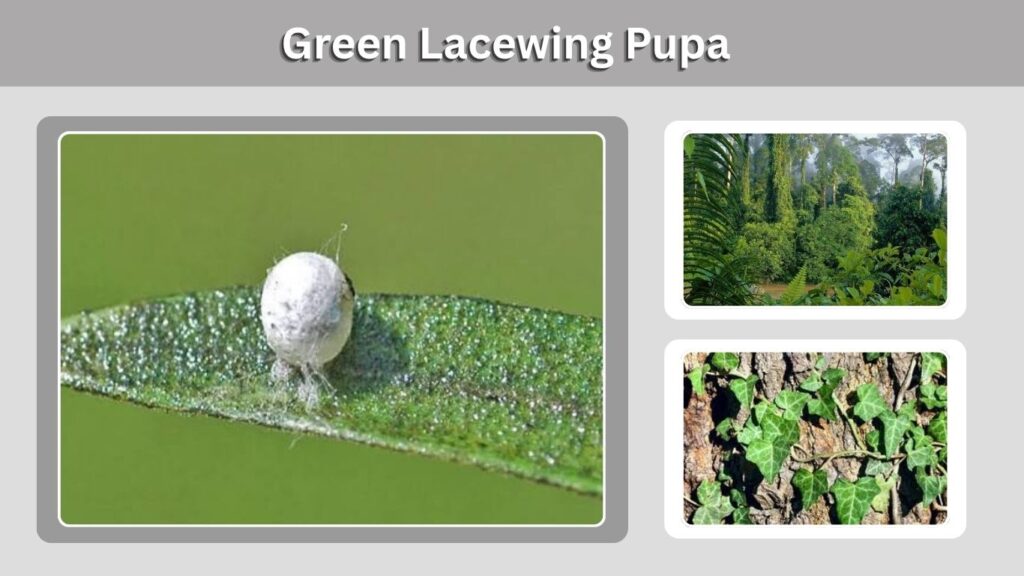
Once the larva has completed its growth, it stops actively hunting and prepares for pupation. This is the stage when the insect undergoes one of the most dramatic transformations in its life.
How Does a Green Lacewing Pupate?
The mature larva produces silk and spins a small, rounded cocoon. The cocoon is often attached to vegetation, bark, leaves, or another protected surface.
Inside the cocoon, the larval body reorganizes into the adult form.
Unlike the constantly moving larval stage, the pupa remains protected while development occurs.
How Long Is the Pupal Stage?
The pupal stage often lasts approximately one to two weeks in warm conditions.
Cooler temperatures can slow development considerably. In some species and climates, particular life stages may also be adapted to survive unfavorable seasonal conditions.
When development is complete, the adult emerges from the cocoon.
Stage 4: Adult Green Lacewing
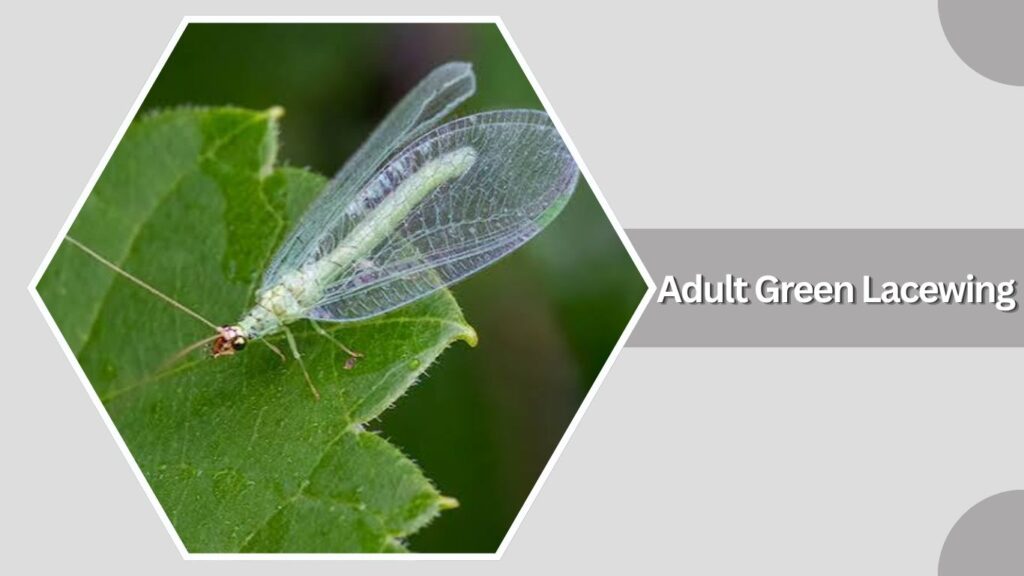
The adult green lacewing looks dramatically different from its larval form. Adults are delicate insects with slender green bodies, long antennae, large eyes, and two pairs of transparent wings.
Adult Green Lacewing Identification
- Pale or bright green body
- Long thread-like antennae
- Large golden or copper-colored eyes
- Two pairs of transparent wings
- Numerous fine veins across the wings
- Wings usually held roof-like over the abdomen
- Delicate, slow-flying appearance
Adult green lacewings are frequently active after sunset and may be attracted to outdoor lights.
What Do Adult Green Lacewings Eat?
Adult feeding habits vary among species. Many consume nectar, pollen, and honeydew produced by sap-feeding insects.
Some species also eat small arthropods.
Providing flowering plants in gardens can help support adult lacewings, allowing them to survive, reproduce, and produce another generation of predatory larvae.
Do Green Lacewings Have a Complete Life Cycle?
Yes. Green lacewings undergo complete metamorphosis, also called holometabolous development.
Complete Metamorphosis Explained
The sequence is:
Egg → Larva → Pupa → Adult
The presence of a pupal stage is one of the main characteristics of complete metamorphosis.
This differs from insects with incomplete metamorphosis, where immature stages generally resemble smaller versions of adults and there is no true pupal stage.
Because lacewing larvae and adults have completely different forms and often different diets, they can occupy different ecological roles during their lives.
How Long Is the Green Lacewing Life Cycle?
There is no single exact duration for every species. Under favorable warm conditions, some green lacewings can progress from egg to adult in roughly three to six weeks.
Factors Affecting Development
- Temperature
- Lacewing species
- Food availability
- Humidity
- Season
- Prey abundance
- Environmental conditions
Warm temperatures within a species’ suitable range generally speed development, while cooler conditions slow it.
Adults may survive for several weeks or longer, depending on species and environmental conditions.
Green Lacewing Life Cycle and Aphids
Aphids play an important role in the lives of many green lacewings. Adult females may lay their eggs near aphid colonies because newly hatched larvae need immediate access to suitable prey.
Why Aphids Matter
Once larvae hatch, a nearby aphid colony offers abundant food. The young lacewings can begin feeding quickly rather than traveling long distances in search of prey.
As the larvae grow, they may consume increasing numbers of aphids and other small pests.
This predator-prey relationship explains why green lacewings are frequently considered beneficial insects in gardens, greenhouses, and agricultural systems.
Green Lacewing Lifespan
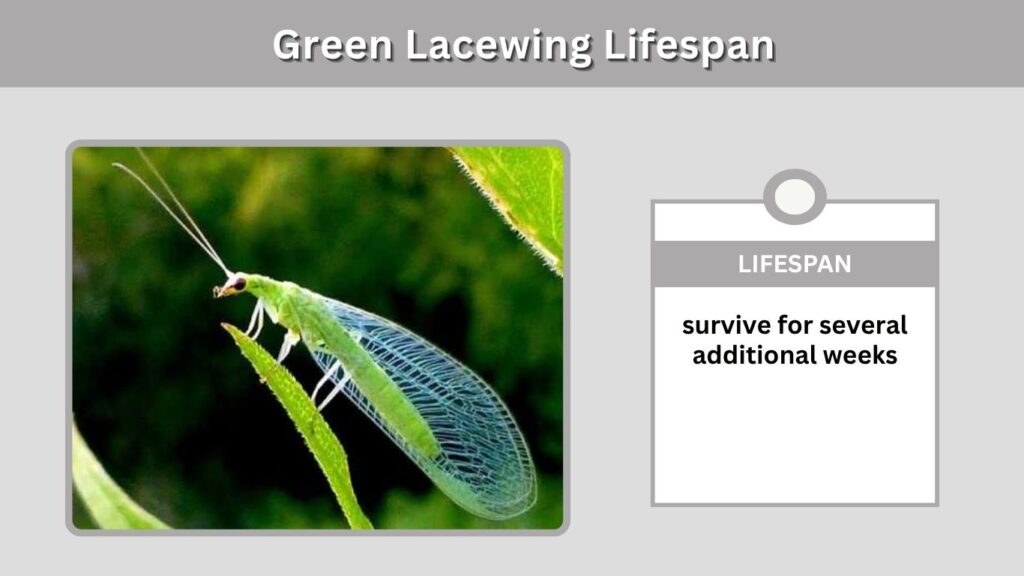
The common green lacewing lifespan varies between species and environmental conditions. The immature stages may take several weeks to complete, while adults can often survive for several additional weeks.
Some species produce several generations during warm months.
What Happens During Winter?
Green lacewings in cooler regions have different strategies for surviving winter. Depending on species, they may overwinter as adults, larvae, pupae, or other developmental forms.
Activity and development resume when temperatures become favorable again.
This seasonal flexibility allows green lacewing populations to return to gardens when plant growth and insect prey increase.
Why the Green Lacewing Life Cycle Is Important
Every life stage has a different function. Eggs allow the next generation to begin close to prey, larvae provide powerful pest control, pupae permit transformation, and adults disperse and reproduce.
Understanding these stages is especially useful for gardeners. A strange-looking brown larva crawling among aphids may not resemble the beautiful green adult it will eventually become, but it is often the most beneficial stage to have around plants.
FAQs
1. What are the four stages of the green lacewing life cycle?
Green lacewings develop through four stages: egg, larva, pupa, and adult. Because they include a true pupal stage and the larva differs greatly from the adult, green lacewings undergo complete metamorphosis.
2. How long does the green lacewing life cycle take?
Under favorable warm conditions, development from egg to adult may take roughly three to six weeks. However, the exact duration varies according to species, temperature, food availability, season, and other environmental factors.
3. How long do green lacewings stay as larvae?
The larval stage often lasts approximately two to three weeks under favorable conditions. During this period, larvae typically pass through three instars and actively hunt aphids, mites, whiteflies, mealybugs, and other small arthropods.
4. Do green lacewings have a pupal stage?
Yes. After completing the larval stage, a green lacewing spins a small silken cocoon and pupates inside it. During this stage, the insect transforms from a predatory larva into a winged adult.
5. Do green lacewing larvae eat aphids?
Yes. Aphids are one of the best-known foods of green lacewing larvae. Females may lay eggs near aphid colonies so newly hatched larvae have access to prey. This feeding behavior makes green lacewings valuable natural predators in gardens and farms.