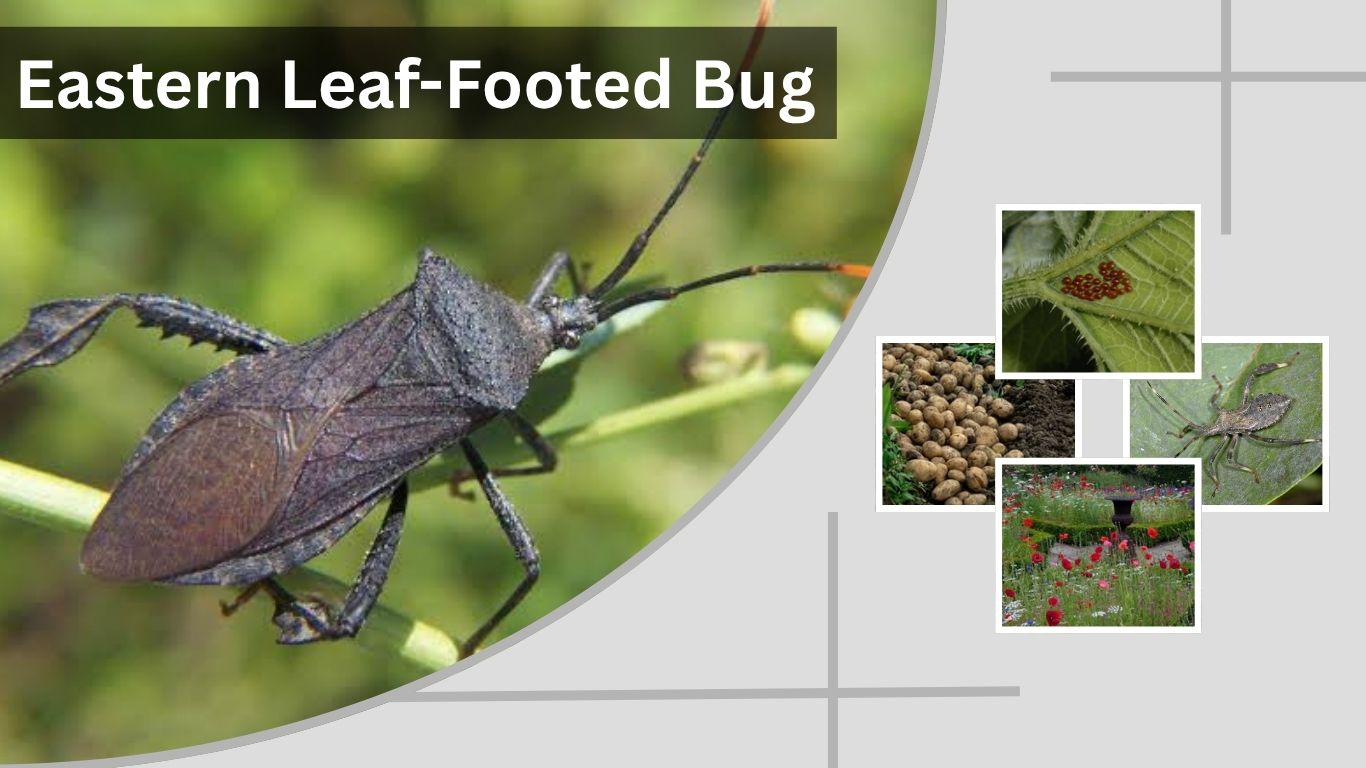
The eastern leaf-footed bug (Leptoglossus phyllopus) is a large plant-feeding true bug recognized by its flattened, leaf-shaped hind legs and pale band across the wings. It is commonly found on vegetables, fruits, ornamentals, and wild plants, especially in warmer parts of the United States. Gardeners often notice adults and bright-colored nymphs on tomatoes, peppers, citrus, and other crops. Although these insects usually do not threaten people, heavy infestations can damage developing fruits, seeds, and plant tissues through repeated feeding.
Eastern Leaf-Footed Bug Identification
Eastern leaf-footed bugs belong to the family Coreidae and the order Hemiptera. Their unusual hind legs make mature insects fairly easy to recognize, although young nymphs can sometimes be mistaken for assassin bugs.
Adults are generally chestnut brown and measure approximately 5/8 to 3/4 inch long. A straight, pale cream or yellowish band crossing the folded wings is particularly useful for distinguishing Leptoglossus phyllopus from several related species.
Key Identification Features
Look for the following characteristics:
- Scientific name: Leptoglossus phyllopus
- Family: Coreidae
- Order: Hemiptera
- Length: About 5/8–3/4 inch
- Body color: Chestnut brown to dark brown
- Hind legs: Broad, flattened, leaf-like expansions
- Wing marking: Straight pale band across the back
- Antennae: Long and segmented
- Mouthparts: Piercing-sucking beak
- Body shape: Long and relatively narrow
The expanded hind tibiae are responsible for the common name “leaf-footed bug.”
Eastern Leaf-Footed Bug Nymphs and Eggs
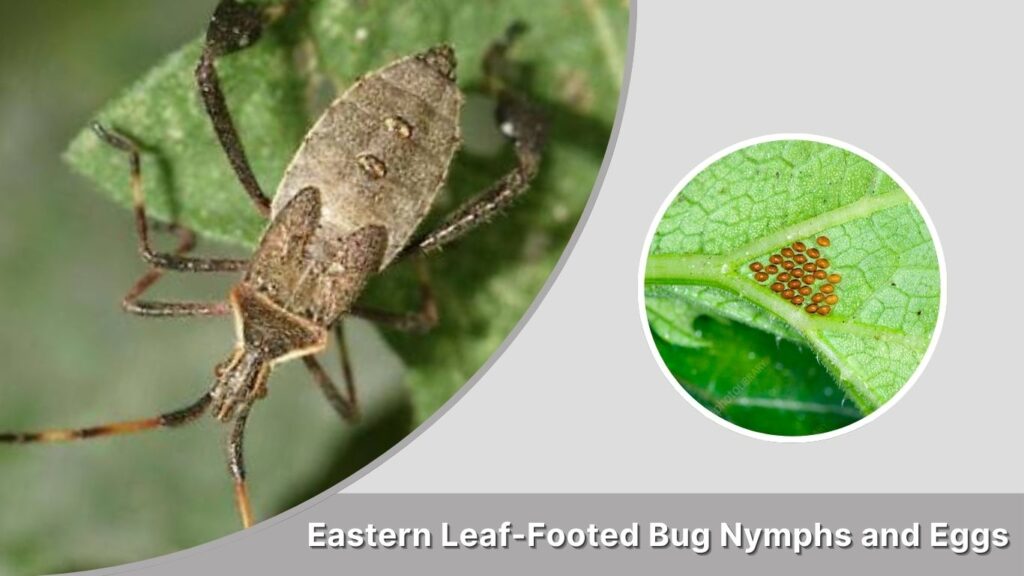
Young eastern leaf-footed bugs look quite different from adults. They are smaller, more brightly colored, and initially lack the broad leaf-shaped hind-leg expansions seen on mature bugs.
Because several beneficial predatory insects can look similar when young, identification is important before attempting control.
Eastern Leaf-Footed Bug Nymph
Newly hatched nymphs are often bright red or reddish-orange, with dark legs and antennae. Their bodies gradually become darker as they pass through successive developmental stages.
Typical nymph characteristics include:
- Red to orange body when young
- Long black or dark legs
- Dark antennae
- No fully developed wings
- No obvious leaf-shaped hind legs in early stages
- Increasingly adult-like appearance as they mature
Nymphs feed on plants using the same piercing-sucking mouthparts as adults.
Eastern Leaf-Footed Bug Eggs
Females lay distinctive golden-brown eggs in a straight row.
The eggs are:
- Cylindrical or barrel-like
- Golden brown
- Attached end-to-end
- Usually placed along stems or leaf veins
- Arranged in a narrow chain rather than a large cluster
Finding and removing these egg rows early can prevent dozens of young bugs from appearing later.
Eastern Leaf-Footed Bug Life Cycle
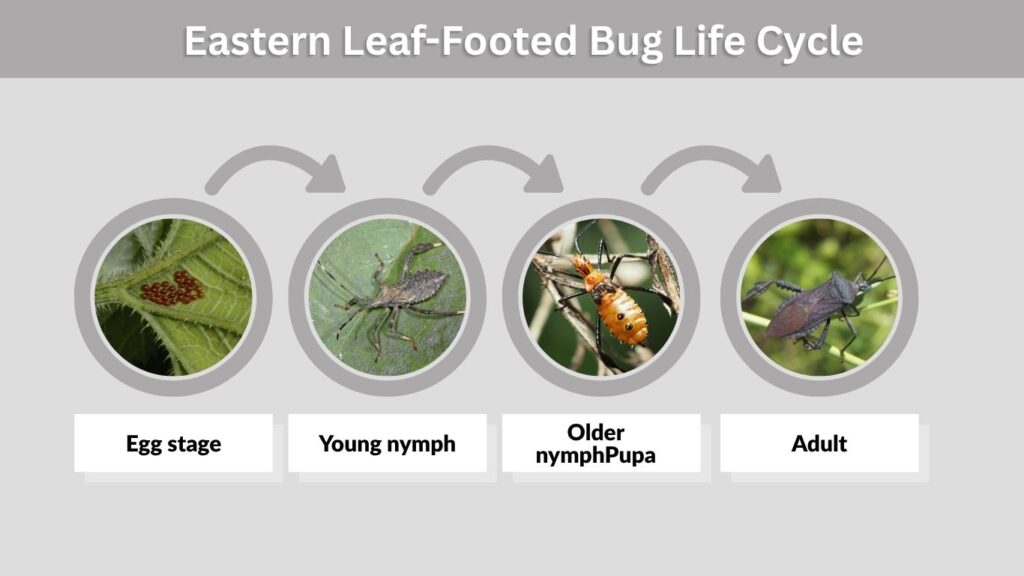
The eastern leaf-footed bug undergoes incomplete metamorphosis. Its development consists of three main stages: egg, nymph, and adult.
It is sometimes mistakenly described as ametabolous. However, leaf-footed bugs are hemimetabolous insects because their nymphs resemble smaller versions of adults and gradually develop adult structures rather than passing through a pupal stage.
Life Cycle Stages
The basic cycle includes:
- Egg: Females deposit rows of eggs on host plants.
- Young nymph: Red or orange nymphs hatch and begin feeding.
- Older nymph: The insects increase in size through several molts.
- Adult: Wings and distinctive flattened hind legs become fully developed.
Nymphs typically pass through five instars before adulthood. Multiple generations may occur in warmer climates, and adults can be present for much of the year in the Deep South.
Eastern Leaf-Footed Bug Habitat and Range
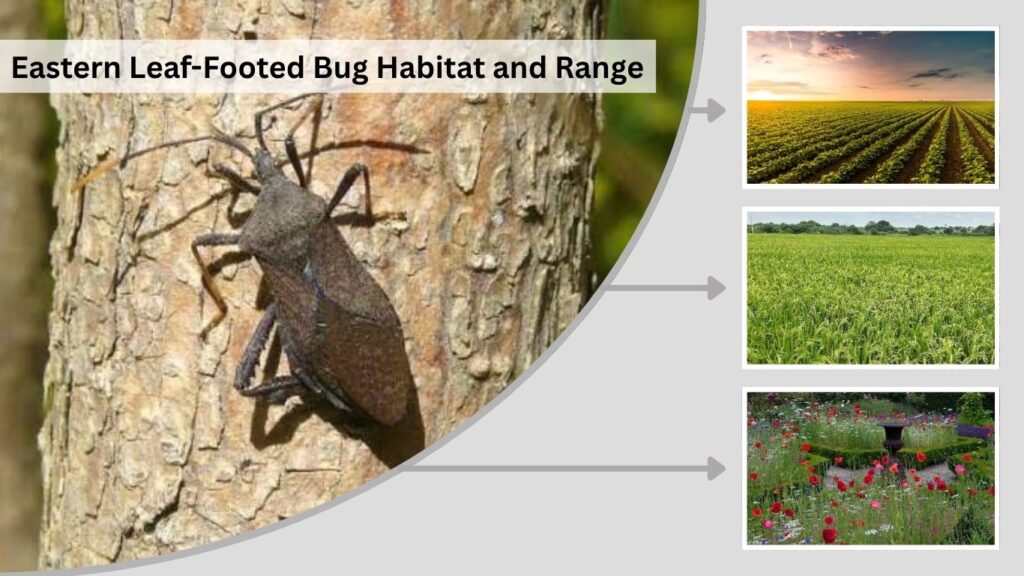
Eastern leaf-footed bugs inhabit gardens, agricultural fields, orchards, roadsides, weedy areas, and other places where suitable host plants occur.
They are especially noticeable during warmer months when adults move between wild plants and cultivated crops.
Where Are Eastern Leaf-Footed Bugs Found?
Their distribution includes much of the southern United States, with records extending north to New York and west through parts of the central and southwestern states. Their broader range continues into Mexico and Central America.
Common habitats include:
- Vegetable gardens
- Fruit orchards
- Citrus groves
- Agricultural fields
- Flower gardens
- Weedy field margins
- Thistle patches
- Shrubs and ornamental plants
Wild plants can support populations before adults move into nearby crops.
Eastern Leaf-Footed Bugs on Tomatoes
Tomatoes are among the crops attacked by eastern leaf-footed bugs. Both nymphs and adults insert needle-like mouthparts into fruits, stems, buds, and other plant tissues and withdraw fluids.
What Damage Do They Cause?
On tomatoes, feeding may result in:
- Small puncture marks
- Pale or cloudy areas beneath the skin
- Sunken feeding spots
- Misshapen developing fruits
- Discolored internal tissue
- Reduced fruit quality
- Greater opportunity for microorganisms to enter damaged tissue
A few bugs generally cause limited damage, but large groups feeding on developing tomatoes can noticeably reduce crop quality.
What Do Eastern Leaf-Footed Bugs Eat?
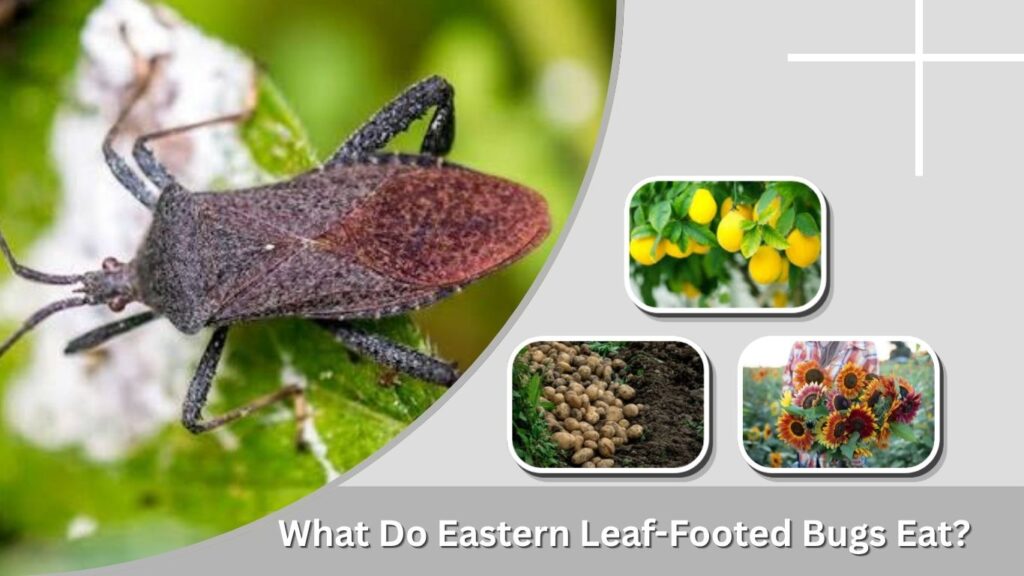
Eastern leaf-footed bugs are plant feeders rather than predators. They attack a surprisingly broad range of plants.
Reported hosts include tomato, beans, peppers, potatoes, eggplant, okra, sunflower, citrus, peaches, pears, pomegranates, watermelons, blueberries, blackberries, pecans, and several wild and ornamental plants.
Common Host Plants
Frequently attacked plants include:
- Tomatoes
- Peppers
- Beans
- Cowpeas
- Eggplants
- Okra
- Potatoes
- Sunflowers
- Citrus
- Peaches
- Watermelons
- Pomegranates
Their feeding is most damaging when insects pierce young fruits, seeds, or developing plant structures.
Eastern Leaf-Footed Bug Predators
Leaf-footed bugs are part of a larger garden food web and are attacked by various natural enemies. Eggs and nymphs are generally more vulnerable than mature adults.
Predatory insects, spiders, birds, and parasitoids can help reduce populations naturally. Maintaining a diverse garden rather than routinely using broad-spectrum pesticides can therefore support biological control.
Natural Enemies
Potential predators and natural enemies include:
- Assassin bugs
- Spiders
- Birds
- Predatory stink bugs
- Parasitic flies
- Parasitic wasps
- Other insect predators
Natural enemies alone may not eliminate a serious infestation, but they can prevent populations from increasing as rapidly.
How to Get Rid of Eastern Leaf-Footed Bugs
Control is easiest when infestations are detected early. Small garden populations rarely require aggressive chemical treatment.
Regular inspection of plants during flowering and fruit development can reveal egg rows and young nymph groups before they become harder-to-control adults.
Effective Control Methods
Use a combination of the following:
- Hand-pick adults and nymphs: Wear gloves and drop bugs into soapy water.
- Remove egg rows: Check stems and leaf veins regularly.
- Control weeds: Remove nearby thistles and other host plants where populations may develop.
- Use row covers: Protect young crops before flowering when appropriate.
- Remove badly infested plant material: This can reduce concentrated groups of nymphs.
- Encourage natural predators: Avoid unnecessary broad-spectrum insecticides.
- Use insecticidal soap on young nymphs: It is generally more useful against immature bugs than adults.
- Use labeled insecticides only when necessary: Severe infestations may require products specifically labeled for the affected crop and pest.
University of Florida guidance identifies cultural control, hand removal, and insecticides as management options, particularly where populations become damaging.
Do Eastern Leaf-Footed Bugs Bite Humans?
Eastern leaf-footed bugs are not considered medically important biting insects. Their mouthparts are designed primarily for piercing plant tissue.
They may defend themselves when handled, and a defensive jab could potentially be uncomfortable, but they do not normally seek humans for blood meals. They also should not be confused with kissing bugs, which belong to a different insect family and have very different feeding behavior.
FAQs
1. Are eastern leaf-footed bugs harmful?
They are mainly harmful to plants rather than people. Heavy populations can damage fruits, seeds, buds, and vegetables by piercing plant tissue and sucking fluids.
2. What does an eastern leaf-footed bug nymph look like?
Young nymphs are typically bright red or orange with dark legs and antennae. They lack the fully developed wings and prominent leaf-shaped hind legs of adults.
3. Do eastern leaf-footed bugs damage tomatoes?
Yes. Feeding can produce punctures, cloudy spots, discoloration, deformation, and poor-quality fruit, particularly when many bugs attack developing tomatoes.
4. What is the eastern leaf-footed bug’s scientific name?
Its scientific name is Leptoglossus phyllopus. It belongs to the family Coreidae and order Hemiptera.
5. How can I control eastern leaf-footed bugs naturally?
Remove eggs and nymphs by hand, eliminate unnecessary nearby host weeds, protect plants when practical, and encourage predators. Early control is much easier because young nymphs cannot fly away like adults.