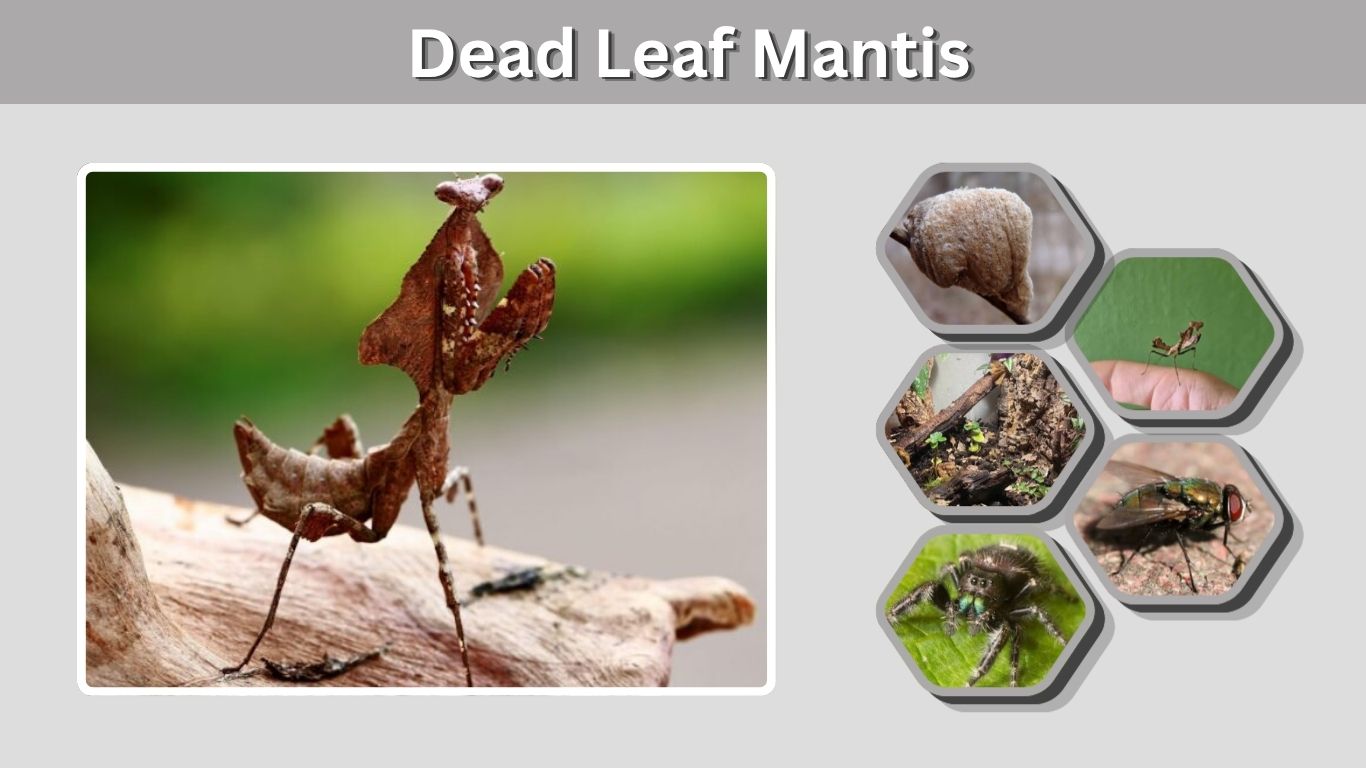
The dead leaf mantis is one of nature’s most impressive camouflage specialists. With a flattened brown body, irregular edges, leaf-like veins, and slow swaying movements, it can look remarkably similar to a dry fallen leaf. Several mantises are called dead leaf mantises, but the giant or Malaysian dead leaf mantis (Deroplatys desiccata) is among the best known. Native to Southeast Asia, these predatory insects use disguise both to avoid predators and to approach unsuspecting prey.
Dead Leaf Mantis Identification
The name “dead leaf mantis” does not refer to just one mantis worldwide. Several species have independently developed dead-leaf mimicry. Asian species in the genus Deroplatys are particularly famous for it, including D. desiccata and D. lobata.
Size and Appearance
The giant dead leaf mantis has a broad, flattened body designed to break up its outline.
Typical characteristics include:
- Scientific name: Deroplatys desiccata
- Order: Mantodea
- Body color: Tan, brown, dark brown, or mottled gray
- Female size: Commonly around 7.5–8 cm
- Male size: Usually around 6.5–7 cm
- Head: Broad and triangular
- Thorax: Wide, irregularly shaped, and leaf-like
- Wings: Flattened with markings resembling leaf veins
- Forelegs: Spiny raptorial legs used for catching prey
Females are generally larger, heavier, and broader than males. Males have a slimmer build and proportionally longer wings.
Female vs Male Dead Leaf Mantis
Adult females are especially convincing leaf mimics because of their broad abdomen and large pronotum. Their body can resemble a curled or partly decayed leaf.
Males are smaller and more lightly built. Their wings are well developed, making them more capable of flight than the heavier females. These differences become increasingly noticeable as the mantises mature.
How Dead Leaf Mantis Camouflage Works
The dead leaf mantis relies on mimicry and camouflage rather than simply matching a single color. Its entire body shape, texture, markings, posture, and behavior contribute to the illusion.
A motionless mantis among dry leaves can be extremely difficult for both predators and prey to recognize.
Dead Leaf Mimicry and Adaptations
Its most important camouflage adaptations include:
- Brown and gray leaf-like coloration
- Irregular body edges resembling torn leaves
- Wing markings similar to veins and decay spots
- A broad, flattened pronotum
- Slow movements that avoid attracting attention
- Swaying behavior that can resemble a leaf moving in wind
- Remaining motionless when danger approaches
Some Deroplatys species may also drop and remain still when seriously threatened, strengthening their resemblance to fallen plant material.
Defensive Display
Camouflage is the first line of defense, but a threatened giant dead leaf mantis has another strategy.
If concealment fails, it can suddenly spread its forelegs and wings to expose contrasting colors and eye-like markings. The abrupt transformation from an apparently harmless leaf into a large, colorful insect may startle a predator long enough for the mantis to escape.
Dead Leaf Mantis Habitat and Range
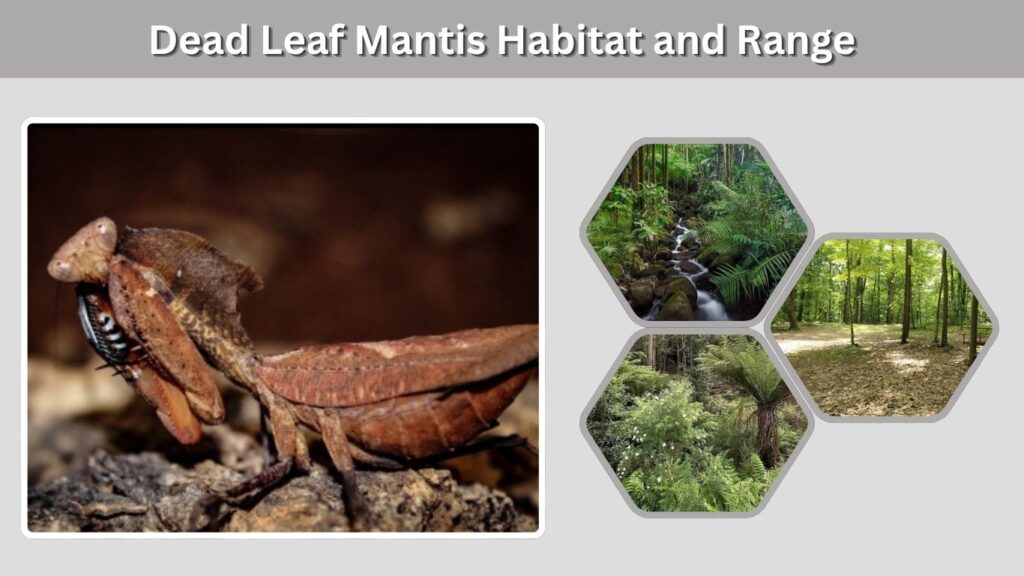
The giant dead leaf mantis is native to Southeast Asia. Records include Malaysia, Borneo, Sumatra, Java, and surrounding regions. Other Deroplatys species occupy overlapping parts of tropical Southeast Asia.
Where Do Dead Leaf Mantises Live?
Typical habitat includes:
- Tropical forests
- Shrubby forest vegetation
- Forest understory
- Areas containing abundant dead foliage
- Branches and low vegetation
- Humid tropical environments
Their brown coloration is particularly effective among dead leaves hanging from vegetation or accumulated around forest plants.
Although called a “leaf” mantis, it does not eat leaves. Its resemblance to vegetation is purely camouflage.
What Do Dead Leaf Mantises Eat?
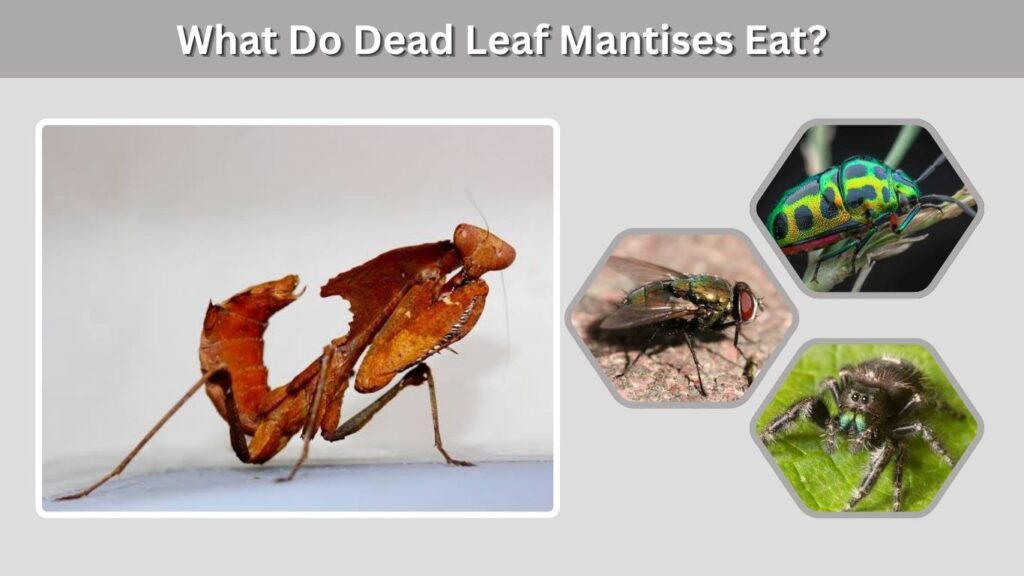
Like other praying mantises, dead leaf mantises are carnivorous ambush predators. They remain still until suitable prey comes close, then strike rapidly with their spiny forelegs.
Dead Leaf Mantis Diet
Common prey can include:
- Flies
- Moths
- Crickets
- Roaches
- Small grasshoppers
- Other insects
- Small arthropods
Baby dead leaf mantises, called nymphs, begin with much smaller prey and take progressively larger insects as they grow.
Dead leaf mantises do not need to chase prey over long distances. Their camouflage allows insects to approach without recognizing the hidden predator.
Dead Leaf Mantis Life Cycle
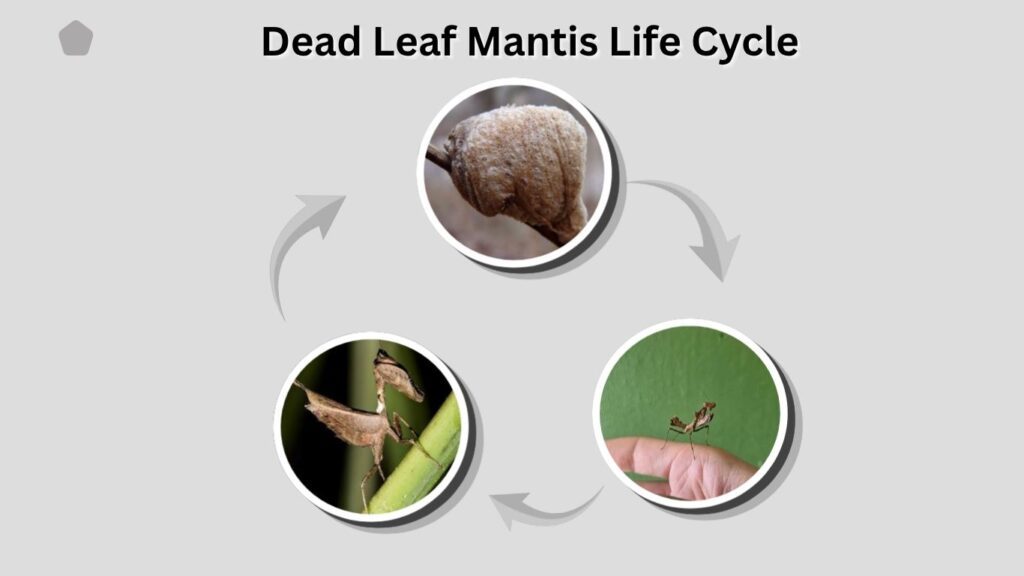
Dead leaf mantises undergo incomplete metamorphosis, meaning there is no caterpillar-like larva or pupal stage. Instead, young mantises resemble miniature adults and grow through repeated molts.
Eggs, Nymphs, and Adults
The life cycle consists of:
- Ootheca: The female produces a protective foamy egg case.
- Egg development: Multiple eggs develop within the hardened ootheca.
- Nymph: Young mantises emerge looking like tiny, wingless adults.
- Molting: Nymphs shed their exoskeleton several times as they grow.
- Adult: Wings and reproductive structures become fully developed.
Females may produce more than one ootheca after reaching adulthood.
Dead Leaf Mantis Molting
Molting is one of the most vulnerable stages of a mantis’s life. A nymph usually hangs upside down while pulling itself from its old exoskeleton.
The new body is initially soft and requires time to harden. Falling during a molt can cause serious injury or deformity, which is why captive mantises require enough vertical space and secure surfaces from which to hang.
How Long Do Dead Leaf Mantises Live?
The exact dead leaf mantis lifespan varies according to species, sex, temperature, food availability, and environmental conditions.
In captivity, many Deroplatys mantises live for roughly several months to around a year, with females commonly surviving longer than males. Males mature more quickly and generally have a shorter adult lifespan.
Rather than a fixed lifespan, development should be considered dependent on both biology and husbandry.
Dead Leaf Mantis Predators
Despite their predatory abilities, mantises can themselves become food for larger animals.
Common Predators
Potential predators include:
- Birds
- Lizards
- Frogs
- Spiders
- Small mammals
- Larger predatory insects
Camouflage reduces the chance of being detected. Remaining completely motionless can be especially important when a visually hunting predator passes nearby.
Dead Leaf Mantis Care as a Pet
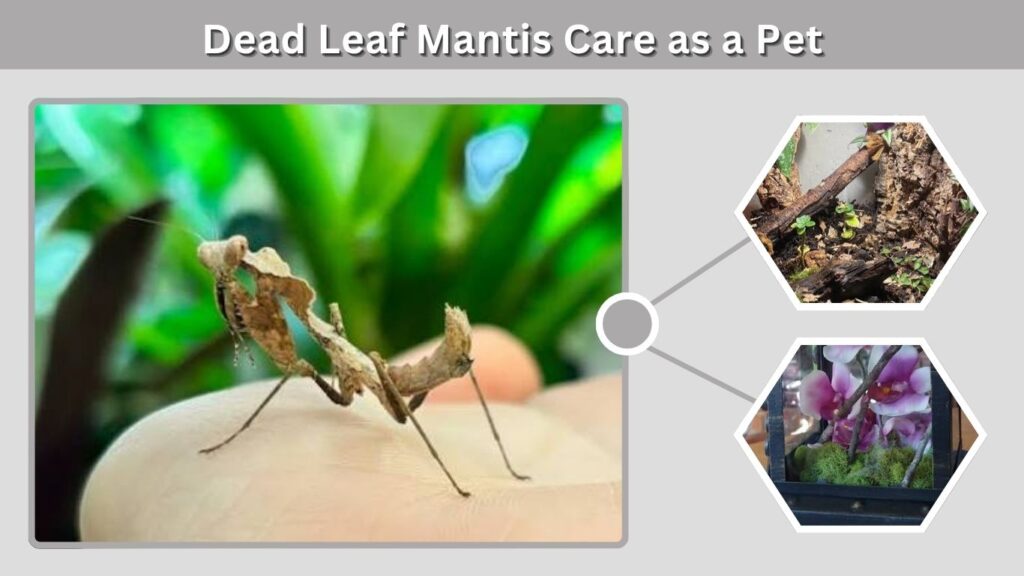
Dead leaf mantises are popular among experienced exotic-invertebrate keepers because of their unusual appearance. However, they require appropriate humidity, ventilation, live food, and safe molting space.
Basic Care Requirements
Important considerations include:
- Keep the enclosure taller than the mantis so it can molt safely.
- Provide branches or mesh for hanging.
- Maintain a warm tropical environment appropriate for the species.
- Provide humidity without keeping the enclosure constantly wet.
- Ensure good airflow to prevent stagnant conditions.
- Feed appropriately sized live insects.
- Remove uneaten prey when the mantis is preparing to molt.
- House individuals separately because mantises may attack one another.
Exact husbandry requirements can differ between Deroplatys species and life stages.
Dead Leaf Mantis for Sale
Captive-bred dead leaf mantises are sold in the exotic-invertebrate trade, especially D. desiccata and D. lobata. Anyone considering one should check local regulations and choose captive-bred animals rather than specimens collected from the wild.
Potential owners should also be prepared to supply live feeder insects throughout the mantis’s life.
Giant, Malaysian, and South American Dead Leaf Mantises
“Dead leaf mantis” is a descriptive common name shared by different mantises, so the geographic label matters.
Types Commonly Called Dead Leaf Mantises
Giant Dead Leaf Mantis (Deroplatys desiccata)
A large Southeast Asian species famous for its broad, dry-leaf appearance. Smithsonian collections recognize it separately as the giant dead leaf mantis.
Malaysian/Southeast Asian Dead Leaf Mantis (Deroplatys lobata)
Another striking Deroplatys species found across parts of Thailand, the Malay Peninsula, Sumatra, Java, and Borneo.
South American Dead Leaf Mantises
Several unrelated South American mantises, particularly species associated with genera such as Acanthops, also mimic dried vegetation. They should not be confused with Southeast Asian Deroplatys.
Therefore, names such as Peruvian, Caribbean, Malaysian, or giant dead leaf mantis may refer to different species rather than regional forms of one animal.
FAQs
1. Is a dead leaf mantis poisonous?
No. Dead leaf mantises are not venomous or poisonous to humans. They use their spiny forelegs to capture insects rather than venom.
2. Why does a dead leaf mantis look like a leaf?
Its shape, coloration, markings, posture, and behavior have evolved to resemble dead vegetation. This camouflage protects it from predators and helps it ambush prey.
3. How big does a giant dead leaf mantis get?
Adult female Deroplatys desiccata can reach roughly 7.5–8 cm, while males are typically smaller and more slender.
4. Can dead leaf mantises fly?
Adult males are generally better flyers because they are lighter and have functional wings. Heavy adult females are much less inclined or able to fly effectively.
5. What is the scientific name of the dead leaf mantis?
There is no single scientific name for every insect called a dead leaf mantis. The giant dead leaf mantis is Deroplatys desiccata, while the Southeast Asian or Malaysian dead leaf mantis may refer to Deroplatys lobata.