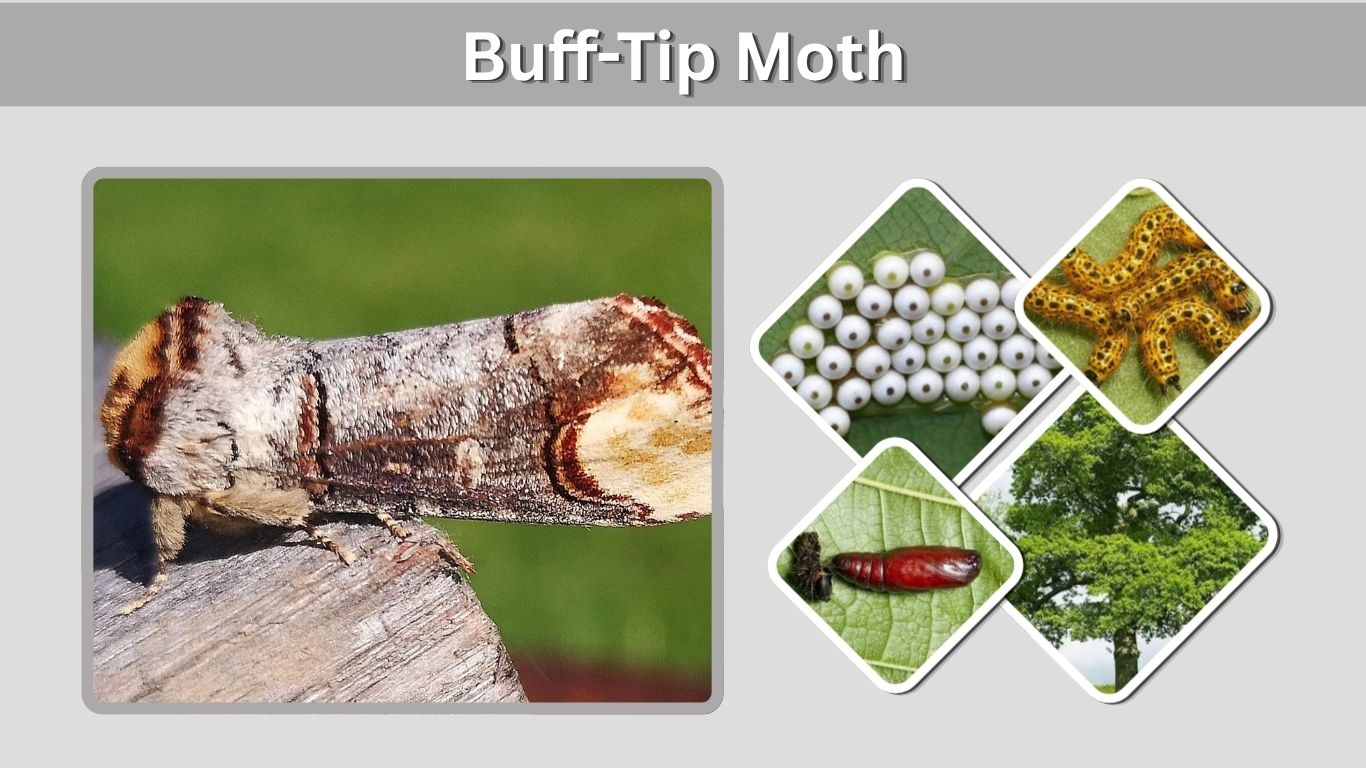
The buff-tip moth (Phalera bucephala) is one of Britain’s most remarkable camouflage experts. When resting, the adult closely resembles a broken birch twig, with silvery-gray wings and rounded buff-colored tips that imitate freshly exposed wood. The species is widespread across the UK and also occurs in Ireland and much of Europe. Its colorful caterpillars look very different from the adults, often feeding together in large groups on deciduous trees. Despite their striking appearance, buff-tip moth caterpillars are not considered dangerously poisonous to humans.
Buff-Tip Moth Identification
Adult buff-tip moths are members of the prominent moth family, Notodontidae. Their unusual body shape and wing pattern make them easy to recognize once you know what to look for.
When resting with their wings folded tightly around the body, they resemble a short broken twig rather than a typical moth.
Size and Appearance
Common identification features include:
- Scientific name: Phalera bucephala
- Family: Notodontidae
- Wingspan: About 42–55 mm
- Forewings: Silvery-gray with darker markings
- Wing tips: Distinctive yellowish-buff patches
- Thorax: Thick, hairy, and grayish
- Body: Stout and cylindrical
- Resting posture: Wings held tightly around the body
- Activity: Primarily nocturnal
The buff-colored ends of the wings and head combine visually to imitate the cut end of a broken branch.
Buff-Tip Moth Camouflage and Adaptations
Camouflage is probably the buff-tip moth’s most famous characteristic. Instead of hiding beneath leaves, adults often rest openly on branches because their appearance makes them difficult for predators to detect.
This form of protective resemblance is an excellent example of camouflage through body shape, color, and posture.
How Does Its Camouflage Work?
Several adaptations contribute to the disguise:
- Gray wings resemble tree bark.
- Buff wing tips resemble exposed wood.
- The cylindrical resting posture mimics a twig.
- Dark wing markings resemble cracks and shadows in bark.
- Remaining motionless during daylight reduces detection.
- Thick body and folded wings create a broken-branch silhouette.
Birds searching visually for insects can easily overlook a motionless buff-tip moth during daylight.
Buff-Tip Moth Habitat and Distribution
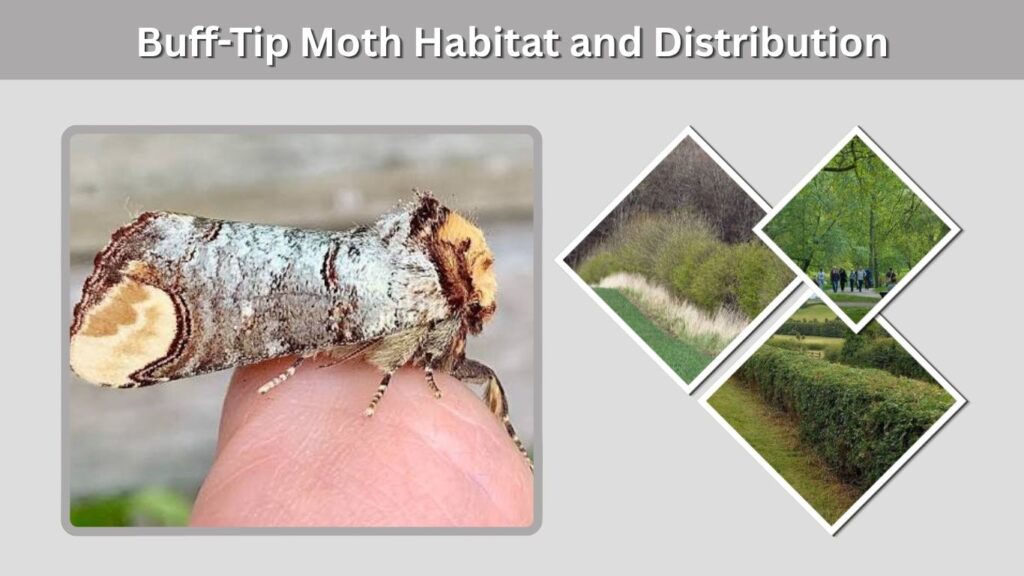
Buff-tip moths are strongly associated with areas containing deciduous trees because their caterpillars feed on the leaves of several common species.
Adults may be encountered in both natural and human-modified environments.
Where Do Buff-Tip Moths Live?
Typical habitats include:
- Deciduous woodland
- Woodland edges
- Hedgerows
- Parks
- Gardens
- Scrubland
- River valleys
- Tree-lined roads
- Areas containing birch, willow, oak, or hazel
The species is widespread across much of Britain and occurs in Ireland, although abundance can vary locally.
Buff-tip moths are also distributed across large parts of Europe and extend eastward through portions of temperate Asia.
Buff-Tip Moth Caterpillar
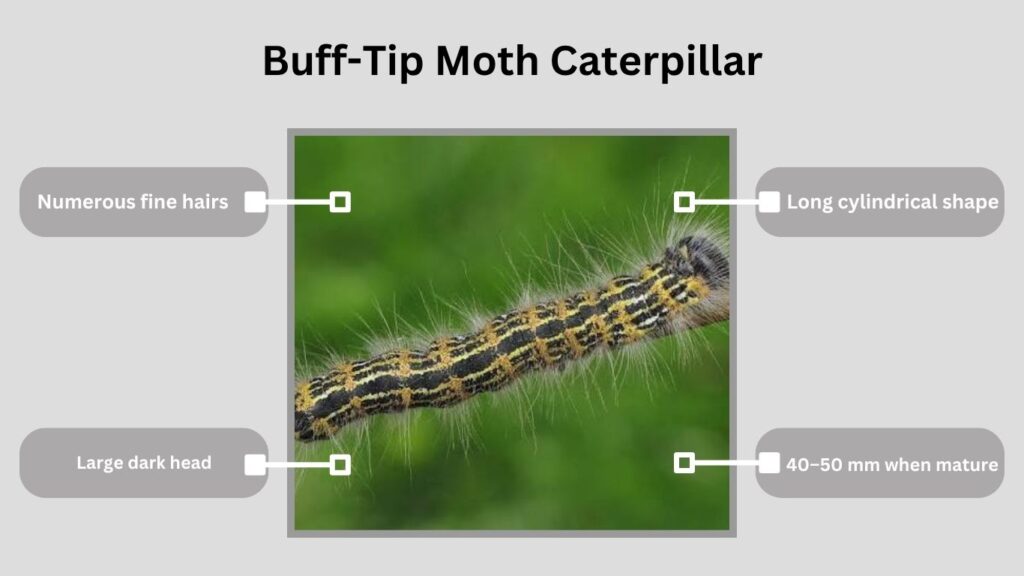
The buff-tip moth caterpillar looks dramatically different from the camouflaged adult. Young larvae often remain together in large groups and can sometimes strip considerable foliage from individual branches.
As they grow, the caterpillars become increasingly noticeable.
Buff-Tip Caterpillar Identification
Typical features include:
- Yellow or orange-yellow body
- Black longitudinal stripes
- Numerous fine hairs
- Large dark head
- Long cylindrical shape
- Strong contrasting pattern
- Size reaching roughly 40–50 mm when mature
Young caterpillars usually feed communally, sometimes with dozens grouped on the same branch. Older larvae may become more dispersed before leaving their host plant to pupate.
Are Buff-Tip Moth Caterpillars Poisonous?
Buff-tip caterpillars are not considered dangerously poisonous or venomous.
Their hairy appearance sometimes causes people to assume they can deliver a painful sting, but they are not regarded like strongly urticating caterpillars whose specialized hairs inject or release potent toxins.
However, it is still sensible to avoid unnecessary handling of any hairy caterpillar. Sensitive individuals can occasionally experience minor skin irritation after contact with insect hairs.
Children and pets should also be discouraged from handling or eating caterpillars.
What Do Buff-Tip Moth Caterpillars Eat?
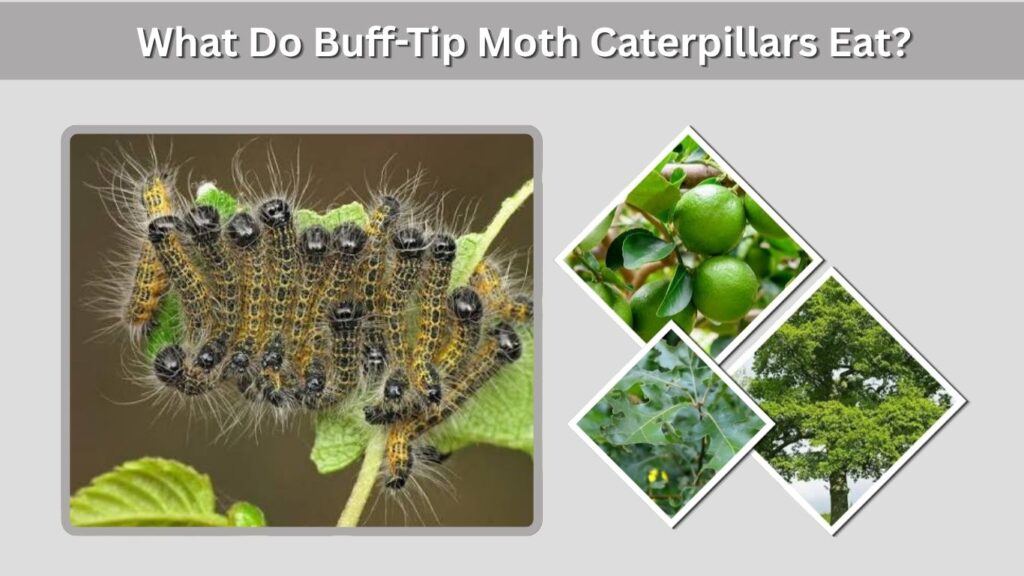
The adult moth does little or no significant feeding, while the caterpillar stage is responsible for most of the species’ food consumption.
Larvae feed primarily on the foliage of broad-leaved trees.
Common Caterpillar Food Plants
Host plants include:
- Birch
- Willow
- Hazel
- Oak
- Lime
- Alder
- Rowan
- Elm
- Poplar
- Hawthorn
Birch and willow are particularly important food plants in many areas.
The caterpillars chew leaves from the edges inward. Because young larvae often feed together, a heavily occupied branch may become partially or completely defoliated.
Healthy mature trees generally recover from limited feeding.
Buff-Tip Moth Life Cycle
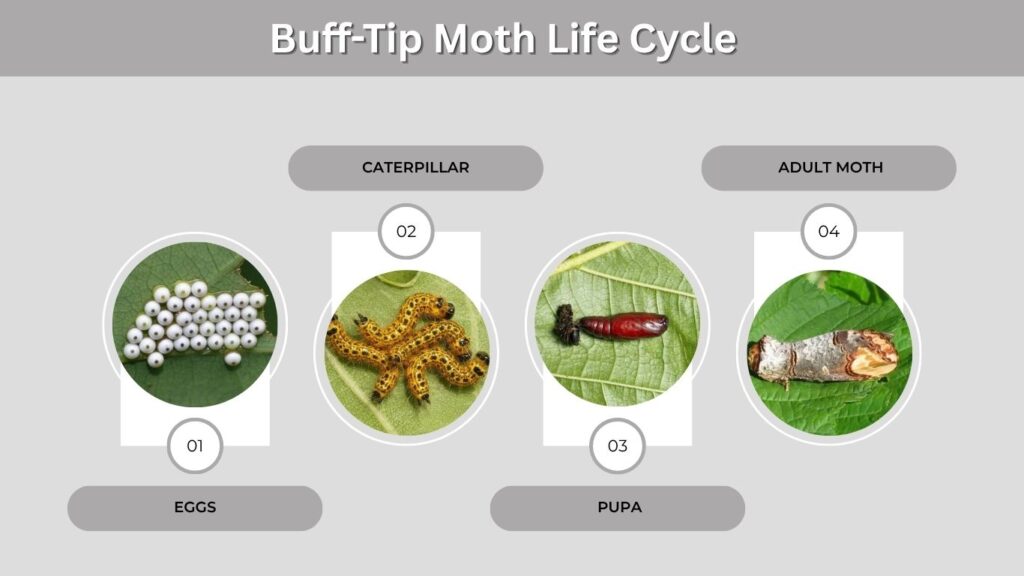
The buff-tip moth undergoes complete metamorphosis, moving through four distinct stages: egg, caterpillar, pupa, and adult moth.
In Britain, the species generally produces one generation per year.
1. Eggs
Females lay groups of eggs on the underside of leaves during late spring or summer.
The eggs are usually:
- Rounded or slightly flattened
- Pale in color
- Laid in compact groups
- Attached to suitable host-plant leaves
After developing, the larvae hatch and immediately begin feeding.
2. Larvae
Young caterpillars remain together and feed communally.
They molt several times as they increase in size. Their yellow-and-black appearance becomes especially obvious during later stages.
Larvae are most commonly noticed during summer and early autumn.
3. Pupa
When fully grown, caterpillars descend from their host trees and enter loose soil or leaf litter.
There they transform into tough brown pupae.
The buff-tip typically spends the winter in this pupal stage.
4. Adult Moth
Adults emerge when temperatures become suitable, generally from late spring through midsummer.
They are active at night and may be attracted to artificial lights. During daylight, they rest on trees, fences, or wooden surfaces where their camouflage is most effective.
Buff-Tip Moth Cocoon, Chrysalis, and Pupa
People frequently search for a buff-tip moth “cocoon” or “chrysalis,” but technically the transformation occurs within a pupa.
Unlike butterflies, whose exposed pupae are commonly called chrysalises, buff-tip moth caterpillars pupate underground or among leaf litter.
What Does the Pupa Look Like?
The pupa is generally:
- Dark reddish-brown
- Smooth
- Firm
- Approximately a few centimeters long
- Hidden underground or beneath debris
A substantial portion of the moth’s annual life cycle can be spent as a dormant pupa waiting for warmer weather.
Buff-Tip Moth Season in the UK
Adult buff-tip moths are most frequently encountered from late spring into summer.
Caterpillars become more noticeable later because they require time to hatch and grow after adults mate.
A simplified seasonal pattern is:
- Late spring: Adult emergence begins.
- Early to midsummer: Adults mate and females lay eggs.
- Summer: Caterpillars hatch and feed.
- Late summer to early autumn: Mature larvae leave host trees.
- Autumn and winter: Pupae remain underground.
- Following spring: New adults emerge.
Weather conditions can cause local variation in these dates.
Buff-Tip Moth Predators
Both adults and larvae face numerous predators during their lives.
The moth’s camouflage primarily protects it from visually hunting animals, while caterpillars depend more on their group behavior and conspicuous appearance.
Common Predators
Potential predators include:
- Insect-eating birds
- Bats
- Spiders
- Predatory insects
- Parasitic wasps
- Parasitic flies
Birds may consume caterpillars, while bats are more likely to hunt flying adults at night.
Parasitoid insects can also develop inside caterpillars or pupae and play an important role in natural population control.
Interesting Buff-Tip Moth Facts
The buff-tip is particularly well known among moth enthusiasts because its appearance provides a clear example of how natural selection can produce highly specialized camouflage.
Quick Facts
- The adult resembles a freshly broken twig.
- Its scientific name is Phalera bucephala.
- It belongs to the Notodontidae family.
- Adults are mainly nocturnal.
- Caterpillars often feed in groups.
- Birch, willow, hazel, and oak are common host plants.
- The species usually overwinters as a pupa.
- Adults and caterpillars have dramatically different appearances.
- Buff-tip moths are widespread in Britain.
- Caterpillars are not considered dangerously poisonous.
FAQs
1. Is the buff-tip moth rare?
No. The buff-tip is generally considered widespread in Britain, although numbers can vary between locations and years.
2. Is the buff-tip moth caterpillar poisonous?
No. It is not considered dangerously poisonous or venomous. However, avoiding unnecessary handling of hairy caterpillars is still sensible because sensitive skin may occasionally become irritated.
3. What does a buff-tip moth caterpillar eat?
The caterpillars eat leaves from deciduous trees, including birch, willow, hazel, oak, lime, alder, and several other species.
4. Where does the buff-tip moth spend winter?
It usually overwinters underground as a pupa. Mature caterpillars leave their host plants and pupate in soil or leaf litter before colder weather arrives.
5. Why does the buff-tip moth look like a stick?
Its silvery-gray coloration, cylindrical body, buff wing tips, and resting posture create a strong resemblance to a broken twig. This camouflage helps protect the moth from predators such as birds.