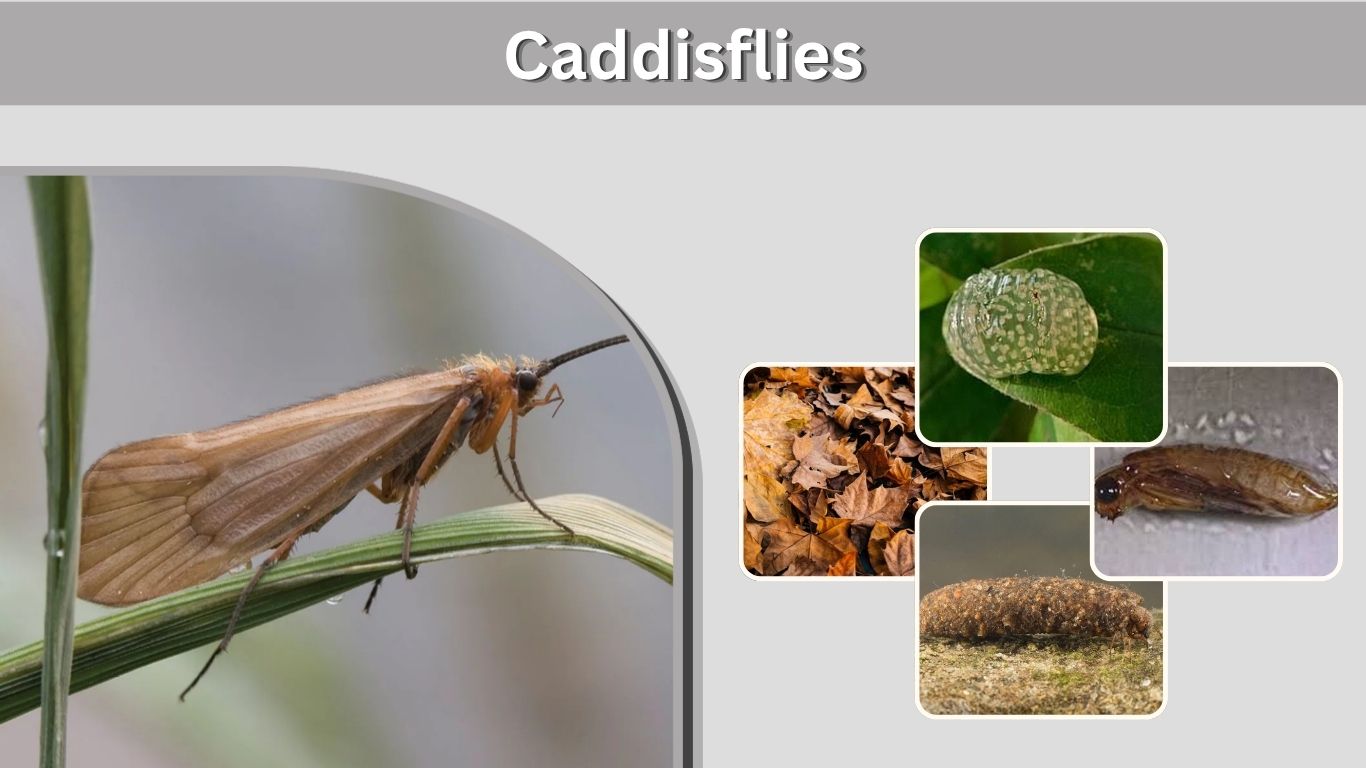
Caddisflies are small moth-like insects best known for their aquatic larvae, many of which build portable cases from sand, tiny stones, leaves, and twigs. They belong to the order Trichoptera and are closely related to moths and butterflies. Caddisflies are important parts of freshwater ecosystems because their larvae recycle organic material and provide food for fish. They are also widely used as indicators of water quality and are especially familiar to anglers because both larvae and adults are important in fly fishing.
What Are Caddisflies?
Caddisflies are insects whose immature stages usually develop in freshwater. Adults are often found close to rivers, streams, ponds, and lakes, especially during warm evenings. Although they may resemble small moths, their hairy wings, long antennae, and aquatic larvae help distinguish them. Thousands of species occur worldwide, occupying many different freshwater habitats.
Caddisfly Classification and Identification
Basic classification and features include:
- Order: Trichoptera
- Class: Insecta
- Type: Aquatic insect
- Adult body: Soft and usually brown, gray, or tan
- Wings: Hairy rather than scaly
- Antennae: Long and slender
- Larvae: Aquatic, soft-bodied, with a hardened head
- Metamorphosis: Complete
- Habitat: Mostly freshwater streams, rivers, lakes, and ponds
The name Trichoptera comes from words meaning “hairy wings,” which describes one of the main differences between adult caddisflies and moths.
Caddisflies vs Moths
Adult caddisflies can easily be mistaken for small moths. Caddisflies usually hold their wings roof-like over the body when resting and often have very long antennae.
Moths usually have scales covering their wings, while caddisfly wings are covered mainly with hairs. The most important difference is their life cycle: caddisfly larvae are predominantly aquatic, while most moth caterpillars live on land.
Caddisfly Larvae and Their Cases
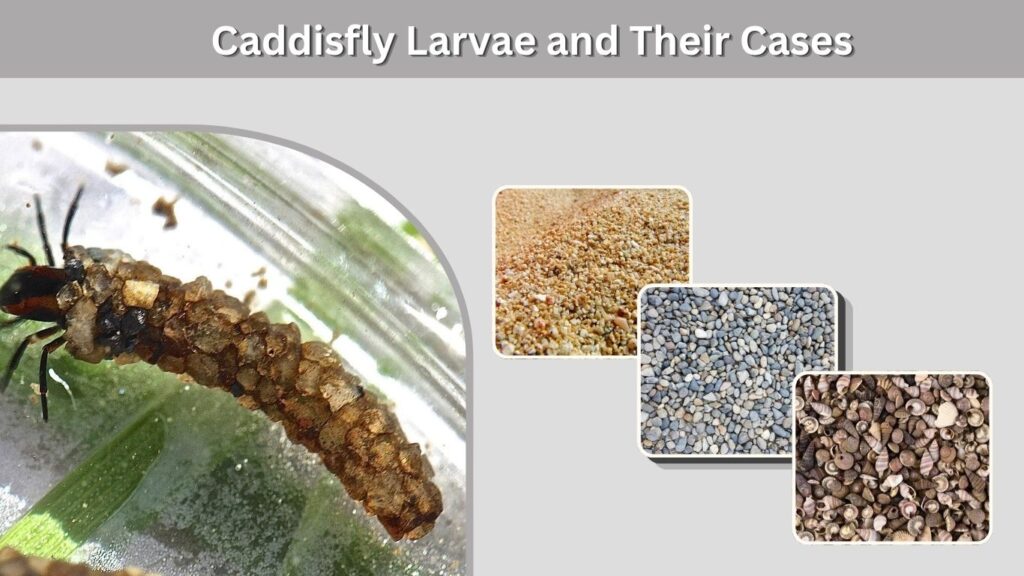
The larval stage is the most distinctive part of a caddisfly’s life. Caddisfly larvae live underwater and have adapted to almost every type of freshwater environment. Some build portable protective cases, some construct fixed retreats, and others move freely across rocks and vegetation. Their behavior has earned them the nickname “underwater architects.”
Cased Caddisflies
Many caddisfly larvae construct portable cases around their bodies. Materials depend on what is available locally.
A case may contain:
- Sand grains
- Small stones
- Tiny shells
- Pieces of leaves
- Twigs
- Bark fragments
- Plant stems
- Other natural debris
The larva binds these materials together with silk produced by glands near its mouth.
As the larva grows, it enlarges its case. The head and front legs extend from the opening so the insect can crawl and feed, while most of the soft abdomen remains protected inside.
Net-Spinning Caddisflies
Not all caddisflies carry cases. Net-spinning species build silk nets underwater, usually between rocks or other solid surfaces.
Water flows through the net, trapping:
- Algae
- Small organic particles
- Tiny animals
- Plant fragments
- Other drifting food
The larva collects and eats the trapped material. This feeding method makes some caddisfly species effective filter feeders.
Where Do Caddisflies Live?
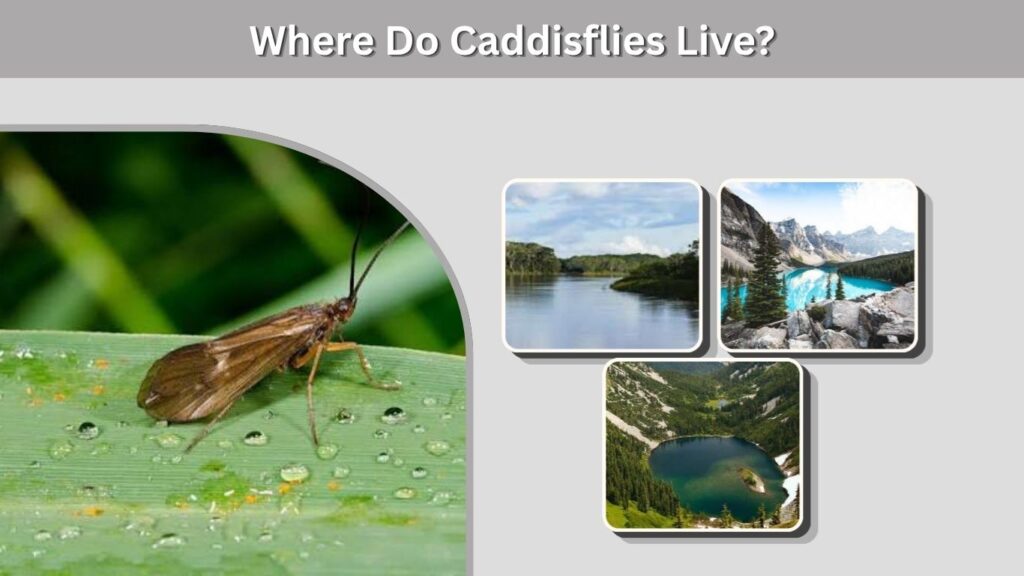
Caddisflies occur on every continent except Antarctica and are especially diverse in clean freshwater habitats. Their larvae may live in fast mountain streams, slow rivers, lakes, ponds, springs, wetlands, and temporary waterways. Different species have different requirements, so the exact type of water, temperature, current, oxygen level, and substrate can influence which species are present.
Caddisfly Habitat
Common habitats include:
- Mountain streams
- Rivers
- Lakes
- Ponds
- Springs
- Wetlands
- Rocky creek beds
- Aquatic vegetation
- Slow-moving pools
Fast-water species often cling tightly to rocks or build streamlined cases that reduce drag.
Species living in ponds and lakes may crawl among plants, mud, sticks, and submerged leaves.
Are Caddisflies Sensitive to Pollution?
Many caddisfly species are sensitive to low oxygen levels, chemical pollution, sedimentation, and major changes in water quality.
For this reason, aquatic biologists frequently study caddisfly larvae when assessing streams.
Caddisflies are commonly considered alongside mayflies and stoneflies in freshwater monitoring. Together these groups are sometimes referred to as EPT insects: Ephemeroptera, Plecoptera, and Trichoptera.
Not every caddisfly species is equally sensitive, but a diverse caddisfly community can be a positive sign of a healthy aquatic environment.
What Do Caddisflies Eat?
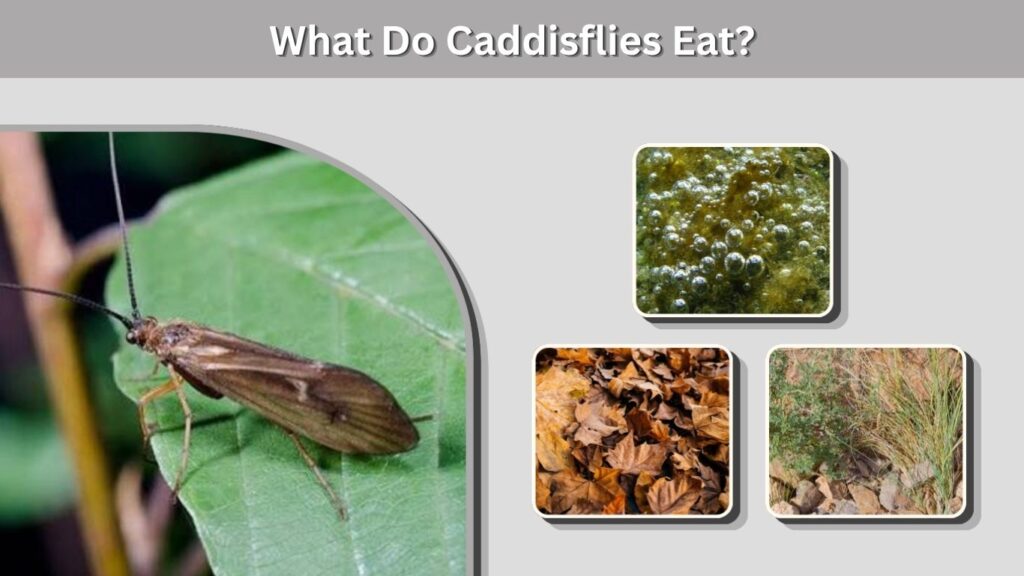
Caddisfly diets vary greatly among species and life stages. Larvae can be grazers, shredders, collectors, filter feeders, or predators. This diversity allows different species to occupy specialized roles within freshwater ecosystems. Adults generally eat very little compared with larvae, although some drink water, nectar, or other liquids during their short above-water lives.
Caddisfly Larvae Diet
Depending on species, larvae may eat:
- Algae
- Diatoms
- Decaying leaves
- Plant fragments
- Fine organic particles
- Bacteria
- Tiny aquatic animals
- Insect larvae
- Small crustaceans
Shredding species break down fallen leaves that enter streams.
Grazing species scrape algae from rocks, while collecting species consume fine particles deposited on the streambed.
Predatory species may hunt other aquatic insects.
Caddisfly Life Cycle
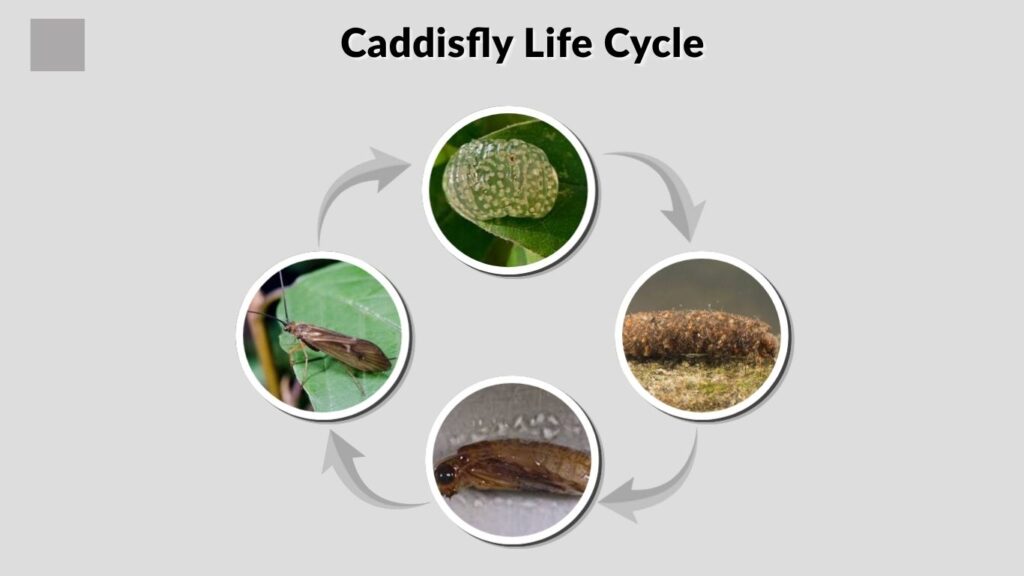
Caddisflies undergo complete metamorphosis, also called holometabolous development. Their life cycle includes egg, larva, pupa, and adult stages. Most of their life is usually spent underwater as larvae. The adult stage is relatively short and is mainly devoted to mating and reproduction.
Four Stages of the Caddisfly Life Cycle
- Egg
Females lay eggs in or near water. Some drop egg masses directly onto the surface, while others enter the water or attach eggs to submerged objects. - Larva
Larvae hatch and begin feeding underwater. They grow through several molts and may build cases, nets, or retreats. - Pupa
Mature larvae create a protected pupal chamber, often using silk and case materials. Transformation into the adult occurs underwater. - Adult
When development is complete, the pupa moves toward the water surface. The adult emerges, dries its wings, and flies away.
How Long Do Caddisflies Live?
The entire life cycle commonly lasts about a year, although timing varies with species and climate.
The aquatic larval stage lasts much longer than the adult stage. Adult caddisflies often live only days or a few weeks, during which their main purpose is to mate and produce the next generation.
Caddisflies and Fly Fishing
Caddisflies are extremely important to freshwater anglers because trout and other fish eat them throughout several stages of their life cycle. Anglers create artificial flies that imitate larvae, pupae, emerging adults, and egg-laying females. A large emergence of adults from the water is known as a hatch and can trigger intense feeding activity among fish.
Caddisfly Imitations Used in Fly Fishing
Common caddisfly patterns imitate:
- Cased larvae
- Free-living larvae
- Caddis pupae
- Emerging adults
- Adult caddisflies
- Egg-laying females
Adult caddisflies often flutter or skate across the water surface, so moving a dry fly slightly can sometimes imitate their natural behavior.
Do Caddisflies Bite or Harm Humans?
Caddisflies are not dangerous to humans. Adults do not have biting mouthparts designed to attack people, and they do not sting or transmit diseases.
Large numbers may sometimes gather around lights near rivers, lakes, bridges, and buildings. This can be annoying, but it does not mean they are harmful.
Caddisflies in the House
Adults may accidentally enter homes when attracted to:
- Porch lights
- Windows
- Indoor lamps
- Bright outdoor lighting
If many caddisflies appear around a house, the property is often located near a productive body of water.
Turning off unnecessary outdoor lights, closing screens, and reducing bright lighting near doors can help prevent them from entering.
Caddisfly Predators and Ecological Importance
Caddisflies are a major food source in freshwater ecosystems. Their larvae transfer nutrients from leaves, algae, and organic debris into larger animals. Adults also carry aquatic nutrients onto land when they emerge from the water, making them valuable links between aquatic and terrestrial food webs.
What Eats Caddisflies?
Common predators include:
- Trout
- Bass
- Minnows
- Aquatic insects
- Dragonfly larvae
- Frogs
- Salamanders
- Birds
- Bats
- Spiders
Fish are among their most important predators, which explains why caddisfly imitations are so widely used in fly fishing.
FAQs
1. What order do caddisflies belong to?
Caddisflies belong to the insect order Trichoptera. They are closely related to moths and butterflies but are distinguished by hairy wings and predominantly aquatic larvae.
2. Do all caddisfly larvae build cases?
No. Some species build portable cases, while others build fixed silk nets or retreats. Certain species are free-living predators and move across rocks without carrying a case.
3. Do caddisflies bite humans?
No. Adult caddisflies do not normally bite or sting humans and are not considered dangerous. Large swarms around lights may simply be a nuisance.
4. Why are caddisflies important?
They recycle organic matter, provide food for fish and other wildlife, and help scientists evaluate freshwater health. Their abundance also makes them extremely important to fly fishing.
5. Are caddisflies a sign of clean water?
Many species prefer clean, well-oxygenated freshwater and can be sensitive to pollution. Finding a diverse community of caddisflies, mayflies, and stoneflies often indicates relatively healthy stream conditions.