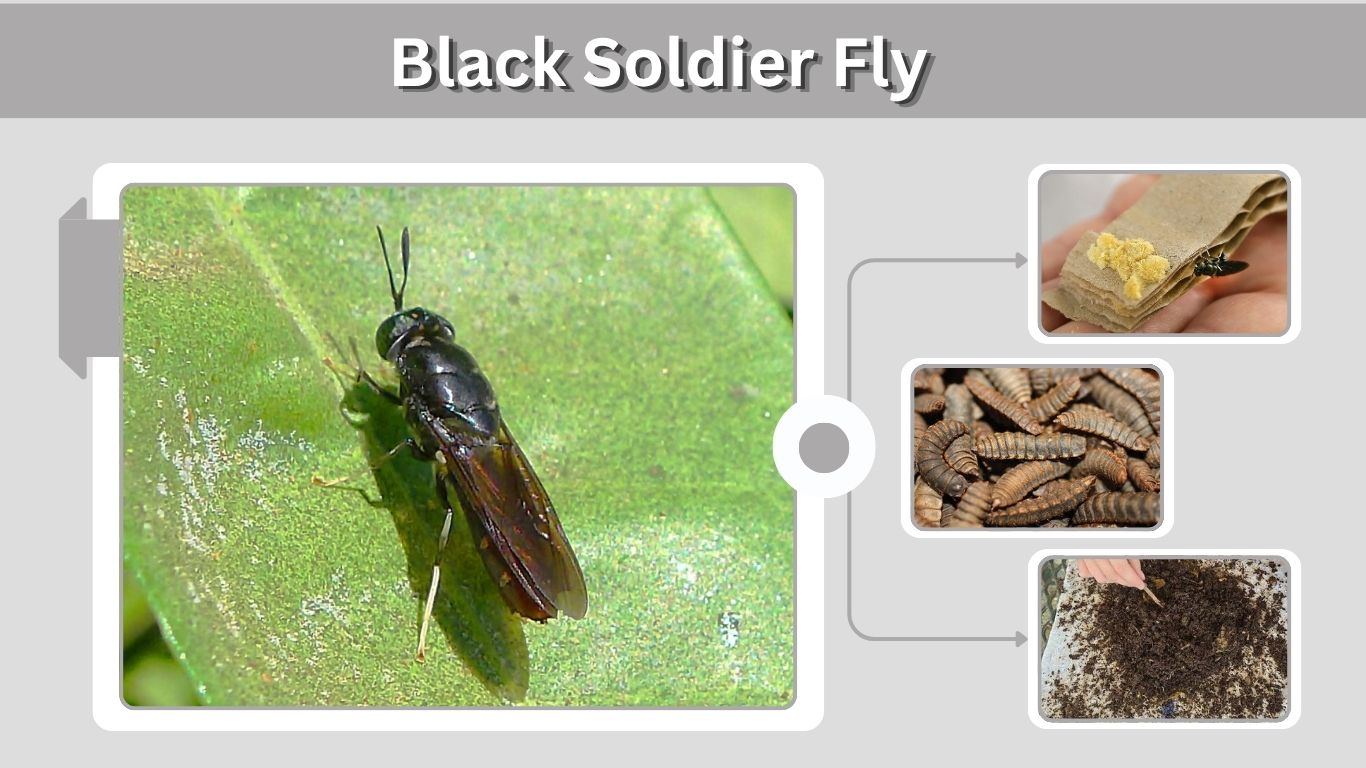
The black soldier fly (Hermetia illucens) is a distinctive wasp-like fly best known for what happens during its larval stage. Black soldier fly larvae can consume large quantities of decomposing organic material and convert it into nutrient-rich biomass, making them valuable for composting, animal feed, and commercial insect farming. Despite their dark appearance, adult black soldier flies do not sting and are generally considered harmless to people. Their unusual life cycle and ability to recycle organic waste have made them increasingly important in sustainable agriculture and waste management.
What Is a Black Soldier Fly?
The black soldier fly belongs to the soldier fly family Stratiomyidae. Its scientific name is Hermetia illucens. The species occurs widely around the world, particularly in warmer climates, and is often associated with compost, manure, food waste, and other decomposing organic materials where females can lay their eggs.
Black Soldier Fly Classification
- Common name: Black soldier fly
- Scientific name: Hermetia illucens
- Order: Diptera
- Family: Stratiomyidae
- Adult type: True fly
- Larvae: Often called BSFL, grubs, or soldier fly larvae
Unlike wasps, adults have only one functional pair of wings. Their narrow waist, dark coloration, and somewhat wasp-like appearance can nevertheless make identification confusing.
Black Soldier Fly Identification
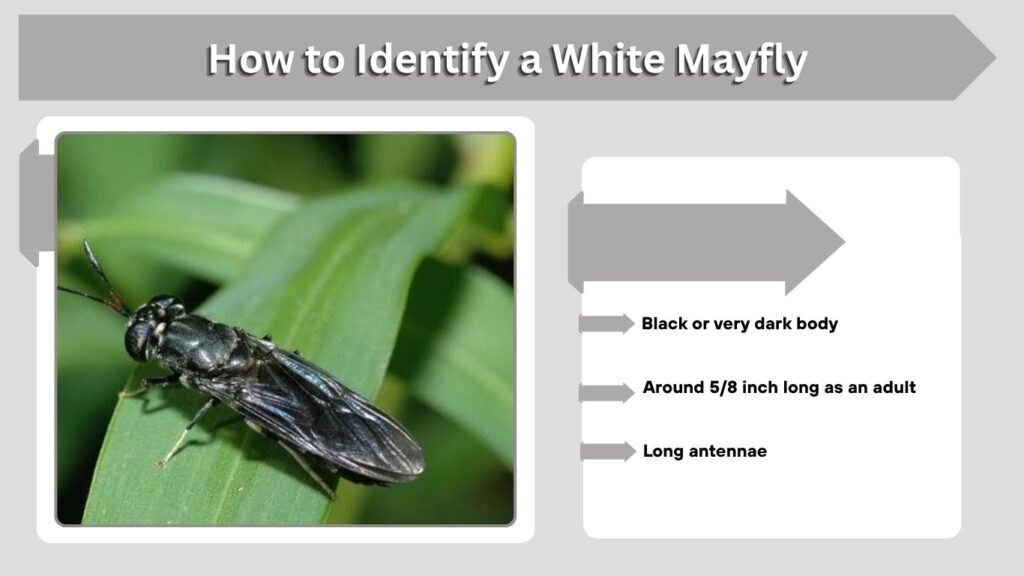
Adult black soldier flies are relatively large, dark insects. They are approximately 5/8 inch long, with black wasp-shaped bodies and smoky wings. White markings on the legs and translucent areas of the abdomen can also help with identification.
Key Identification Features
- Black or very dark body
- Around 5/8 inch long as an adult
- Smoky or translucent wings
- Long antennae
- Wasp-like body shape
- White markings on portions of the legs
- Only one pair of functional wings
- Does not have a stinger
Adult black soldier flies are often noticed around composting areas or animal facilities, although the larvae are usually far more numerous.
Black Soldier Fly Larvae
The black soldier fly larvae, commonly abbreviated BSFL, are the most economically useful stage of the insect. Fully grown larvae can approach 3/4 to 1 inch in length and have tough, deeply segmented bodies. Younger larvae are relatively light-colored but darken as they approach the prepupal stage.
What Do Black Soldier Fly Larvae Eat?
Larvae can develop in many types of decomposing organic material, including:
- Fruit and vegetable scraps
- Food waste
- Animal manure
- Decaying plant material
- Spoiled feed
- Agricultural byproducts
- Some food-processing residues
They consume these materials rapidly and convert part of them into larval biomass containing protein and fat. The precise nutritional composition of the larvae depends strongly on their age and the substrate on which they were raised.
Black Soldier Fly Life Cycle
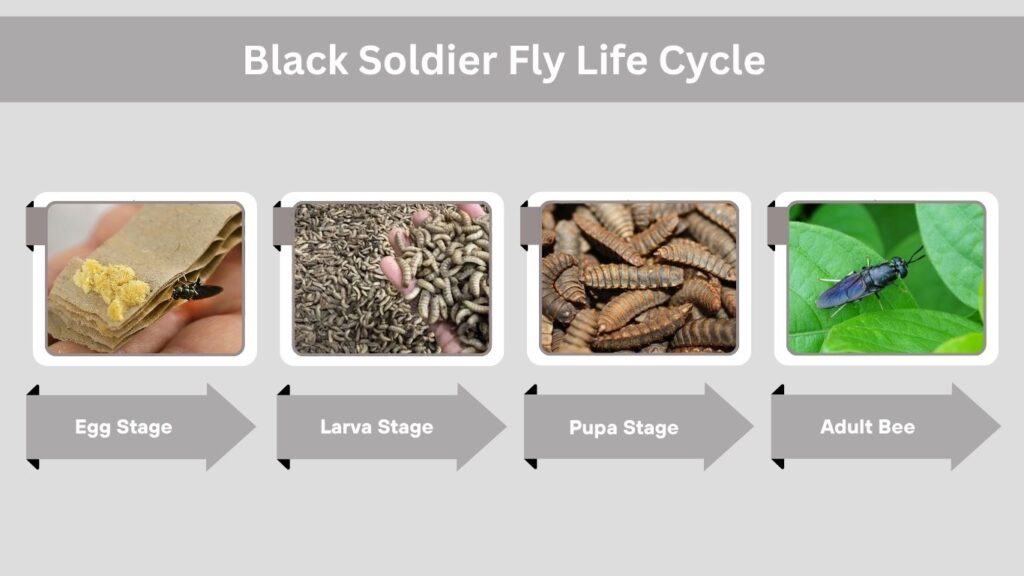
Like other true flies, black soldier flies undergo complete metamorphosis. They develop through egg, larva, pupa, and adult stages. Temperature, humidity, diet, and farming conditions can substantially change the amount of time spent in each stage.
Four Stages of the Life Cycle
- Egg: Females lay eggs close to suitable decomposing material rather than directly inside very wet waste.
- Larva: The larvae hatch and spend most of their growth period feeding heavily.
- Prepupa and pupa: Mature larvae stop feeding, become darker, and search for a dry location in which to pupate.
- Adult: Adults emerge, mate, and females seek suitable places for the next generation of eggs.
One University of Georgia production description reports about 18 days of active larval feeding, roughly 14 days in the pupal stage, and around nine days for the adult stage, although real development times vary considerably with environmental conditions.
Black Soldier Fly Composting
Black soldier fly larvae are particularly useful for processing moist organic waste. Instead of simply allowing food scraps to decompose, a managed population of larvae actively consumes the material and converts part of it into insect biomass.
Benefits of Black Soldier Fly Composting
- Reduces the volume of organic waste
- Converts discarded material into larval biomass
- Produces a residue that can be further processed as a soil amendment
- Can work faster than passive decomposition under suitable conditions
- Allows mature larvae to be harvested for other uses
University of Florida research summaries describe larvae as effective manure recyclers and note their potential to turn organic waste into both valuable larvae and improved residual material.
A black soldier fly bin usually works best when it remains moist without becoming flooded. Mature larvae naturally leave the feeding material to find a dry place to pupate, allowing specially designed ramps to make collection easier.
Black Soldier Fly Farming
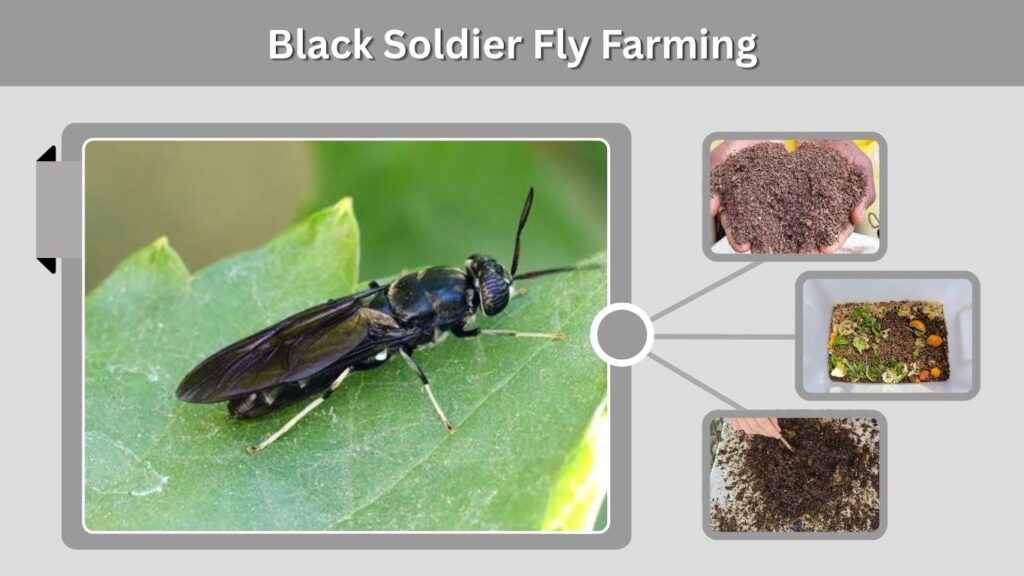
Commercial and small-scale black soldier fly farming focuses primarily on producing larvae rather than adults. A successful system must provide breeding adults with suitable conditions while maintaining a separate moist feeding environment for growing larvae.
Basic Requirements for Farming BSFL
- Suitable organic feed material
- Consistent moisture without waterlogging
- Warm temperatures
- Good drainage and ventilation
- Egg-laying surfaces
- Protection from predators
- A dry pupation area
- Collection ramps or containers
Farmers can harvest larvae alive, dry them, process them into meal, or use them as ingredients in animal feeds. Their final nutritional value varies according to diet, harvest age, and processing method.
Black Soldier Fly Larvae as Animal Feed
One major reason BSFL farming has expanded is their potential as a source of protein and fat for animal diets. Research has evaluated black soldier fly products for poultry, fish, and other farmed animals. Reviews describe BSFL meal as a promising feed ingredient, although formulation and inclusion levels must be appropriate for the animal and product.
Black Soldier Fly Larvae for Chickens
Chickens readily consume live or dried larvae. BSFL can contribute protein, fat, and other nutrients, but they should be treated as part of a balanced feeding program rather than automatically replacing a complete poultry ration.
Studies have found that appropriately formulated diets containing processed BSFL can replace some traditional feed ingredients without necessarily reducing poultry growth performance.
Black Soldier Fly Larvae for Reptiles
BSFL are also widely used as feeder insects for reptiles such as bearded dragons and some geckos. Their usefulness depends on the reptile species, age, overall diet, and the nutritional composition of the larvae.
Variety remains important when feeding insect-eating pets, and feeding recommendations should be adjusted to the specific animal rather than relying exclusively on one feeder insect.
Are Black Soldier Flies Dangerous?
Black soldier flies can look alarming because adults resemble dark wasps. However, they are not equipped with a stinger and are not generally considered dangerous household insects.
Do Black Soldier Flies Bite or Sting?
Black soldier flies do not sting. They are flies, not wasps. Mississippi State University specifically notes that their wasp-like appearance is misleading because they do not sting.
They are also not known as blood-feeding flies. Adult black soldier flies are therefore very different from mosquitoes, horse flies, or other insects that actively seek people for blood meals.
Why Are Black Soldiers Flying Larvae in My House?
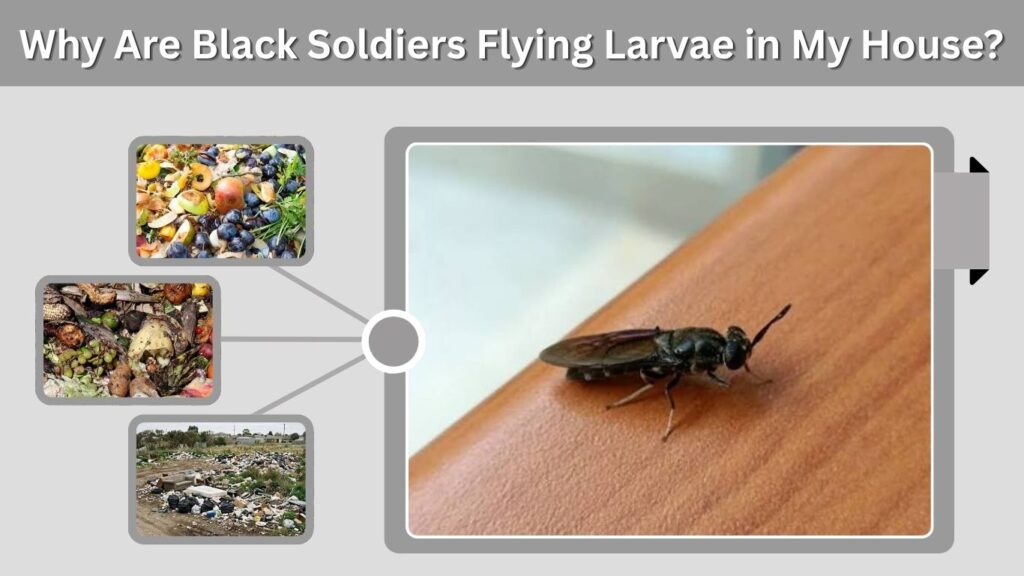
Finding one or two larvae indoors does not necessarily mean they developed where they were discovered. Fully grown larvae naturally wander away from their moist feeding source to locate a dry place for pupation, sometimes traveling several yards.
Possible Sources Indoors
- Wet organic waste
- Rotting food
- Poorly maintained garbage
- Compost near the building
- Animal waste
- Drain or sewage problems
- Spoiled pet or livestock feed
If larvae continually appear indoors, locating and removing the breeding material is generally more useful than simply killing the wandering larvae. Sanitation and moisture management are key control measures.
Black Soldier Fly Disadvantages
Although BSFL provides many benefits, they are not automatically suitable for every situation.
Commercial or home farming can produce odors if feed becomes too wet, overloaded, or poorly aerated. Escaping larvae may also become a nuisance when bins are poorly designed. The nutritional value of harvested larvae can vary considerably depending on what they consume.
Most importantly, larvae intended for animal or human food cannot simply be raised on any available waste. Research emphasizes that the safety of the growing substrate matters because contaminants and biological hazards must be considered when BSFL are produced for food or feed.
FAQs
1. What is a black soldier flying?
The black soldier fly (Hermetia illucens) is a large, dark member of the soldier fly family. Its larvae specialize in feeding on decomposing organic material and are widely used for waste conversion and animal-feed production.
2. Do black soldier flies sting?
No. Adult black soldier flies do not have a stinger and are generally harmless to people.
3. Are black soldiers fly larvae maggots?
Technically, yes. “Maggot” is a general term for the larval stage of many flies. However, these larvae are usually called black soldier fly larvae, BSFL, or grubs.
4. Are black soldier fly larvae good for chickens?
They can be a useful ingredient or supplemental food for chickens because they contain substantial protein and fat. They should still be used as part of an appropriately balanced poultry diet.
5. Why are black soldier fly larvae useful for compost?
Their larvae rapidly consume decomposing organic material and convert part of it into insect biomass, reducing waste while producing larvae that can potentially be harvested for animal feed.