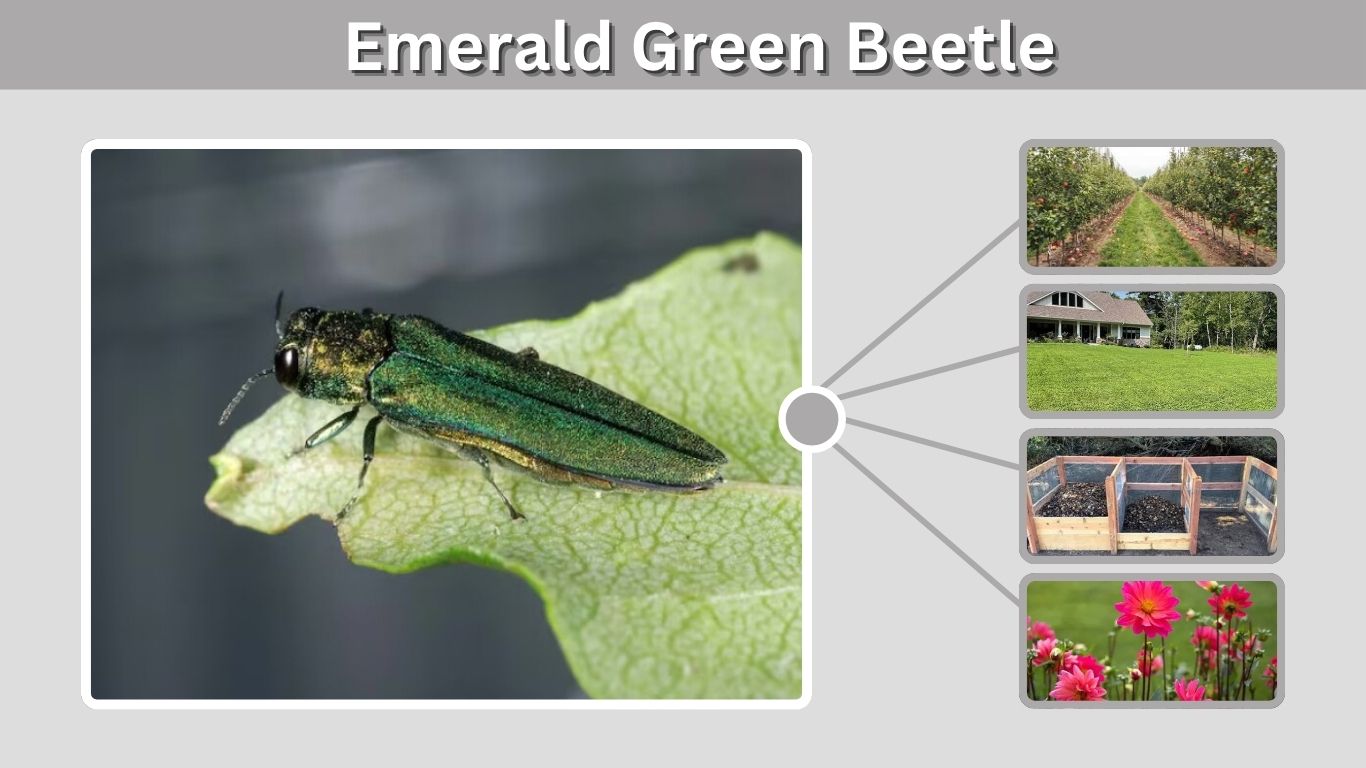
An emerald green beetle is not always one exact species. People use this phrase for many shiny green insects, including emerald ash borers, green tiger beetles, green June beetles, Japanese beetles, and jewel beetles. Some are harmless predators, some are garden pests, and one is a serious ash-tree pest. This guide explains how to identify emerald green beetles by size, shape, location, color, diet, and behavior.
What Is an Emerald Green Beetle?
An emerald green beetle is usually any beetle with a bright metallic green, blue-green, or jewel-like body. The name describes the color, not one scientific species. That means identification depends on body shape, size, legs, antennae, habitat, and where you found it.
| Beetle Type | Size | Main Identification Clue |
| Emerald ash borer | 3/8–1/2 inch | Small, narrow, metallic green body |
| Six-spotted tiger beetle | 12–14 mm | Long legs, big eyes, sickle-shaped jaws |
| Green June beetle | Nearly 1 inch | Large scarab, bronze-yellow body edges |
| Japanese beetle | Less than 1/2 inch | Green body, copper wings, white hair tufts |
| Green tiger beetle | Medium-large | Metallic green with pale wing spots |
The most important thing is not to identify every green beetle as an emerald ash borer. Many harmless beetles are metallic green, but emerald ash borer is strongly associated with ash trees.
Emerald Green Beetle Identification
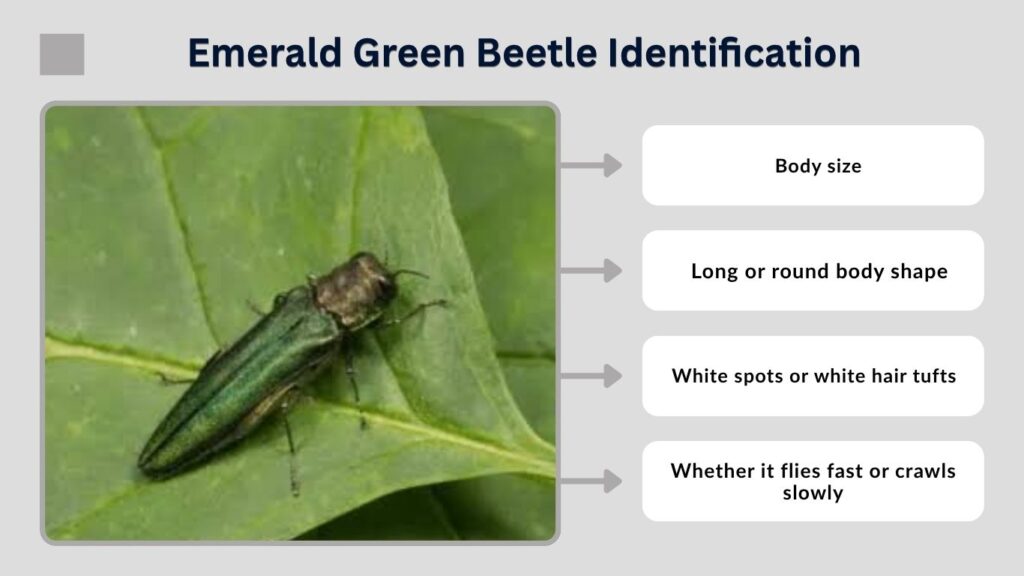
Emerald green beetles can look similar at first glance. Look closely at the beetle’s body shape and where it was found.
Main Features to Check
Use these signs for identification:
- Body size
- Long or round body shape
- Metallic green, bronze, copper, or blue color
- White spots or white hair tufts
- Long running legs or short digging legs
- Whether it flies fast or crawls slowly
- Whether it is on ash trees, flowers, lawns, or paths
If the beetle is small, narrow, metallic green, and found around ash trees, emerald ash borer is possible. USDA APHIS describes adult emerald ash borers as metallic green beetles with a coppery-red abdomen and about one-half inch long.
Common Types of Emerald Green Beetles
Several beetles can match the “emerald green beetle” keyword. These are some of the most common or commonly searched types.
Emerald Ash Borer
The emerald ash borer, Agrilus planipennis, is one of the most important green beetles to know. It is small, metallic green, and destructive to ash trees. Adults are only about the size of a cooked grain of rice, around 3/8 to 1/2 inch long and very narrow.
This beetle is a major concern because its larvae tunnel under ash bark and damage the tree’s ability to move water and nutrients. USDA APHIS says emerald ash borer can attack and kill healthy ash trees in forests, urban areas, suburbs, and rural settings.
Emerald Green Tiger Beetle
The phrase “emerald green tiger beetle” often refers to shiny green tiger beetles. In North America, one common example is the six-spotted tiger beetle, Cicindela sexguttata. The University of Minnesota describes it as a striking metallic green or sometimes blue beetle with long legs, large bulging eyes, and large sickle-shaped mandibles.
Tiger beetles are active hunters. They run quickly on sunny paths, woodland trails, sandy ground, and open soil. Unlike emerald ash borers, they are predators and do not damage trees.
Green June Beetle
A large emerald green flying beetle may be a green June beetle. NC State Extension describes adult green June beetles as metallic green and nearly one inch long, with bronze to yellow margins on the body.
Green June beetles are scarab beetles. Adults often fly loudly in summer and may feed on ripe fruit, while larvae live in soil or organic matter. Their size makes them easy to separate from emerald ash borers.
Japanese Beetle
Japanese beetles are another shiny green beetle people may notice in gardens. Wisconsin Horticulture describes adults as shiny metallic green, slightly less than 1/2 inch long, with coppery-brown wing covers and small white hair patches along the sides.
They are common garden pests because adults feed on leaves, flowers, and fruit. Their white side tufts are one of the easiest ID clues.
Small vs Large Emerald Green Beetles
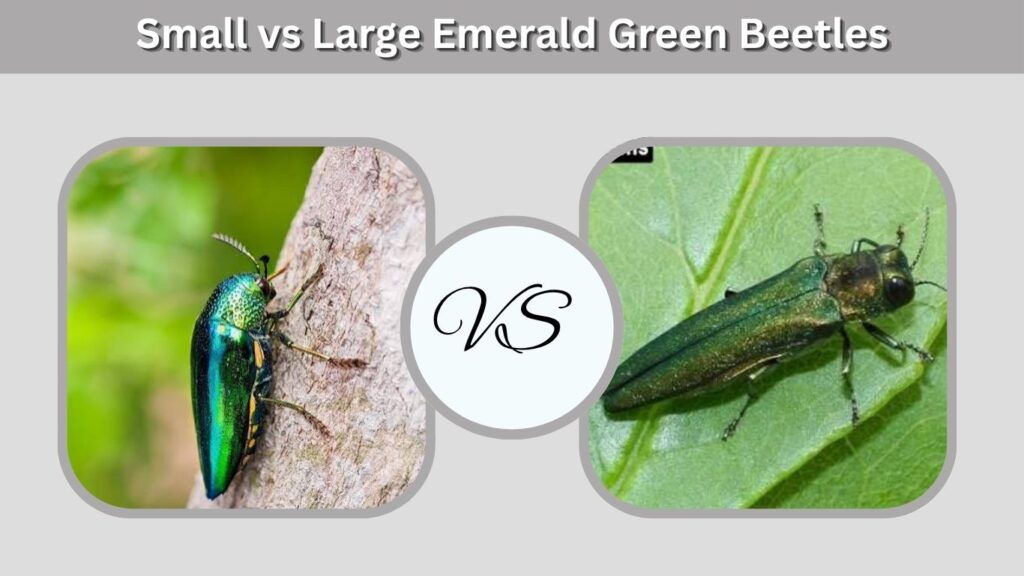
Size is one of the fastest ways to narrow down the ID. A small emerald green beetle on an ash tree may raise concern for emerald ash borer. A large emerald green beetle buzzing around lawns or fruit is more likely a green June beetle or similar scarab.
| Description | Possible Beetle | Helpful Clue |
| Small, narrow, metallic green | Emerald ash borer | Often linked with ash trees |
| Fast, long-legged green beetle | Tiger beetle | Hunts on open ground |
| Large, loud, green flying beetle | Green June beetle | Nearly 1 inch long |
| Green with copper wings | Japanese beetle | White side hair tufts |
| Bright jewel-like green beetle | Jewel beetle or scarab | Often region-specific |
A photo from above, the side, and a size comparison can help with proper identification.
Emerald Green Beetle Habitat
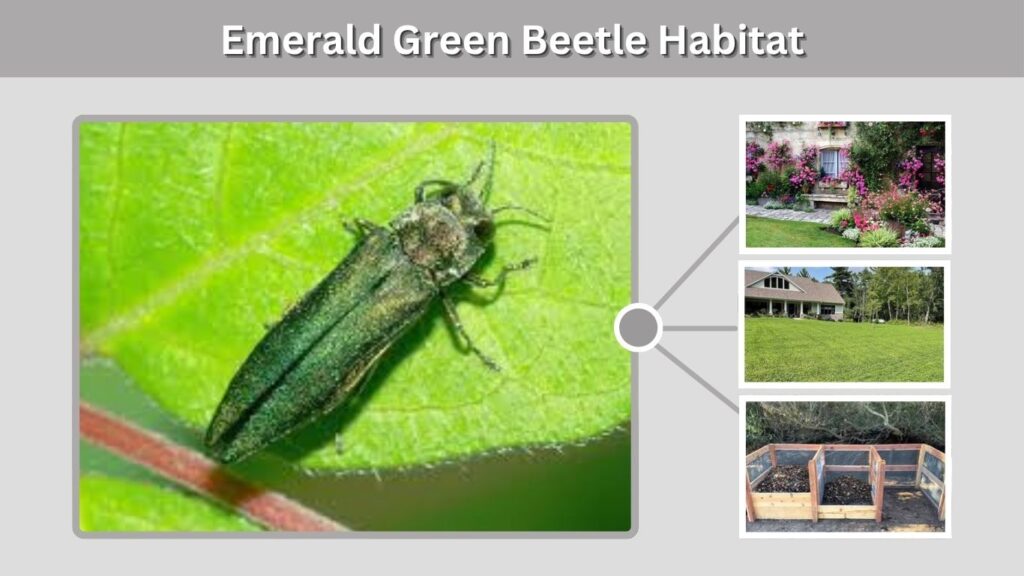
Emerald green beetles live in many habitats because the phrase covers many beetle groups. Emerald ash borers are linked with ash trees. Tiger beetles often prefer sunny open ground. Green June beetles are often seen around lawns, gardens, compost, and fruit trees.
Where You Might Find Them
Common places include:
- Ash trees
- Garden plants
- Lawns
- Woodland trails
- Sandy paths
- Fruit trees
- Flowers
- Compost areas
- Porch lights
The UK green tiger beetle, Cicindela campestris, is widespread in Britain and recognized by iridescent green coloring and yellowish spots on its back.
Emerald Green Beetle by Location
Location is useful because different green beetles are common in different regions. In the United States, emerald ash borer is a major concern in many states, especially where ash trees grow. Green June beetles are common in many eastern and southern areas. Tiger beetles may be found on sunny trails and open ground.
California
A big emerald green beetle in California may be a green fruit beetle or figeater beetle rather than emerald ash borer. These scarabs are often seen near ripe fruit and compost in warm areas.
Texas and Arizona
In dry or southwestern regions, some emerald green beetles may be jewel scarabs, tiger beetles, or other metallic beetles. Color alone is not enough for identification.
UK
In the UK, “green tiger beetle” usually refers to Cicindela campestris. Wildlife Trusts describes it as a large metallic-green beetle with purple-bronze legs and eyes and large creamy spots on the wing cases.
What Do Emerald Green Beetles Eat?
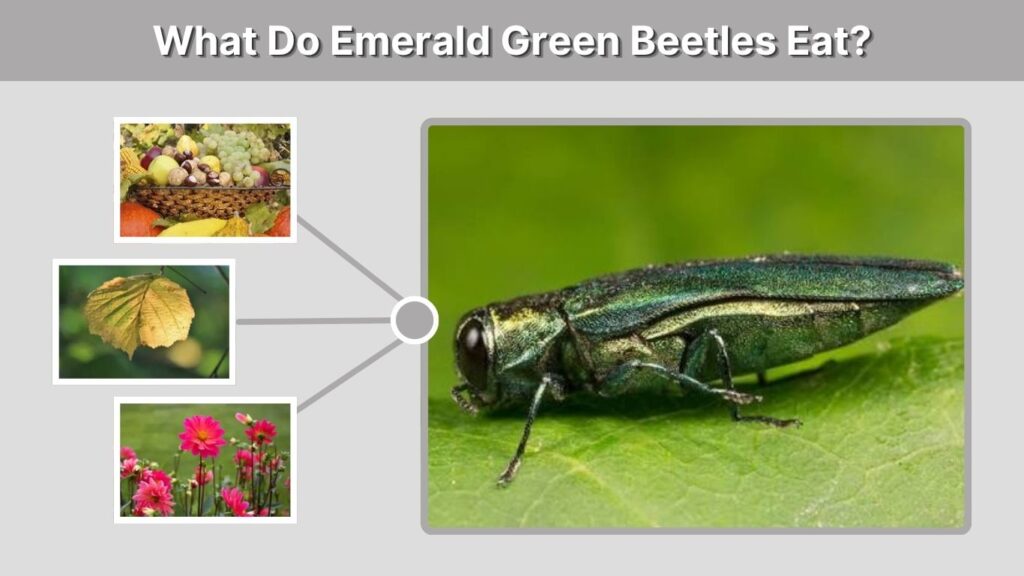
Diet depends on the species. Some emerald green beetles eat leaves, some eat fruit, some eat tree tissue, and others hunt small insects.
Emerald ash borer larvae feed under ash bark, causing the most serious damage. Tiger beetles are predators that hunt small invertebrates. Japanese beetles feed on many garden plants. Green June beetles may feed on ripe or damaged fruit.
Common Diet Examples
- Emerald ash borer larvae: inner ash-tree tissue
- Tiger beetles: small insects and invertebrates
- Green June beetles: ripe fruit and organic matter
- Japanese beetles: leaves, flowers, and fruit
- Jewel beetles: often wood or plant material, depending on species
Because the diets are different, the plant or surface where you found the beetle can help identify it.
Do Emerald Green Beetles Bite?
Most emerald green beetles are not dangerous to people. They do not sting, and most are not aggressive. Tiger beetles have noticeable jaws because they are predators, but they usually run or fly away rather than bite humans.
A beetle may pinch or scratch if handled roughly, so it is better to observe it or move it gently with a container. Wash your hands after handling any insect.
Is an Emerald Green Beetle Harmful?
Some emerald green beetles are harmless or even helpful. Tiger beetles are predators and can help control small insects. Others, such as Japanese beetles, can damage garden plants. Emerald ash borer is the most serious because it kills ash trees.
A green beetle may be harmful if:
- It is an emerald ash borer on or near ash trees
- It appears in large numbers on garden plants
- It skeletonizes leaves
- It damages fruit
- Its larvae are damaging turf roots
If you suspect emerald ash borer, check for D-shaped exit holes, bark splitting, canopy thinning, and winding larval galleries under bark. USDA APHIS lists adult appearance and infestation signs as key things to watch for.
FAQs
What is an emerald green beetle?
An emerald green beetle is usually any beetle with a bright metallic green body. It may be an emerald ash borer, tiger beetle, green June beetle, Japanese beetle, or jewel beetle. The exact species depends on size, shape, location, and habitat.
Is an emerald green beetle the same as an emerald ash borer?
Not always. Emerald ash borer is a small metallic green beetle that attacks ash trees, but many other beetles are also emerald green. Large scarabs, tiger beetles, and Japanese beetles can all look green and shiny but are different insects.
Are emerald green beetles harmful?
Some are harmful, while others are not. Emerald ash borers kill ash trees, and Japanese beetles damage garden plants. Green tiger beetles are usually helpful predators, and green June beetles are mostly a nuisance unless they damage fruit or turf.
What does an emerald green tiger beetle eat?
An emerald green tiger beetle is a predator. Adults hunt small insects and other tiny invertebrates on open ground, trails, or sandy soil. Their long legs, large eyes, and strong jaws help them chase and catch prey.
How can I identify a small emerald green beetle?
Check its size, shape, and host plant. A very small, narrow metallic green beetle near ash trees may be an emerald ash borer. A fast beetle with long legs may be a tiger beetle. A green beetle with copper wings and white side tufts may be a Japanese beetle.