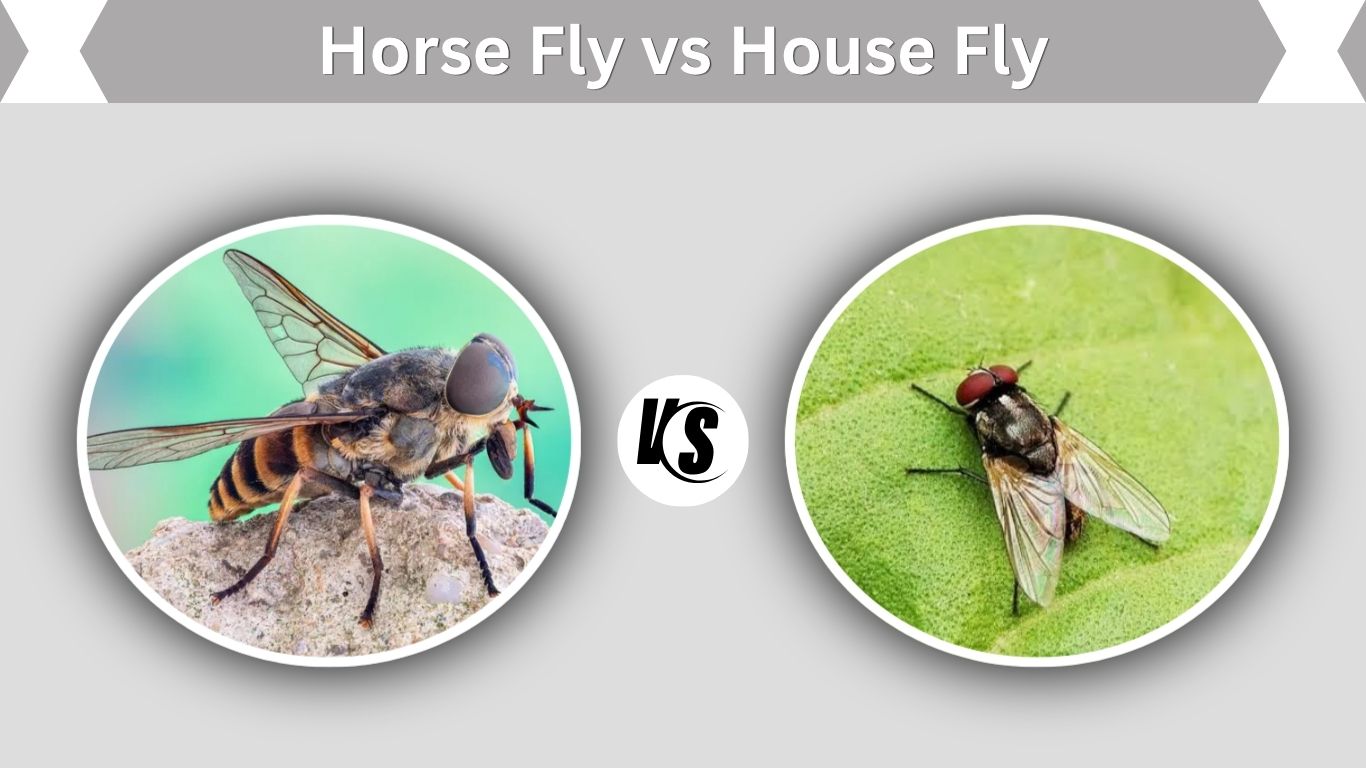
Horse flies and house flies may both appear around homes, animals, and outdoor spaces, but they are very different insects. Horse flies are larger, stronger fliers, and females can deliver painful bites because they feed on blood. House flies are smaller, do not bite, and are more closely associated with garbage, food waste, manure, and indoor sanitation problems. Understanding the differences in size, appearance, behavior, habitat, and bite risk makes identification easier and helps you choose the right control method.
Horse Fly vs House Fly: Quick Differences
The easiest way to separate a horse fly from a house fly is to compare size, body shape, feeding behavior, and where the insect is found. Horse flies are noticeably larger and often occur around livestock, wetlands, and outdoor areas. House flies are smaller and much more commonly seen inside homes, kitchens, barns, and garbage areas.
Main Differences at a Glance
- Horse fly: Usually larger and heavier-bodied
- House fly: Smaller and more compact
- Horse fly: Females can bite people and animals
- House fly: Does not bite
- Horse fly: Often found outdoors near livestock and water
- House fly: Common around homes, garbage, food, and manure
- Horse fly: Strong, fast flier
- House fly: Frequently lands on indoor surfaces and food
- Horse fly: Belongs to the family Tabanidae
- House fly: Scientific name is Musca domestica
Which One Is Easier to Recognize?
A horse fly usually looks much more substantial than an ordinary house fly. Its large eyes, broad body, and powerful flight are noticeable when it comes close.
House flies are familiar gray flies commonly seen walking across windows, countertops, walls, and food surfaces. They usually seem lighter, smaller, and less intimidating than horse flies.
Horse Fly vs House Fly Size
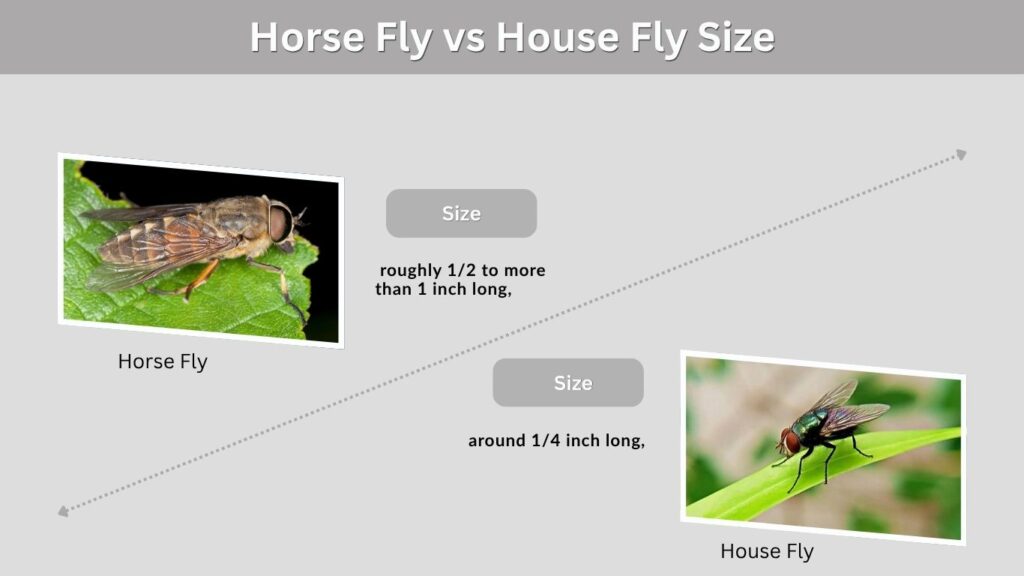
Size is one of the clearest identification clues. Although exact measurements vary between horse fly species, many horse flies are significantly larger than common house flies. Looking at overall body length, wing span, and body thickness can quickly narrow down which insect you are dealing with.
Horse Fly Size
Many horse flies measure roughly 1/2 to more than 1 inch long, depending on the species. Their bodies tend to be thick and muscular, giving them a heavier appearance.
Common size features include:
- Broad head
- Large, prominent eyes
- Thick thorax
- Strong wings
- Robust abdomen
- Overall heavy-bodied appearance
Some of the largest species are immediately recognizable because they appear far bigger than flies normally found indoors.
House Fly Size
A typical adult house fly is around 1/4 inch long, although individual size can vary.
House flies have a more compact body with gray coloration and darker longitudinal stripes across the thorax. Their size allows them to move quickly through small openings and land easily on walls, windows, food, and household surfaces.
If a fly looks unusually large, aggressive, and powerful in flight, it is much more likely to be a horse fly than a common house fly.
Appearance and Identification
Beyond size, horse flies and house flies have several visible differences. Eye size, body color, wing structure, and overall shape can all help with identification. Close inspection is rarely necessary because their behavior and body proportions are often different enough to tell them apart from a safe distance.
What Does a Horse Fly Look Like?
Horse flies usually have very large eyes that may appear brightly colored or patterned. Their bodies can range from dark brown and black to grayish or yellowish tones.
They generally have broad heads, strong wings, and thick bodies. Their mouthparts are adapted for blood feeding in females, although these structures are not always obvious without magnification.
What Does a House Fly Look Like?
House flies are usually gray with four dark stripes running lengthwise along the upper thorax.
Other identifying features include:
- Large reddish compound eyes
- One pair of functional wings
- Grayish abdomen
- Small to medium body size
- Sponging mouthparts rather than biting mouthparts
House flies frequently clean their legs and mouthparts while resting, a behavior often seen on walls and countertops.
Wings and Flight Behavior
Horse flies are strong, direct fliers and can move quickly over considerable distances. They may repeatedly circle animals or people before attempting to land.
House flies also fly rapidly, but their movement indoors tends to involve short flights between windows, food, walls, garbage cans, and other surfaces.
That difference in flight behavior can be another useful identification clue.
Do Horse Flies and House Flies Bite?
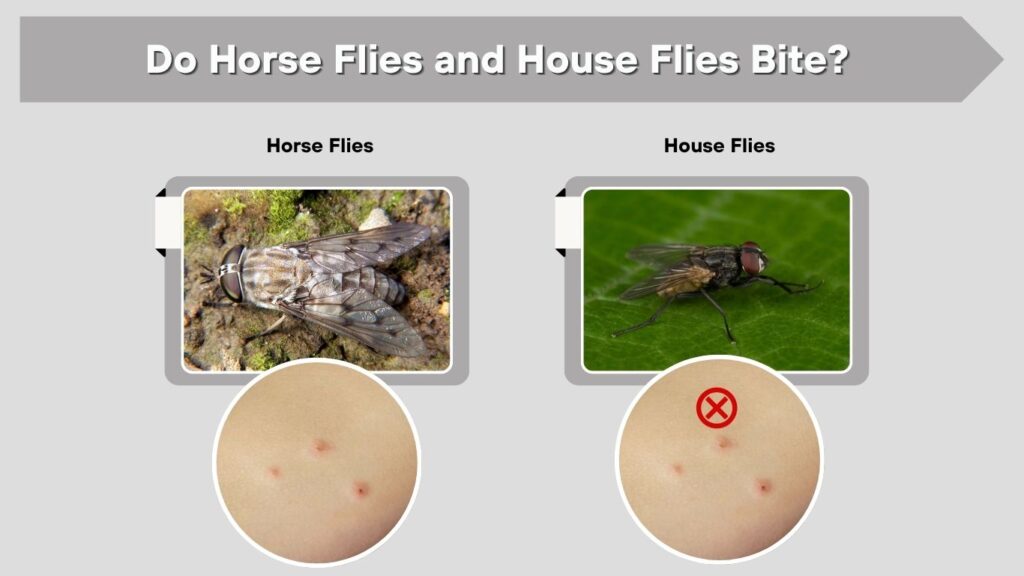
Biting behavior is one of the most important differences between these two flies. Female horse flies can bite because they require blood for egg development. House flies do not have piercing mouthparts and cannot bite people in the same way.
Horse Fly Bites
Female horse flies use cutting mouthparts to create a wound and then feed on blood. Their bites can be painful because the mouthparts tear the skin rather than puncturing it like a mosquito.
Common reactions may include:
- Sudden sharp pain
- Redness
- Local swelling
- Itching
- Tenderness around the bite
Most bites cause localized irritation, although people who develop severe swelling, breathing difficulty, or signs of a serious allergic reaction should seek medical attention.
Can House Flies Bite?
No. Common house flies do not bite humans or pets.
Their mouthparts are designed to sponge up liquid food. They often regurgitate digestive fluids onto solid food before feeding, which is one reason their presence around kitchens and food-preparation areas is undesirable.
Although they do not bite, house flies can contaminate surfaces after visiting garbage, feces, animal waste, or other unsanitary materials.
Habitat and Behavior
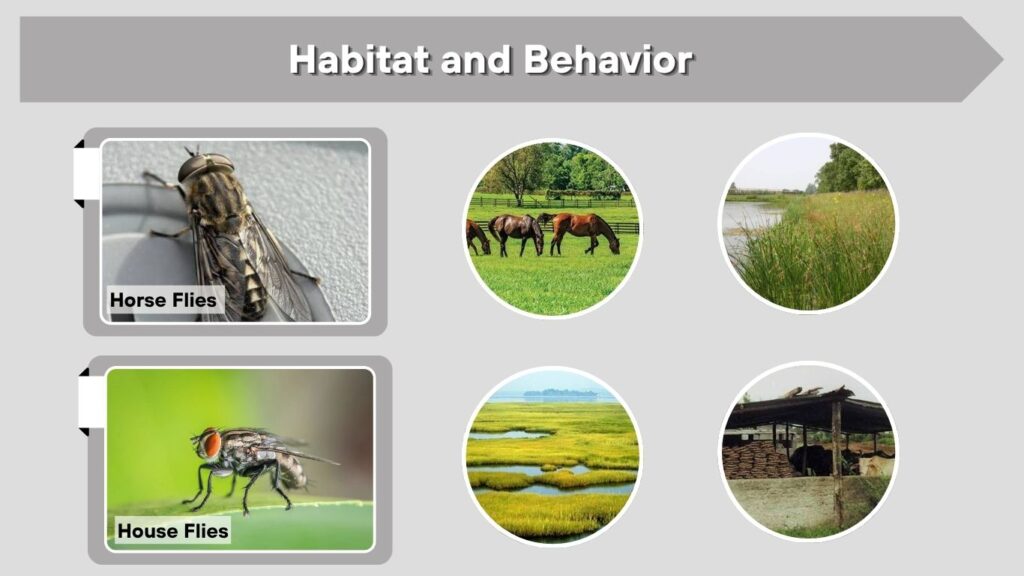
Horse flies and house flies also prefer different environments. Horse flies are primarily outdoor insects, while house flies readily live around human structures. Knowing where the fly appears can therefore provide an important clue about its identity.
Where Horse Flies Are Found
Horse flies are commonly associated with:
- Farms and pastures
- Livestock areas
- Wetlands
- Pond and lake edges
- Wooded locations
- Marshy environments
- Outdoor recreational areas
Their larvae typically develop in moist soil, wet organic material, or aquatic and semi-aquatic habitats depending on the species.
Adults are especially noticeable around horses, cattle, deer, and people during warm weather.
Where House Flies Are Found
House flies thrive near human activity. They commonly occur around homes, restaurants, farms, dumpsters, animal facilities, and garbage areas.
Females lay eggs in decaying organic material such as manure, food waste, and garbage. The eggs hatch into maggots, which feed before moving into the pupal stage.
Because suitable breeding materials are common around people, house fly populations can increase quickly if sanitation is poor.
Horse Fly vs House Fly Control
Control methods differ because the two flies have different habits. House fly control usually centers on sanitation and exclusion, while horse fly management often focuses on reducing exposure outdoors and protecting animals.
How to Reduce House Flies
House fly control should focus on removing breeding material and preventing entry.
Useful steps include:
- Keep garbage containers tightly covered
- Clean spills and food residue quickly
- Remove pet waste and manure frequently
- Repair damaged window and door screens
- Clean garbage cans regularly
- Store food in sealed containers
- Eliminate decaying organic material
Fly traps can supplement sanitation, but they will not solve the problem if breeding material remains available.
How to Reduce Horse Fly Problems
Horse flies are more difficult to eliminate because they may travel from breeding areas beyond your property.
Reducing exposure can include keeping doors and screens closed, using appropriate personal repellents, providing livestock with protected areas, and using traps designed for large biting flies.
Removing standing water alone may not eliminate horse flies because many species develop in much larger wet habitats that cannot realistically be treated.
Horse Fly vs Deer Fly vs House Fly
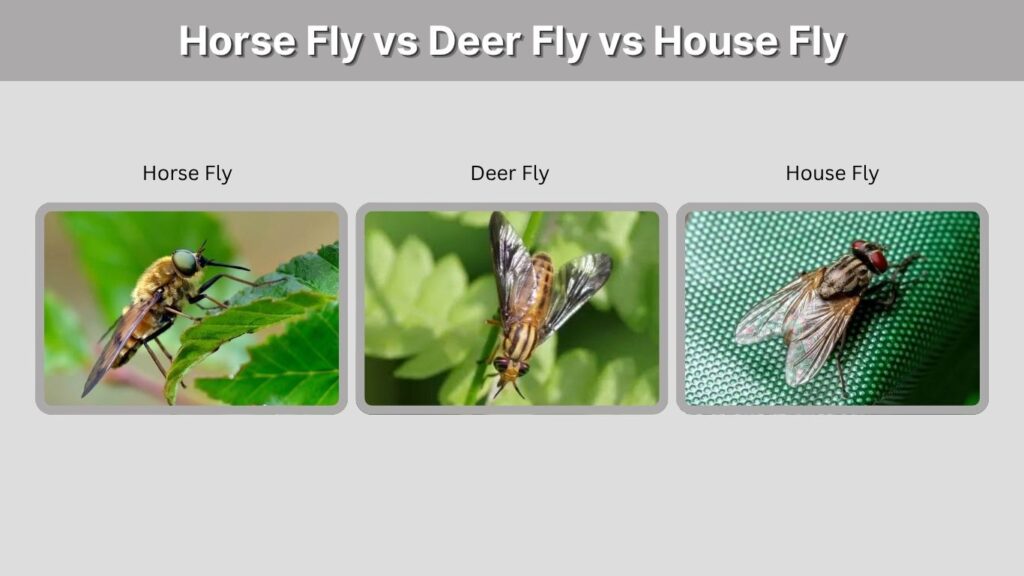
These three flies are sometimes confused, but they differ considerably. Horse flies and deer flies are both members of the Tabanidae family and females of both groups feed on blood. House flies belong to a different fly family and do not bite.
How Deer Flies Compare
Deer flies are generally smaller than many horse flies and often have patterned wings. They can also deliver painful bites and commonly occur in wooded, wet, or rural environments.
House flies are usually smaller than both and lack the biting behavior that makes horse flies and deer flies so noticeable.
If the insect is large, outdoors, and actively trying to bite, it is far more likely to be a horse fly or deer fly than a house fly.
FAQs
1. Is a horse fly bigger than a house fly?
Yes. Most horse flies are noticeably larger and heavier-bodied than common house flies. Many horse flies can reach around 1/2 inch or more in length, while house flies are commonly about 1/4 inch long.
2. Which is more dangerous, a horse fly or a house fly?
Horse flies are more likely to cause direct injury because females bite and feed on blood. House flies do not bite, but they are important sanitation pests because they can transfer contaminants from waste to food and household surfaces.
3. Why are horse flies around my house?
Horse flies may appear around homes located near livestock, wooded land, wetlands, ponds, or other moist habitats. They usually come from outdoor breeding environments rather than reproducing inside houses.
4. Can house flies turn into horse flies?
No. House flies and horse flies are separate groups of flies. A house fly develops from a house fly egg, while a horse fly develops from eggs laid by a horse fly. One species cannot transform into the other.
5. How can I tell a horse to fly from a house quickly?
Look at size and behavior. Horse flies are usually much larger, stronger-bodied, and may repeatedly approach people or animals to bite. House flies are smaller, gray, non-biting flies commonly found around food, garbage, windows, and indoor surfaces.