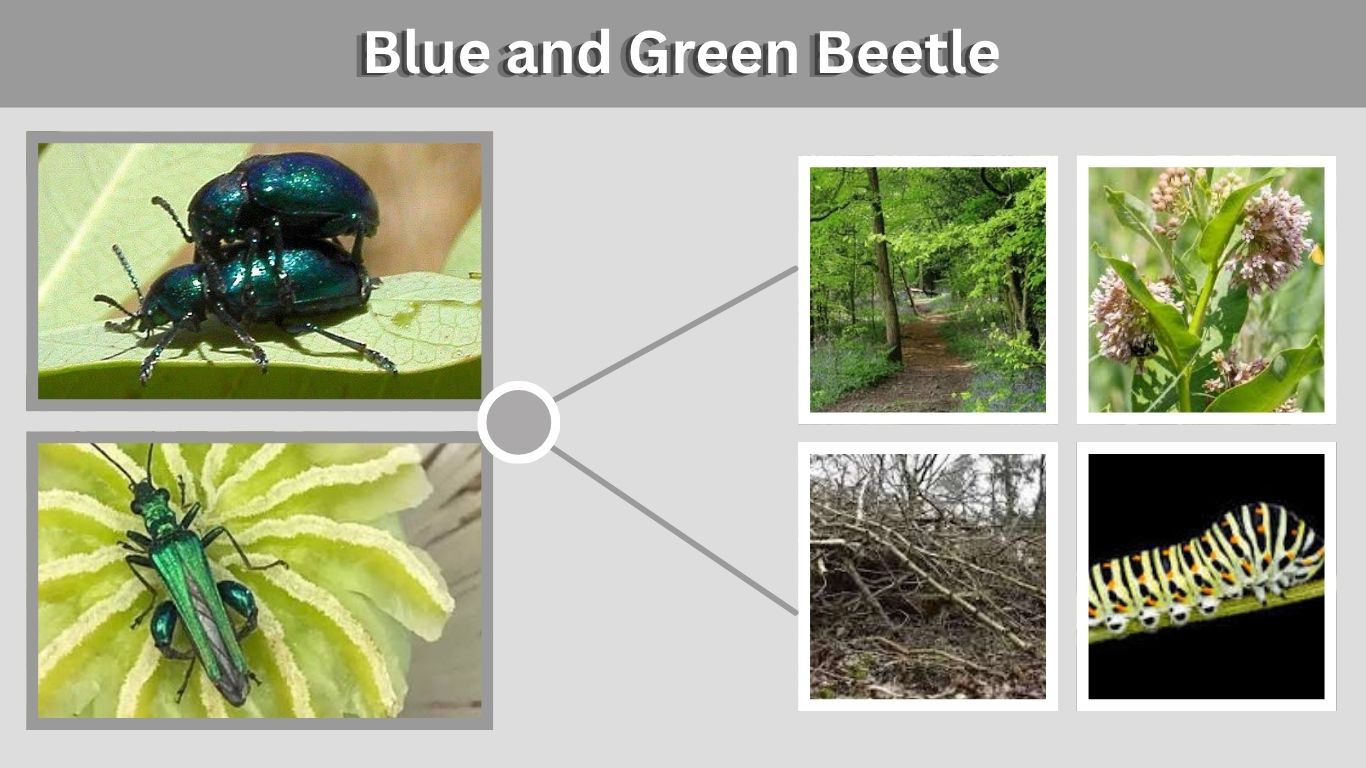
A blue and green beetle is usually a shiny or metallic beetle with iridescent colors. These colors can change from green to blue, copper, gold, or purple depending on the light. Many people notice them on leaves, flowers, garden paths, dead wood, sandy soil, or flying around in warm weather. The most common matches include dogbane beetles, green tiger beetles, six-spotted tiger beetles, ground beetles, leaf beetles, and some wood-boring beetles.
What Is a Blue and Green Beetle?
A blue-green beetle is not one single species. It is a color description used for many beetles with metallic or iridescent bodies. The color may come from tiny surface structures on the beetle’s outer shell, not just pigment. This is why the same beetle may look green from one angle and blue, gold, or copper from another.
Many blue-green beetles are harmless to humans. Some are predators that hunt small insects, while others feed on leaves, flowers, roots, dead wood, or plant sap. Identification depends on body shape, size, habitat, and behavior.
| Blue-green beetle clue | Possible beetle type |
| Shiny oval beetle on dogbane or milkweed | Dogbane beetle |
| Fast runner on sandy path | Tiger beetle |
| Long-legged predator on ground | Ground beetle |
| Small beetle eating leaves | Leaf beetle |
| Long body on dead wood or bark | Wood-boring beetle |
| Large flying beetle in summer | June beetle or scarab-type beetle |
Common Types of Blue and Green Beetles
Several beetles can match the search term blue green beetle insect. Below are the most likely types.
Dogbane Beetle
The dogbane beetle is one of the best matches for “metallic blue green beetle.” Its scientific name is Chrysochus auratus. It is small, shiny, oblong, and often shows blue, green, gold, copper, and reddish colors. BugGuide lists the dogbane beetle at about 8–11 mm long and describes it as shiny and iridescent.
Dogbane beetles are strongly linked with dogbane plants. The Missouri Department of Conservation notes that this beetle feeds on dogbanes, which explains its common name. You may also see them around milkweed-type plants, especially in fields, roadsides, prairie edges, and sunny wild areas.
Six-Spotted Tiger Beetle
The six-spotted tiger beetle is another common blue-green beetle, especially in eastern North America. It is metallic green or blue-green, has long legs, large eyes, and strong jaws. It often runs quickly on woodland trails, sunny paths, and open forest edges.
This species is usually called Cicindela sexguttata. BugGuide lists it as about 10–14 mm long and notes that it is found across much of eastern North America. Despite the name, it may not always show exactly six spots.
Green Tiger Beetle
In the UK, many people who search for a green or blue-green beetle may be seeing the green tiger beetle, Cicindela campestris. The Wildlife Trusts describe it as a metallic green beetle with yellowish spots, purple-bronze legs, and large eyes, found on bare sandy ground, heathland, grassland, dunes, and brownfield sites.
Green tiger beetles are fast predators. They chase small insects and other invertebrates on warm, open ground.
Blue-Green Ground Beetles
Some ground beetles are dark with metallic blue, green, purple, copper, or bronze reflections. These beetles usually have long legs, strong jaws, and a flattened or elongated body. Many hide under logs, stones, leaf litter, bark, or garden debris during the day and hunt at night.
Ground beetles are usually beneficial because many eat pest insects, slugs, larvae, and other small animals.
Blue-Green Leaf Beetles
Leaf beetles are another common answer for small blue green beetles or blue green leaf beetles. They are often rounded or oval, shiny, and found directly on host plants. Some feed on dogbane, milkweed, willow, roses, or vegetable leaves.
A blue-green beetle eating the tops of radishes, roses, or other garden plants is more likely to be a leaf beetle than a tiger beetle.
Blue and Green Beetle Identification
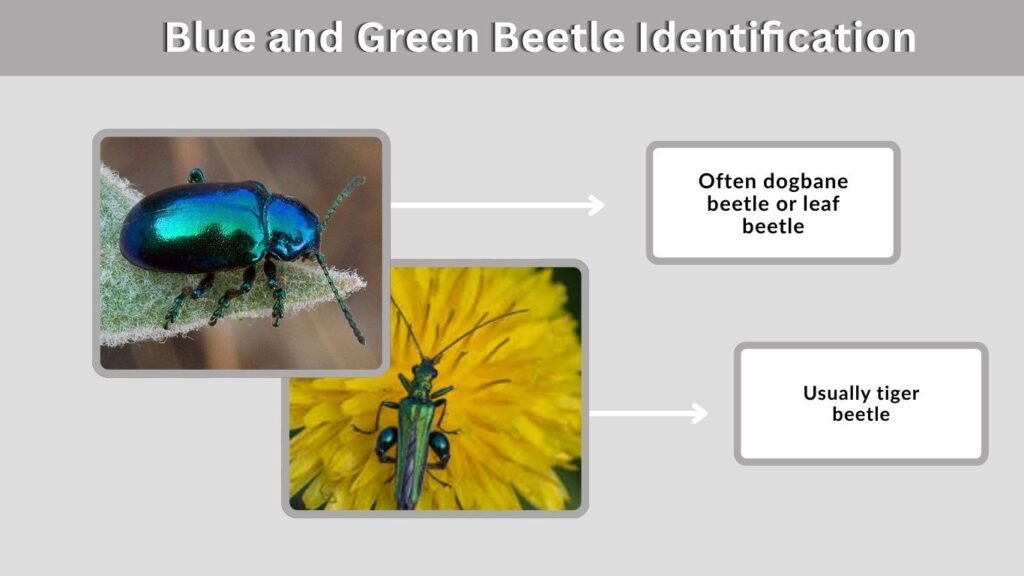
To identify a blue-green beetle, look beyond color. Many beetles share metallic colors, so body shape and behavior matter more.
Key Identification Features
- Oval and shiny body — often dogbane beetle or leaf beetle
- Long legs and big jaws — often tiger beetle or ground beetle
- Fast running on bare soil — usually tiger beetle
- Feeding on leaves — often leaf beetle
- Found under bark or dead wood — possibly wood-boring beetle
- Large flying beetle at night — may be a scarab or June beetle
- Blue-green body with copper or gold shine — often dogbane beetle
If the beetle is tiny, rounded, and sitting on leaves, start with leaf beetles. If it is running fast on a trail, start with tiger beetles. If it is dark, flat, and hiding under objects, start with ground beetles.
Why Are Some Beetles Blue and Green?
Many metallic beetles look blue and green because of iridescence. This means light reflects from the surface in a way that changes color depending on viewing angle. The beetle may look green in sunlight, blue in shade, and gold or copper from the side.
The dogbane beetle is a good example. The Illinois State Museum describes it as a shiny insect with blue, gold, green, and coppery colors, with a bluish-green underside. That is why one person may call it a green beetle, while another calls the same insect a blue-green or rainbow-colored beetle.
Where Do Blue-Green Beetles Live?
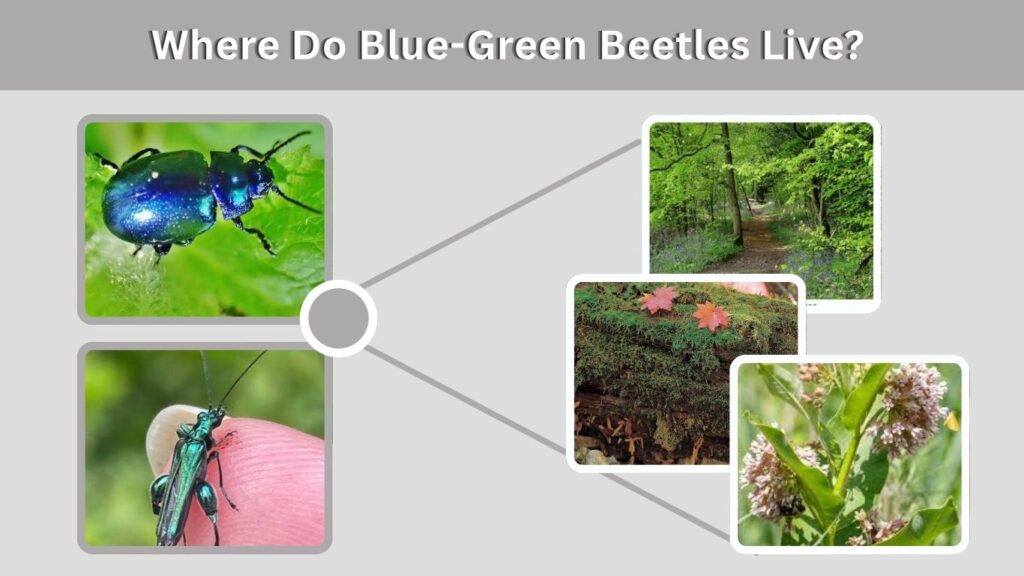
Blue-green beetles live in many habitats because the color appears in different beetle families. Habitat is one of the best ways to narrow down the species.
| Habitat | Likely beetle |
| Dogbane or milkweed plants | Dogbane beetle |
| Woodland trail or sandy path | Six-spotted tiger beetle |
| UK heathland or dunes | Green tiger beetle |
| Under rocks, logs, or leaf litter | Ground beetle |
| On leaves of garden plants | Leaf beetle |
| Dead wood or under bark | Wood beetle or longhorn beetle |
In North America, dogbane beetles are associated with dogbane plants and may also be reported around common milkweed. In the UK, the green tiger beetle is most often seen from April to September on bare sandy ground in open habitats.
What Do Blue and Green Beetles Eat?
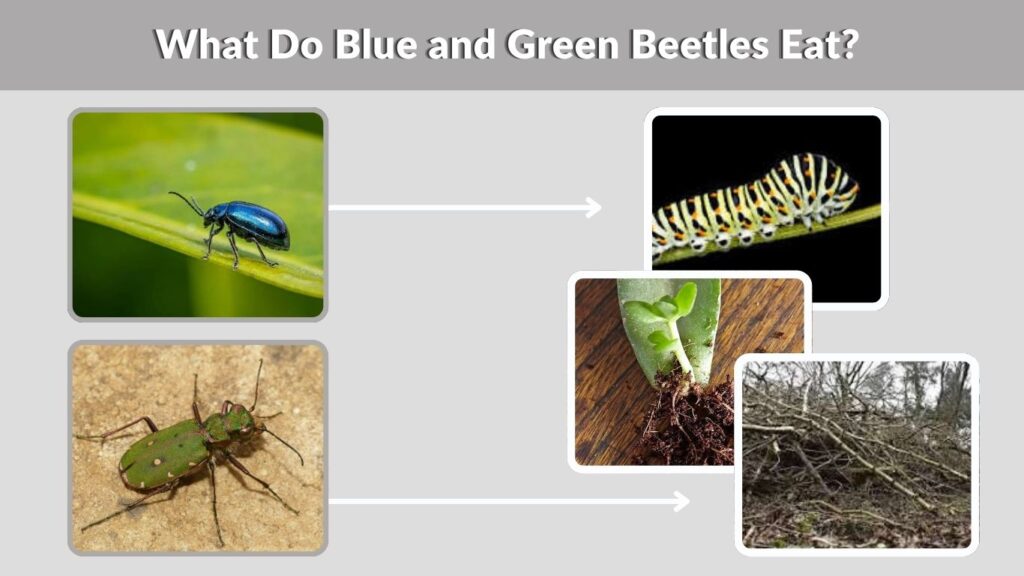
Diet depends on the type of beetle. A blue-green color does not tell you whether the beetle is a plant eater or predator.
Dogbane beetles feed on dogbane plants and related host plants. Tiger beetles are predators that hunt small insects and other invertebrates. Insect Week notes that green tiger beetle adults are very fast runners, while their larvae live in burrows and wait for prey near the burrow entrance. Ground beetles are often predators, while many leaf beetles eat leaves, roots, or flowers.
Common foods may include:
- Dogbane leaves
- Milkweed-family plants
- Small insects
- Ants and tiny flies
- Caterpillars
- Plant leaves
- Roots
- Dead wood
- Soft-bodied invertebrates
Are Blue and Green Beetles Dangerous?
Most blue-green beetles are not dangerous to humans. They do not attack people and are usually more interested in feeding, mating, hiding, or escaping. Tiger beetles and ground beetles have strong jaws, so they may pinch if handled, but they are not considered dangerous.
Leaf beetles and dogbane beetles may contain or use plant chemicals from their host plants as protection, so it is better not to handle them or let children put them near the mouth. The safe choice is to observe, photograph, and leave them alone.
Blue-Green Flying Beetles
A blue green flying beetle may be a tiger beetle, leaf beetle, scarab beetle, or wood-boring beetle. Tiger beetles often run first and then fly a short distance when disturbed. Leaf beetles may fly from plant to plant. Larger scarab-type beetles may fly clumsily around lights, fruit trees, or lawns.
If the beetle is large and noisy in flight, it may not be a dogbane beetle or tiger beetle. Large flying beetles are often June beetles, flower chafers, or other scarabs.
Blue-Green Beetle vs Green Tiger Beetle
A blue-green beetle may look like a green tiger beetle, but there are simple differences.
| Feature | Blue-green leaf/dogbane beetle | Green or six-spotted tiger beetle |
| Body shape | Oval, rounded, compact | Long-legged, narrow, athletic |
| Movement | Walks or flies from plants | Runs very fast on ground |
| Main food | Leaves or host plants | Small insects |
| Habitat | On plants | Bare soil, trails, sandy ground |
| Jaws | Small, less obvious | Large, curved, noticeable |
| Human risk | Harmless | Harmless, may pinch if handled |
Blue-Green Beetle in California, Texas, New Mexico, UK and Gardens
Location helps, but it does not give a final ID by itself. In the USA, a metallic blue-green beetle on plants may be a dogbane beetle or another leaf beetle. A blue-green beetle running on dry ground may be a tiger beetle. In the UK, a metallic green beetle on sandy open ground may be a green tiger beetle.
In gardens, pay attention to the plant. A beetle on roses, radishes, willows, or milkweed-like plants may be feeding. A beetle walking on soil or hiding under mulch may be hunting pests.
FAQs
What is a blue and green beetle?
A blue and green beetle is usually a metallic or iridescent beetle. It may be a dogbane beetle, tiger beetle, ground beetle, leaf beetle, scarab beetle, or wood-boring beetle.
Are blue-green beetles poisonous?
Most are not dangerous to people. Some may use plant chemicals for defense, especially beetles that feed on toxic plants, so it is best not to handle or eat them.
What is the shiny blue-green beetle on milkweed or dogbane?
It is often the dogbane beetle, Chrysochus auratus. It is small, shiny, blue-green, gold, and coppery, and it feeds mainly on dogbane plants.
What is a blue-green beetle running fast on the ground?
It may be a tiger beetle, such as the six-spotted tiger beetle in North America or the green tiger beetle in the UK. Tiger beetles are fast-running predators with large eyes and strong jaws.
Do blue-green beetles bite?
Some predatory beetles, especially tiger beetles and ground beetles, may pinch if picked up. They are not aggressive toward people and are usually harmless when left alone.