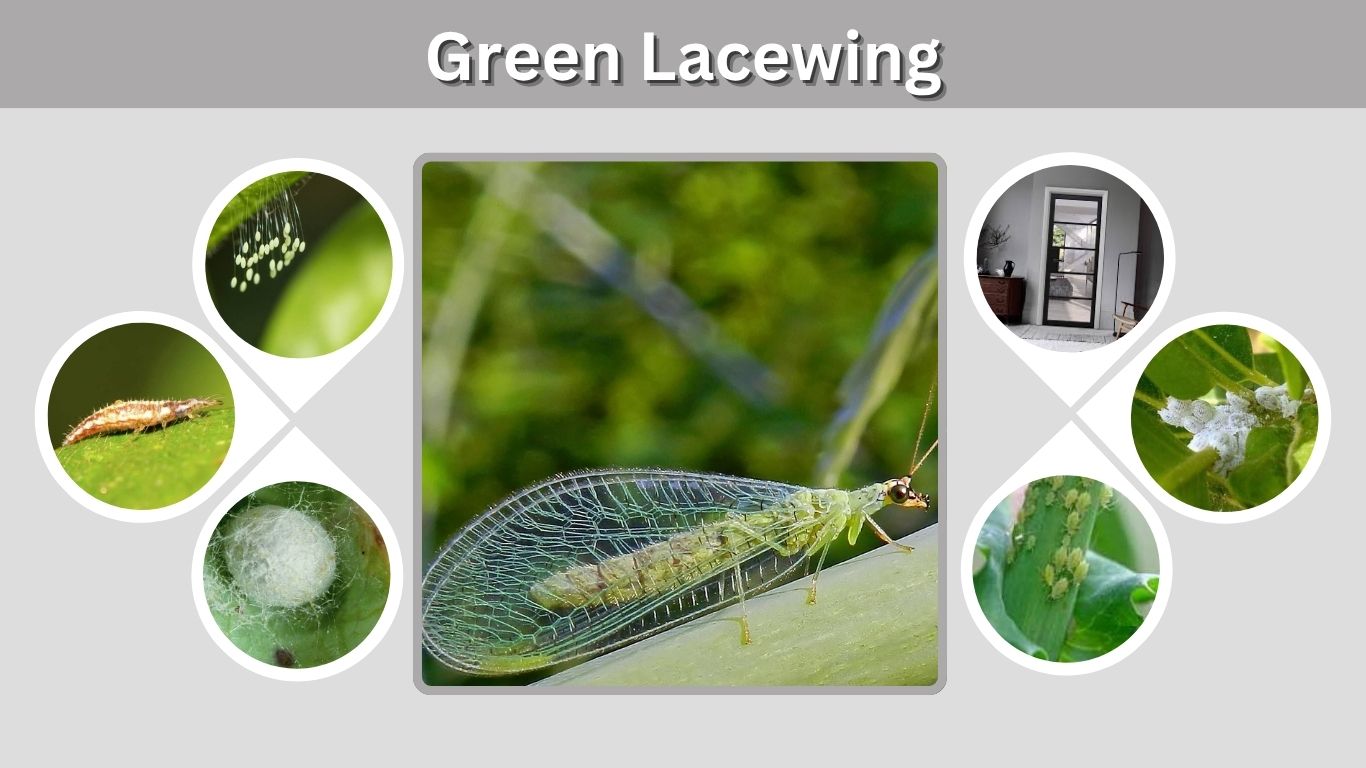
Green lacewings are delicate, beneficial insects recognized by their bright green bodies, transparent wings, and striking golden eyes. Although adults may look fragile, their larvae are aggressive predators that consume aphids and many other small garden pests. Because of this natural pest-control ability, gardeners and farmers often welcome green lacewings around plants. These insects are generally harmless to people, pets, and plants. Understanding their appearance, life cycle, diet, habitat, and behavior can help you appreciate their important role in healthy gardens.
What Is a Green Lacewing?
Green lacewings are insects belonging mainly to the family Chrysopidae within the order Neuroptera. Thousands of lacewing species occur worldwide, with green lacewings being among the most familiar. Adults are usually active around vegetation and lights, while their larvae hunt through leaves and stems searching for small insects to eat.
Appearance and Characteristics
An adult green lacewing usually has a slender, soft green body with long antennae and two pairs of transparent wings. The wings contain an intricate network of veins that gives them their characteristic lace-like appearance.
Their eyes may appear golden, copper-colored, or reddish depending on lighting. Most adults measure roughly 10–20 mm long, although size varies among species.
When resting, green lacewings normally hold their wings roof-like over their bodies. Their delicate appearance makes them easy to distinguish from many beetles, flies, and other common garden insects.
Where Green Lacewings Live
Green lacewings occur in gardens, agricultural fields, forests, grasslands, orchards, and areas containing shrubs or flowering plants. They are especially common where aphids and other soft-bodied insects are abundant.
Adults frequently visit flowers for nectar and pollen. During warm evenings, they may also fly toward porch lights, windows, or other artificial lighting.
How to Identify a Green Lacewing
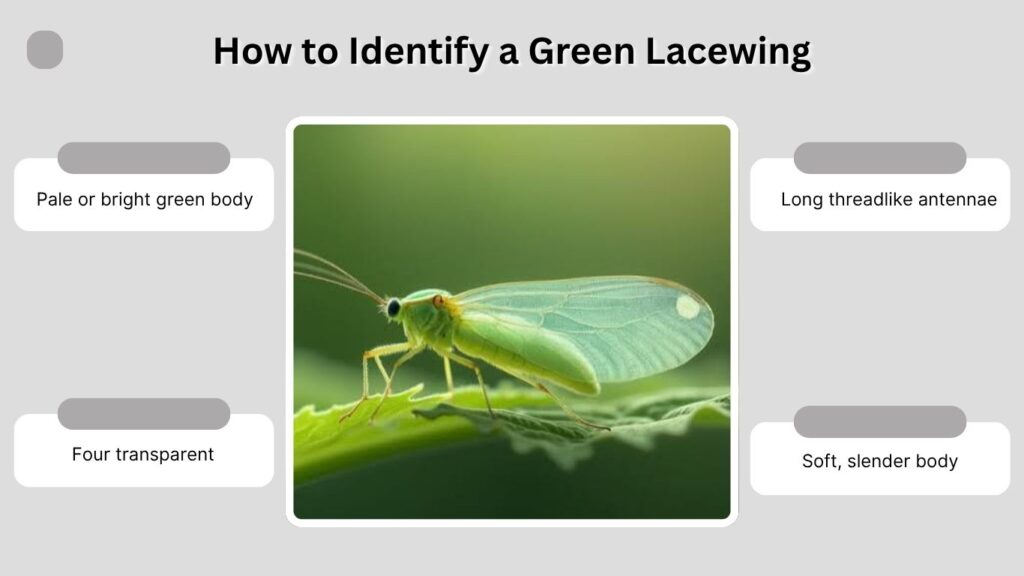
Correct identification helps distinguish beneficial green lacewings from insects that might damage plants. Adults and larvae look dramatically different, so people sometimes mistake the two stages for completely unrelated insects. Adults are delicate and winged, while larvae resemble tiny elongated predators equipped with powerful curved jaws.
Adult Green Lacewing Identification
Look for these common characteristics:
- Pale or bright green body
- Large golden or copper-colored eyes
- Long threadlike antennae
- Four transparent, heavily veined wings
- Wings extending beyond the abdomen
- Soft, slender body
- Wings held like a roof while resting
- Typical body length of around 10–20 mm
Some adults become brownish during cooler weather, so body color alone should not be used for identification.
What Green Lacewing Larvae Look Like
Green lacewing larvae look very different from adults. They have elongated bodies, six legs, and prominent curved jaws projecting from the head.
Their coloration can include brown, gray, cream, or reddish markings. Some species camouflage themselves by carrying pieces of debris or the remains of prey on their backs.
Because the larvae actively hunt other insects, they move quickly across leaves rather than remaining stationary for long periods.
Green Lacewing Life Cycle
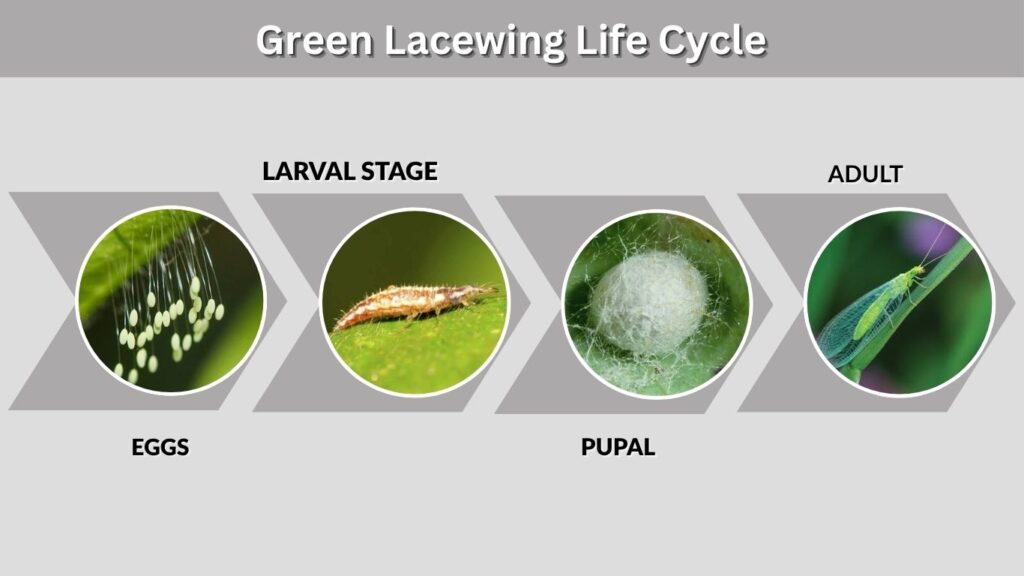
Green lacewings undergo complete metamorphosis, meaning they develop through egg, larval, pupal, and adult stages. Temperature, species, and food availability influence how quickly development occurs. Their unusual eggs and highly predatory larvae make the green lacewing life cycle particularly interesting to gardeners observing these insects around their plants.
Green Lacewing Eggs
Female lacewings commonly lay eggs near colonies of aphids or other potential prey. Important characteristics include:
- Eggs are small and oval.
- Each egg is usually attached to a thin stalk.
- Eggs may be laid individually or in groups.
- Newly laid eggs are often pale green.
- They may become darker as they develop.
- Stalks help reduce the chance of newly hatched larvae attacking neighboring eggs.
Larvae eventually emerge and immediately begin searching for food.
Larval Stage
The larval stage is when green lacewings provide their strongest natural pest-control benefits. Larvae actively patrol plant surfaces and capture prey using their curved jaws.
After grabbing an insect, the larva feeds on its body fluids. It continues hunting and feeding while growing through several developmental stages.
Lacewing larvae are sometimes called aphid lions because of their effectiveness at attacking aphids.
Pupal and Adult Stages
After completing larval development, the lacewing forms a small silk cocoon, often attached to vegetation or hidden within protected areas.
Inside the cocoon, it transforms into an adult. The newly emerged lacewing eventually develops fully functioning wings and begins searching for food and mates.
Adult lifespan varies considerably according to species and environmental conditions.
What Do Green Lacewings Eat?
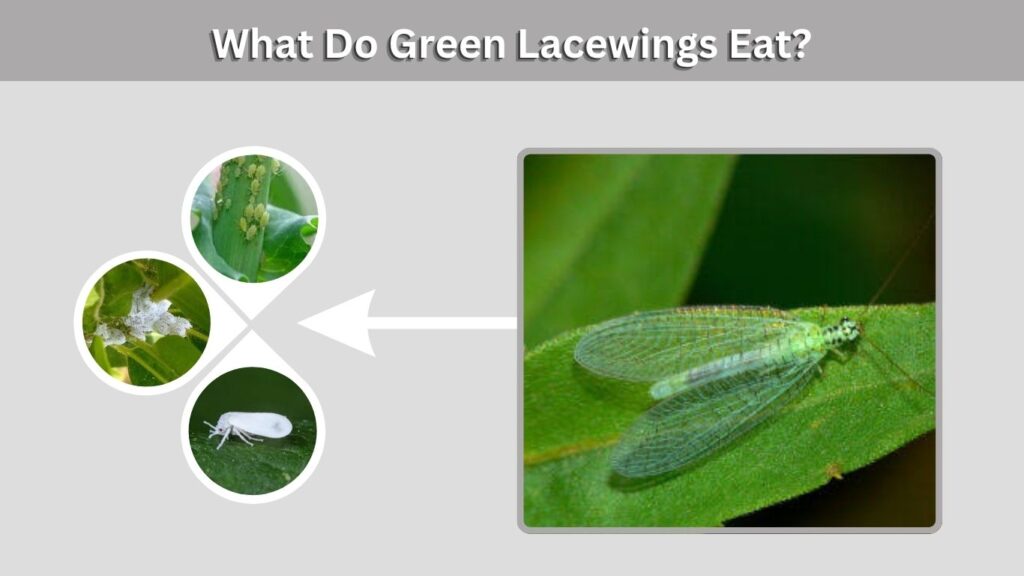
Diet changes considerably throughout a green lacewing’s development. Larvae are primarily predators of other small arthropods, whereas many adults rely more heavily on nectar, pollen, and honeydew. Some adult species remain predatory and continue feeding on insects after reaching maturity.
What Green Lacewing Larvae Eat
Their common prey includes:
- Aphids
- Whiteflies
- Mealybugs
- Thrips
- Spider mites
- Small caterpillars
- Insect eggs
- Scale insects
- Leafhopper nymphs
- Other small soft-bodied insects
A single larva may consume numerous pests while developing, making green lacewings useful biological control insects.
What Adult Green Lacewings Eat
Many adults feed primarily on flower nectar, pollen, and honeydew produced by sap-feeding insects. These foods provide the carbohydrates and nutrients needed for survival and reproduction.
Some species remain partly or strongly predatory as adults. Their exact diet therefore depends on the lacewing species involved.
Planting nectar-producing flowers can encourage adult lacewings to remain around a garden.
Are Green Lacewings Beneficial?
Green lacewings are among the most useful naturally occurring predators in gardens and agricultural environments. Their larvae attack several pests capable of damaging flowers, vegetables, fruit trees, and ornamental plants. Encouraging lacewings can therefore reduce pest populations while supporting a more balanced garden ecosystem.
Benefits of Green Lacewings in Gardens
Green lacewings can provide several advantages:
- Naturally reduce aphid populations
- Attack several types of plant pests
- Help reduce dependence on insecticides
- Cause little or no damage to healthy plants
- Support biological pest-management programs
- Work well alongside other beneficial insects
- Help protect vegetables and ornamental plants
Gardeners sometimes deliberately release commercially raised lacewing eggs or larvae where pest populations are high.
Are Green Lacewings Dangerous?
Green lacewings are not considered dangerous to humans. Adults do not normally attack people and are not venomous.
Larvae possess strong jaws designed for capturing tiny prey. Occasionally, a larva crawling on human skin may pinch or bite, causing brief irritation. Such incidents are uncommon and generally minor.
Green lacewings are also not structural pests and do not damage furniture, buildings, clothing, or stored food.
Green Lacewings in the House
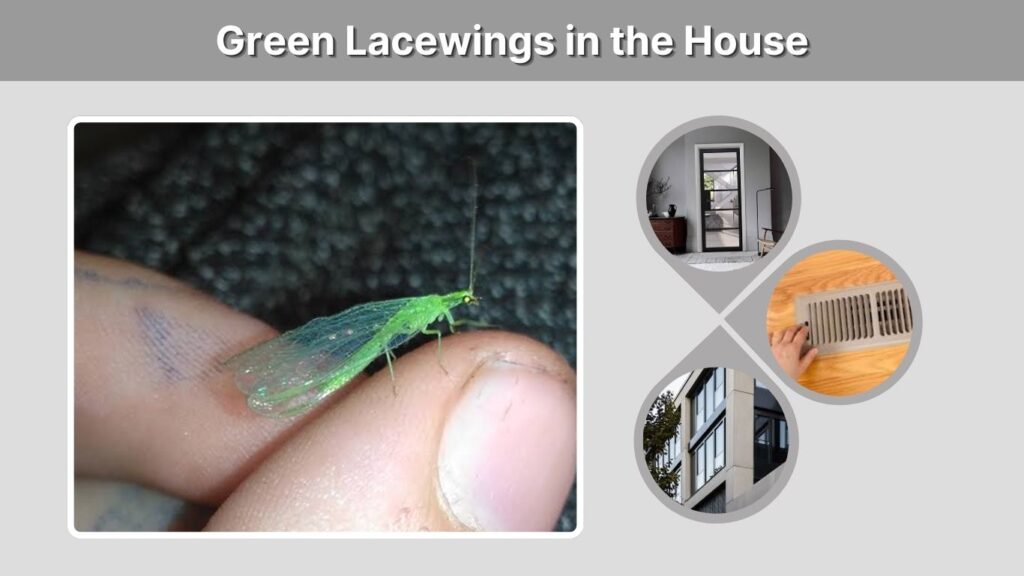
Finding a green lacewing indoors usually does not indicate an infestation. Adults may accidentally enter buildings through doors, windows, vents, or small openings. Artificial lights are particularly attractive to some lacewing species, explaining why they frequently appear near windows or lamps at night.
Why Green Lacewings Come Inside
Green lacewings usually enter homes accidentally while following light or seeking sheltered locations. Cooler autumn weather can also encourage some species to look for protected places.
They do not normally reproduce heavily inside homes because indoor environments lack the food and habitat required by their larvae.
One or two individuals therefore rarely indicate a problem.
How to Remove Green Lacewings
If you find one indoors:
- Place a cup or container over the insect.
- Slide paper underneath the container.
- Carry the lacewing outdoors.
- Release it near shrubs or garden plants.
- Repair damaged window screens.
- Seal unnecessary gaps around windows and doors.
- Reduce outdoor lighting close to open windows when possible.
Avoid immediately killing green lacewings because they can provide valuable pest control once returned to the garden.
FAQs
1. Are green lacewings good for the garden?
Yes. Green lacewing larvae eat aphids, whiteflies, mites, mealybugs, thrips, insect eggs, and several other garden pests. Their feeding behavior makes them important natural predators and valuable insects for gardeners who want to reduce pest populations without relying heavily on chemical pesticides.
2. Do green lacewings bite humans?
Adult green lacewings generally do not bite humans. Lacewing larvae have curved jaws for capturing prey and may occasionally pinch human skin if handled or trapped against the body. Any irritation is normally temporary, and green lacewings are not considered medically dangerous insects.
3. Why are green lacewing eggs on stalks?
Female green lacewings attach their eggs to thin stalks that raise them above the plant surface. This arrangement can help protect eggs from predators and may reduce cannibalism because newly hatched lacewing larvae are aggressive hunters capable of attacking nearby eggs or smaller larvae.
4. What attracts green lacewings?
Green lacewings are attracted to areas containing abundant prey and flowering plants. Adult lacewings may visit flowers for nectar and pollen, while females look for locations containing aphids and similar insects for egg laying. Many adults are also attracted to artificial lights during nighttime hours.
5. Should I kill green lacewings in my house?
Usually, no. A green lacewing inside your home is generally an accidental visitor rather than a household pest. Carefully capture it and release it outdoors near vegetation. Once outside, it or its offspring may help control aphids and other insects that damage garden plants.