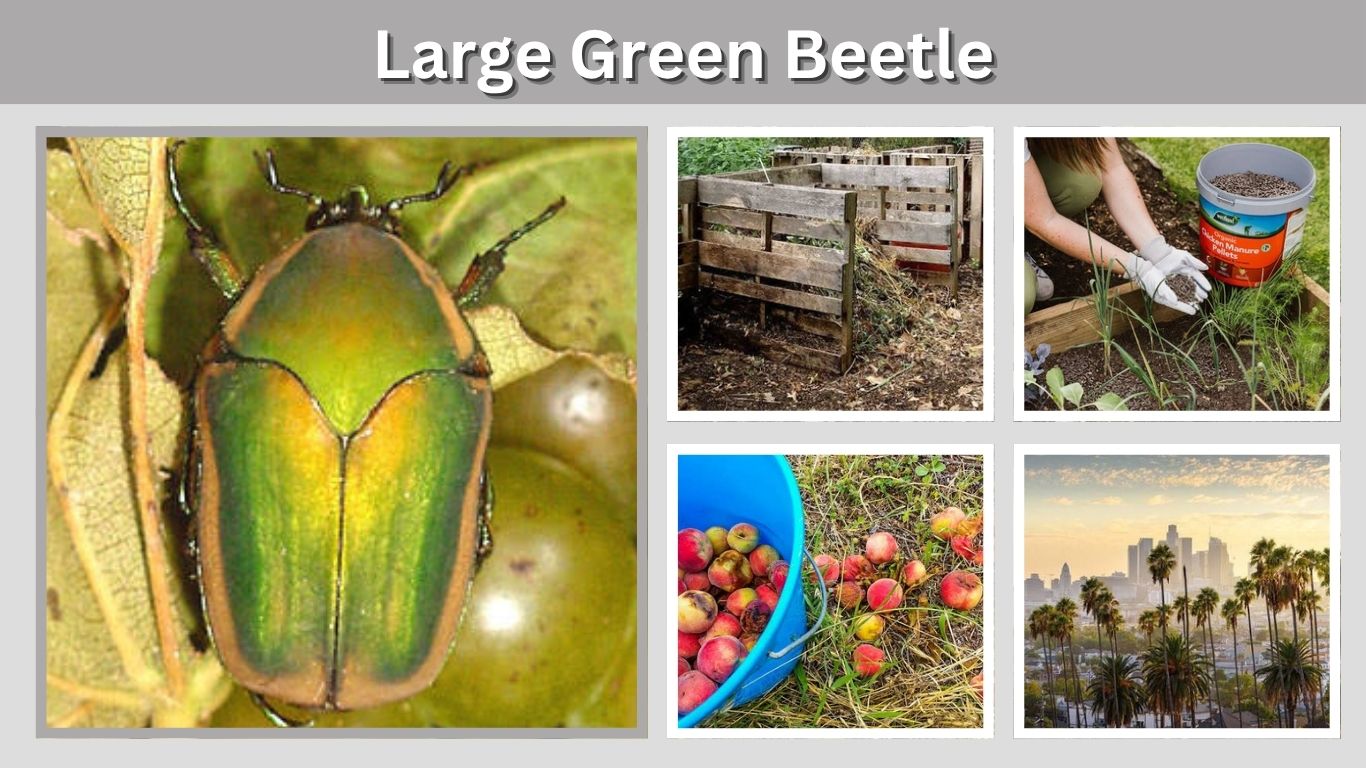
A large green beetle is often a green June beetle, figeater beetle, green fruit beetle, Japanese beetle, or tiger beetle. The exact identification depends on size, color, location, markings, and behavior. Some large green beetles are harmless visitors, while others may damage fruit, flowers, lawns, or garden crops. If you see a shiny green flying beetle around your yard, check its body shape, wing covers, spots, and where it was found.
What Is the Large Green Beetle in My Yard?
The most common large green beetle in many eastern and southern U.S. yards is the green June beetle. Adult green June beetles are metallic green and nearly 1 inch long, often with bronze-yellow body edges and sometimes reddish-brown wing covers. Their grubs live in soil and can grow up to 2 inches long.
In California and the Southwest, a large green flying beetle is often the figeater beetle, also called the green fruit beetle. The University of California says green fruit beetles and green June beetles can look nearly identical, and confident separation may require expert examination.
| Beetle Type | Main ID Clue | Common Area |
| Green June beetle | Large metallic green scarab | Eastern and southern U.S. |
| Figeater / green fruit beetle | Big shiny green beetle, often near fruit | California, Southwest |
| Japanese beetle | Smaller green beetle with copper wings | Many U.S. states |
| Six-spotted tiger beetle | Fast, metallic green predator | Trails and wood edges |
| Spotted cucumber beetle | Small yellow-green beetle with black spots | Gardens and crops |
Green June Beetle
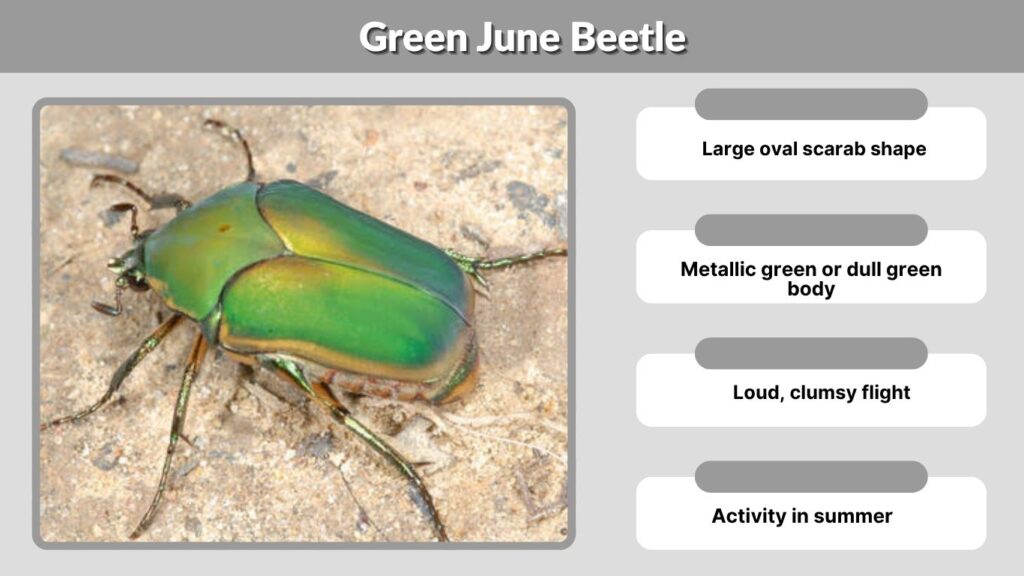
The green June beetle is one of the best matches for searches like “large green beetle,” “large green flying beetle,” and “large shiny green beetle.” Adults are about ¾ to 1 inch long, with a velvety green to dull brown upper body and yellow-orange to greenish stripes on the wing covers.
Identification
Look for these features:
- Large oval scarab shape
- Metallic green or dull green body
- Bronze, gold, or yellowish edges
- Loud, clumsy flight
- Activity in summer
- Attraction to ripe fruit, compost, and lawns
The Missouri Department of Conservation describes adult green June beetles as about an inch long, with dull metallic green wings, gold or brownish highlights, and shiny green underparts.
Large Green Flying Beetle
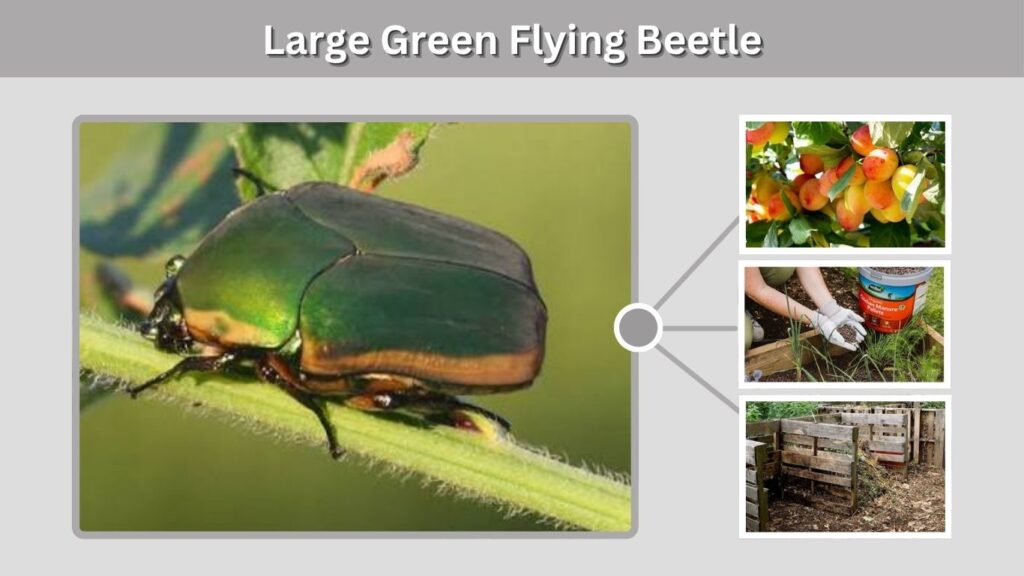
A large green flying beetle buzzing around trees, lawns, or fruit plants is usually a scarab beetle. Green June beetles and figeater beetles are both strong fliers, but they often look clumsy in the air. They may bump into windows, people, walls, or porch lights.
Green June beetles often appear during warm months. NC State Extension notes that females lay eggs in clusters of 10 to 30 in soil rich in organic matter, and larvae feed as grubs before becoming adults.
Why Are Large Green Beetles Swarming?
Large green beetles may seem to swarm when adults emerge at the same time. They may gather around:
- Ripe fruit
- Compost piles
- Manure-rich soil
- Lawns with organic matter
- Flowering shrubs
- Tree sap
- Garden areas
A few beetles are usually not a serious problem. Large numbers may damage soft fruit or indicate grub activity in turf.
Large Green Beetles in California
In California, a large green beetle is often the green fruit beetle, also called the figeater beetle. It is commonly seen flying during warm weather and may visit figs, peaches, grapes, tomatoes, and other soft fruit. UC IPM notes that the eastern green June beetle is very similar to green fruit beetle and is reported only in southern California.
California searches such as “large green beetle San Diego,” “large green flying beetle California,” and “large green beetle Southern California” often point to figeater-type beetles. They are shiny, loud, and noticeable, but they are usually more of a nuisance than a dangerous insect.
Large Metallic Green Beetle
A large metallic green beetle may be a scarab, tiger beetle, or jewel beetle. The body shape helps with identification. Scarabs are rounder and heavier. Tiger beetles are slimmer, faster, and have large eyes and long legs.
Six-spotted tiger beetles are metallic green or sometimes blue, with long legs, large sickle-shaped jaws, and large bulging eyes. They are about half an inch long, and their white spots can vary from six to none.
Scarab vs Tiger Beetle
| Feature | Green June / Figeater Beetle | Tiger Beetle |
| Body shape | Heavy, oval, rounded | |
| Movement | Slow walking, clumsy flying | |
| Legs | Shorter and thicker | |
| Diet | Fruit, sap, plant material | |
| Tiger beetle shape | Slim, fast, long-legged | |
| Tiger beetle diet | Predatory, eats insects |
Tiger beetles are usually beneficial predators. If the beetle is running quickly on a sunny trail or bare soil, it may be a tiger beetle instead of a fruit-feeding scarab.
Large Green Beetle With Black Spots
A “large green beetle with black spots” can be tricky because many spotted green beetles are actually small. The spotted cucumber beetle is yellow-green with black spots, but it is only about ¼ inch long, not truly large. Oregon State University describes the western spotted cucumber beetle as yellowish green, ¼ inch long, with distinct black spots on the wing covers.
Maryland Extension says spotted cucumber beetle adults are up to ¼ inch long, with a black head and 12 black spots on the back. If your beetle is nearly 1 inch long, it is probably not a spotted cucumber beetle.
Large Black and Green Beetle
A large black and green beetle may be a green June beetle, figeater beetle, or another scarab with dark green wing covers and a black underside. Some beetles look black from a distance but shine green in sunlight. Others have dark heads, dark legs, or black markings.
When identifying a black-and-green beetle, check:
- Is it round and heavy or narrow and long?
- Does it fly loudly during the day?
- Does it have copper or bronze edges?
- Is it eating fruit, flowers, or leaves?
- Does it have white hair tufts or black spots?
Japanese beetles are smaller than green June beetles. Wisconsin Horticulture says adult Japanese beetles are shiny metallic green and slightly less than ½ inch long, with coppery-brown wing covers and small white hair patches along the sides.
Large Green Beetles by State
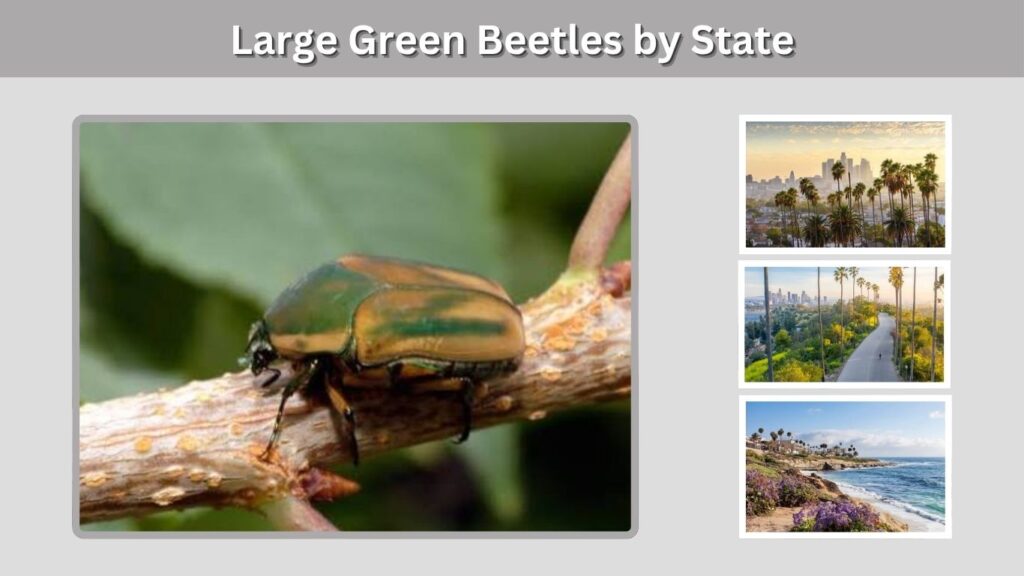
Many state-based searches come from people seeing the same general beetle in different areas. In the eastern and southern U.S., green June beetles are a common answer. In California, Arizona, and parts of the Southwest, figeater or green fruit beetles are more likely.
Common State Clues
- California: often figeater or green fruit beetle
- Arizona: figeater, green scarabs, or tiger beetles
- Texas: green June beetle or figeater-type beetles
- Georgia: green June beetle
- North Carolina: green June beetle
- Tennessee: green June beetle
- Missouri: green June beetle
- Ohio: Japanese beetle, tiger beetle, or green June beetle
- Michigan: Japanese beetle or cucumber beetle
- Pennsylvania: green June beetle or Japanese beetle
Location helps, but it is not enough by itself. Use size and markings to confirm the ID.
Are Large Green Beetles Harmful?
Most large green beetles are not dangerous to people. They do not sting, and they are not aggressive. Some may scratch with their legs if handled, but they are not venomous.
They can be harmful to plants, depending on species and numbers. Green June beetles and green fruit beetles may feed on soft or damaged fruit. Japanese beetles can skeletonize leaves and damage many landscape plants. Cucumber beetles damage cucurbits and can spread plant disease, but they are much smaller than most “large green beetle” searches.
How to Get Rid of Large Green Beetles
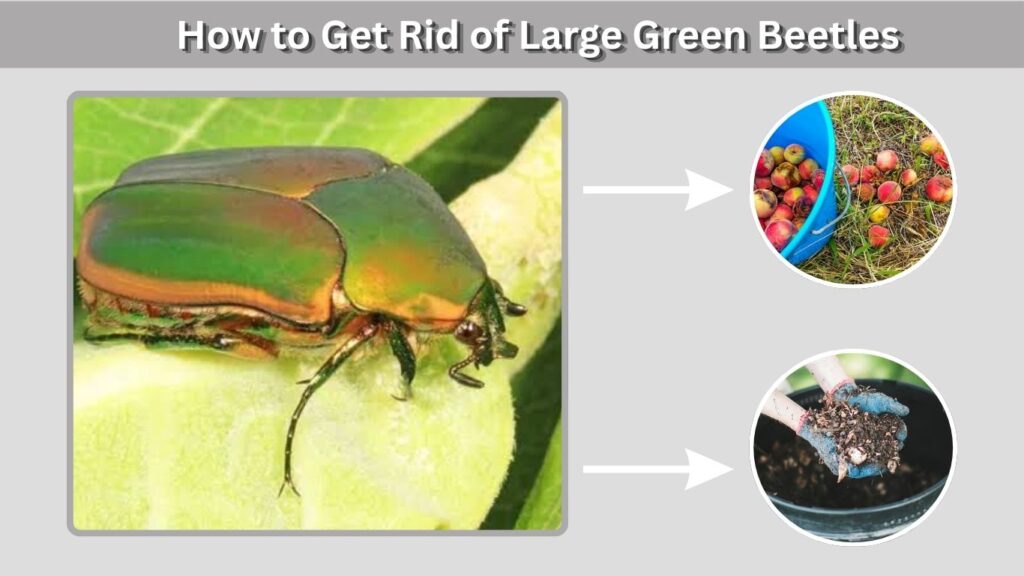
Control depends on the species. For green June beetles and figeater beetles, start with sanitation. Remove overripe fruit, clean up fallen fruit, manage compost piles, and reduce decaying organic matter where larvae develop. For Japanese beetles, hand-picking and plant protection may help in small gardens.
Useful control steps include:
- Pick beetles off plants by hand
- Remove fallen fruit quickly
- Harvest ripe fruit before it splits
- Keep compost covered or managed
- Reduce excess organic matter near lawns
- Use row covers for vegetable crops when appropriate
- Avoid unnecessary pesticide spraying
- Identify the beetle before treating
Do not spray every large green beetle automatically. Some beetles are only temporary visitors, and some metallic green beetles, such as tiger beetles, are beneficial predators.
FAQs
What is a large green beetle?
A large green beetle is often a green June beetle, figeater beetle, or green fruit beetle. In some cases, it may be a Japanese beetle, tiger beetle, or another metallic green species.
What is the large green flying beetle in my yard?
In the eastern and southern U.S., it is often a green June beetle. In California and the Southwest, it may be a figeater or green fruit beetle.
Are large green beetles dangerous?
Large green beetles are usually not dangerous to people. They do not sting, but some species can damage fruit, flowers, garden plants, or lawns when present in large numbers.
What is a large green beetle with black spots?
If it is yellow-green with black spots and only about ¼ inch long, it may be a spotted cucumber beetle. If it is close to 1 inch long, it is probably another beetle with dark markings.
How do I get rid of large green beetles?
Remove fallen fruit, reduce decaying organic matter, hand-pick beetles from plants, and identify the species before using treatments. Many large green beetles do not need chemical control.