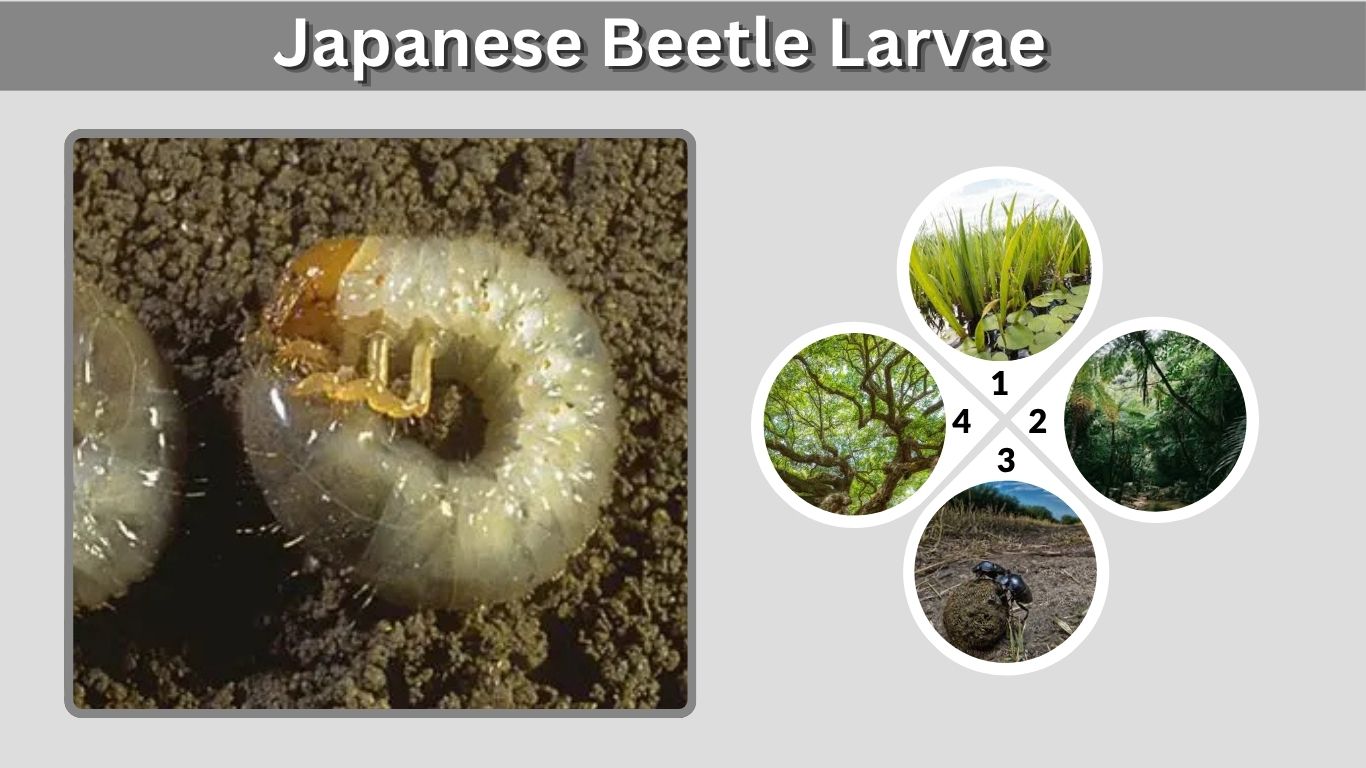
Japanese beetle larvae are white grubs that live underground and feed mainly on grass roots. They are the immature stage of the Japanese beetle, an invasive scarab beetle known for damaging lawns as larvae and skeletonizing leaves as adults. If your lawn has brown patches, loose turf, or animals digging for grubs, Japanese beetle larvae may be one possible cause. Correct identification is important because not every white grub is a Japanese beetle.
What Are Japanese Beetle Larvae?
Japanese beetle larvae are the grub stage of Popillia japonica. Adult Japanese beetles feed on leaves and flowers, but the larvae live in soil and damage turf by eating roots. Wisconsin Horticulture notes that Japanese beetle adults feed on more than 350 plant species, while the grubs feed below ground on turfgrass and other plant roots.
Are Grubs Japanese Beetle Larvae?
Some grubs are Japanese beetle larvae, but not all. Many scarab beetles have similar C-shaped white grubs, including June beetles, European chafers, masked chafers, and Oriental beetles. To confirm Japanese beetle larvae, experts often examine the raster pattern, which is the arrangement of hairs and spines near the rear end of the grub.
What Do Japanese Beetle Larvae Look Like?
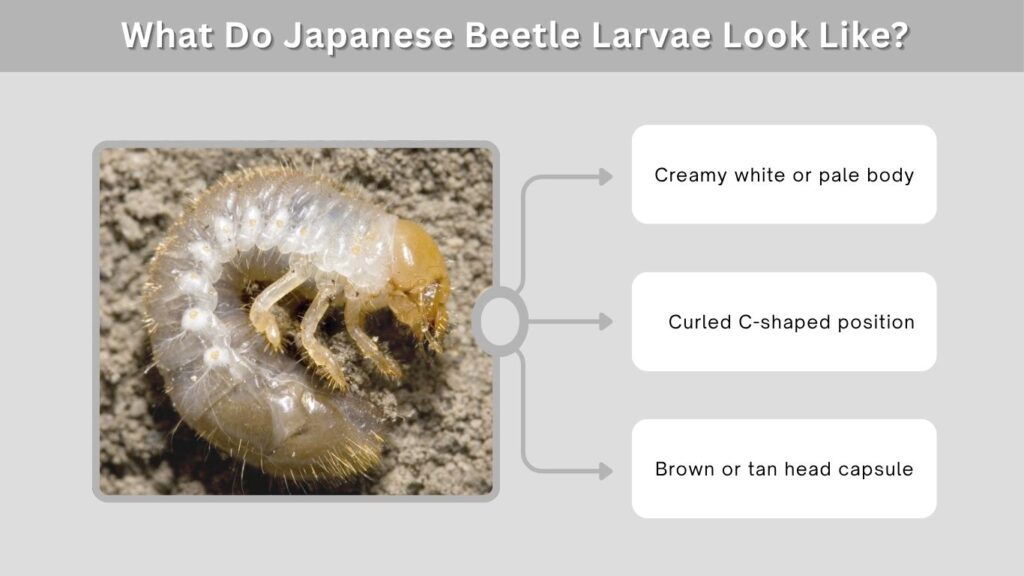
Japanese beetle larvae look like small, creamy-white, C-shaped grubs with a brownish head and six legs near the front of the body. Newly hatched larvae are very small, while mature grubs may reach about 1 inch long. Wisconsin Horticulture describes newly hatched larvae as about ⅛ inch long and mature grubs as up to one inch long.
Japanese Beetle Larvae Identification
- Creamy white or pale body
- Curled C-shaped position
- Brown or tan head capsule
- Six small legs near the head
- Darker rear end visible through the body
- Found in soil under turfgrass
- Mature size usually up to about 1 inch
White grubs often look alike, so visual appearance alone may not be enough for exact species identification.
Japanese Beetle Larvae Size and Stages
Japanese beetle larvae go through several growth stages, called instars. They hatch from eggs in summer, feed on roots, grow larger through late summer and fall, move deeper into soil for winter, then return near the root zone in spring before pupating.
| Stage | What Happens |
| Egg | Laid in moist soil during summer |
| Small larva | Newly hatched grub begins feeding on roots |
| Larger larva | Most damaging root-feeding stage |
| Overwintering grub | Moves deeper into soil during cold weather |
| Pupa | Changes into adult beetle |
| Adult | Emerges and feeds on foliage |
Japanese beetles usually have one generation per year. Eggs hatch after about two weeks, and grubs begin feeding on turfgrass and ornamental roots.
Japanese Beetle Larvae Damage
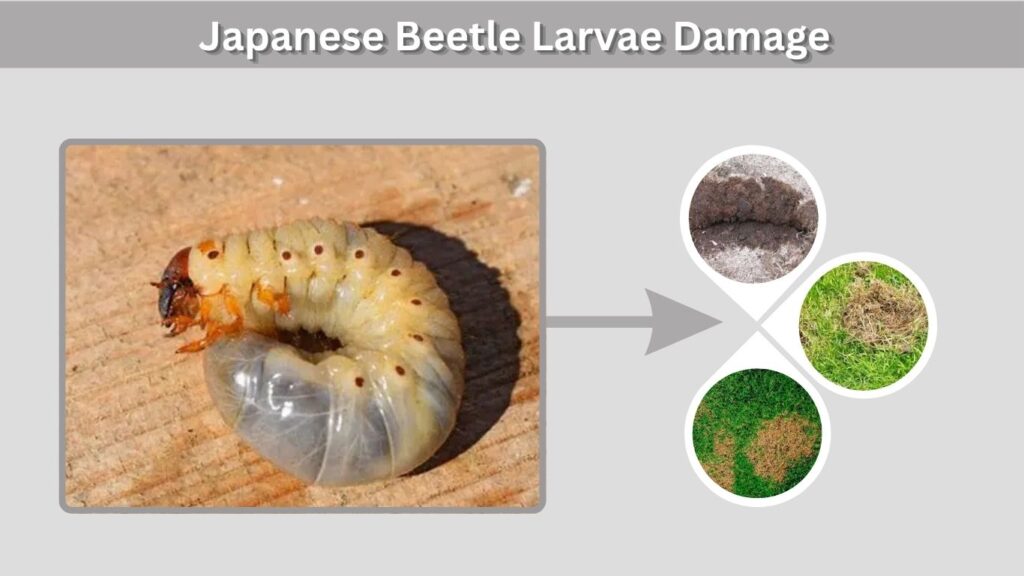
Japanese beetle larvae damage lawns by eating grass roots. At first, the lawn may look dry, yellow, or brown, similar to drought stress. As root damage gets worse, the turf may feel loose and can sometimes be pulled back like a carpet.
Signs of Larvae Damage
- Brown or yellow lawn patches
- Grass that wilts even with watering
- Turf that rolls back easily
- Spongy-feeling grass
- Skunks, raccoons, birds, or moles digging
- Grubs found in the top few inches of soil
University of Maryland Extension notes that root loss during August and early September can become severe enough that turf rolls back from the soil like a rug.
What Do Japanese Beetle Larvae Eat?
Japanese beetle larvae mainly eat the roots of lawn grasses. They may also feed on roots of other plants in soil. This root feeding reduces the plant’s ability to absorb water and nutrients, which is why damage often looks worse during hot, dry weather.
Adult Japanese beetles cause a different kind of damage. They feed above ground on leaves, flowers, fruit crops, ornamentals, and garden plants.
June Bug Larvae vs Japanese Beetle Larvae
June bug larvae and Japanese beetle larvae are both white grubs, and they can look very similar. Both are C-shaped, pale, and found in soil. The main difference is not always obvious without close inspection.
| Feature | Japanese Beetle Larvae | June Bug Larvae |
| Body shape | C-shaped white grub | C-shaped white grub |
| Legs | Six legs near head | Six legs near head |
| Lawn damage | Common turf root feeder | Also damages turf roots |
| Life cycle | Usually 1 year | Often 2–3 years for May/June beetles |
| Best ID clue | Raster pattern | Raster pattern |
Because they are so similar, homeowners often call all white grubs “Japanese beetle larvae,” but exact identification may need a local extension office or pest expert.
Japanese Beetle Larvae Control
Japanese beetle larvae control works best when treatments target young grubs in summer. Treating too late or too early often gives poor results. University of Minnesota Extension recommends late July to mid-September for curative treatment when grubs are still small, and says spring treatment is not recommended because large spring grubs are harder to kill and feed only briefly.
Best Time to Treat Japanese Beetle Larvae
| Treatment Type | Best Timing |
| Preventive control | June to July |
| Curative control | Late July to September |
| Spring treatment | Usually not recommended |
| Late fall treatment | Usually ineffective |
Wisconsin Horticulture lists June–July as the preventive timing for Japanese beetle grubs and August–October as the curative treatment window, with curative products working best against smaller grubs early in that period.
How to Get Rid of Japanese Beetle Larvae
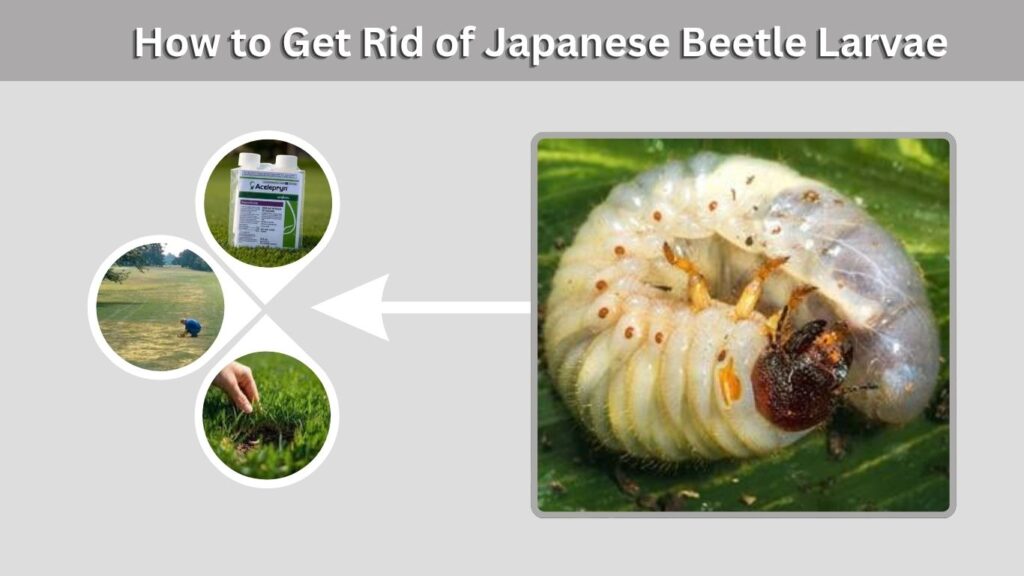
First, confirm that grubs are actually present. Dig into the top few inches of soil near damaged grass and look for C-shaped larvae. UNH Extension says an occasional grub is normal and not always a reason to treat, because healthy turf can often tolerate a few grubs.
Control Steps
- Check the lawn before treating.
- Count grubs in damaged areas.
- Keep turf healthy with proper mowing and watering.
- Treat only damaged or high-risk areas.
- Apply products at the correct time.
- Water in grub treatments if the label requires it.
- Avoid unnecessary pesticide use near flowering weeds.
For chemical products, always follow the label. Wisconsin Horticulture notes that grub insecticides need about ½ inch of water after application to move the product into the root zone.
Natural and Biological Control
Biological controls include beneficial nematodes, Bacillus thuringiensis galleriae products, natural predators, and milky spore bacteria. However, results can vary. University of Maryland Extension reports that some nematodes can provide good control of Japanese beetle grubs, but microbial products such as milky spores have not consistently suppressed Japanese beetle grub populations in turfgrass.
What Eats Japanese Beetle Larvae?
Natural enemies include birds, skunks, raccoons, predatory beetles, parasitic wasps, flies, and beneficial nematodes. Some of these animals can help reduce grubs, but digging predators may also tear up lawns while searching for larvae.
Do Vinegar or Cedar Chips Kill Japanese Beetle Larvae?
Vinegar, cedar chips, and homemade mixtures are not reliable Japanese beetle larvae treatments. They may harm grass, soil organisms, or nearby plants without solving the grub problem. Better options include monitoring, lawn health, targeted biological controls, and properly timed labeled grub treatments.
FAQs
What do Japanese beetle larvae look like?
Japanese beetle larvae are creamy-white, C-shaped grubs with brown heads and six legs near the front. Mature larvae may reach about 1 inch long. They look very similar to other white grubs, so exact identification may require checking the raster pattern.
How do you kill Japanese beetle larvae?
The best way is to treat young grubs at the correct time, usually late summer for curative control or early summer for preventive control. Always confirm grubs are present before treating, and follow product labels carefully.
When should I treat the lawn for Japanese beetle larvae?
The best treatment window is usually late July through September for active young grubs. Preventive products are often applied in June or July. Spring treatment is usually less effective because grubs are larger and soon stop feeding.
What do Japanese beetle larvae eat?
Japanese beetle larvae mainly eat grass roots. This damages turf by reducing its ability to take up water and nutrients. Adult Japanese beetles feed above ground on leaves, flowers, fruits, vegetables, and ornamental plants.
Are Japanese beetle larvae the same as June bug larvae?
No, but they look very similar. Both are white, C-shaped scarab beetle grubs with brown heads and six legs. Japanese beetle larvae usually complete development in one year, while many June beetle larvae take longer.